
Hélène Cao
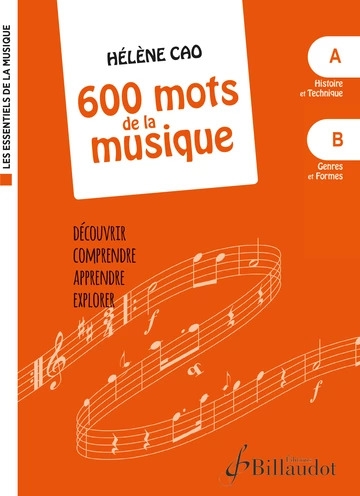
600 Mots De La Musique - A & B (coffret)
Les Essentiels de la musique
Video
view
Hélène Cao
600 Mots De La Musique - A & B (coffret)
Les Essentiels de la musique
- Instrumentation Literature
- Composer Hélène Cao
- Edition Book
- Publisher Gerard Billaudot
- Order no. BILL10083

Description:
The two volumes of 600 Words of Music cover the essential vocabulary of so-called "learned" Western music. Volume A contains words concerning theory (chromaticism, tonality), compositional procedures (counterpoint, inversion), practices (basso continuo, transposition), aesthetics and musical trends (Baroque, classical style, spectral music). Volume B focuses on genres and formal structures. Vocabulary relating to instrument making, which belongs to another field, has therefore been omitted, as well as terminology specific to oral traditions, non-European and popular music (chanson, jazz, pop, rock, etc.).
The most important words give their title to the entries. But within the entries, additional terms are also defined (for example, "bécarre" appears on the page devoted to "altération"): we felt it more appropriate to put closely related notions into immediate perspective, and to avoid the dictionary formula which would have led to a large number of repetitions. The titles of some entries combine two or three words ("ambitus, tessiture, registre", or "chaconne et passacaille"), when it makes sense to treat them together.
An index groups together all the terms, making it easy to find those that don't have their own entry. In the body of the text, the sign ‡ designates words explained in volume A; the asterisk *, those commented on in volume B. To lighten the presentation, the less "technical" and more familiar words (such as air, concert, improvisation, romanticism, tempo) do not systematically carry a cross-reference sign. These signs are also absent from quotations and titles of works.
For the sake of readability and accessibility, musical examples of early works are printed in modern notation, and the spelling of early quotations has been updated. The date indicated after a work corresponds to the year of its completion. When the composition spans a significant number of years, and we feel it would be useful to give this information, the start date of composition is given in addition to the end date. When the date of composition is unknown, the date of publication is used instead.
The most important words give their title to the entries. But within the entries, additional terms are also defined (for example, "bécarre" appears on the page devoted to "altération"): we felt it more appropriate to put closely related notions into immediate perspective, and to avoid the dictionary formula which would have led to a large number of repetitions. The titles of some entries combine two or three words ("ambitus, tessiture, registre", or "chaconne et passacaille"), when it makes sense to treat them together.
An index groups together all the terms, making it easy to find those that don't have their own entry. In the body of the text, the sign ‡ designates words explained in volume A; the asterisk *, those commented on in volume B. To lighten the presentation, the less "technical" and more familiar words (such as air, concert, improvisation, romanticism, tempo) do not systematically carry a cross-reference sign. These signs are also absent from quotations and titles of works.
For the sake of readability and accessibility, musical examples of early works are printed in modern notation, and the spelling of early quotations has been updated. The date indicated after a work corresponds to the year of its completion. When the composition spans a significant number of years, and we feel it would be useful to give this information, the start date of composition is given in addition to the end date. When the date of composition is unknown, the date of publication is used instead.
Customers rated this product:
Manufacturer Information:
Gérard Billaudot Éditeur, S.A.S.
14, rue de l’Échiquier
75010
Paris
Deutschland
Related products:
- Literature
- Book
- Gerard Billaudot
-
 ships within 4-8 working days
- Literature
- Book
- Gerard Billaudot
-
ships within 4-8 working days