
Kai Köpp
Handbook of historical orchestral practice
Baroque - Classical - Romantic
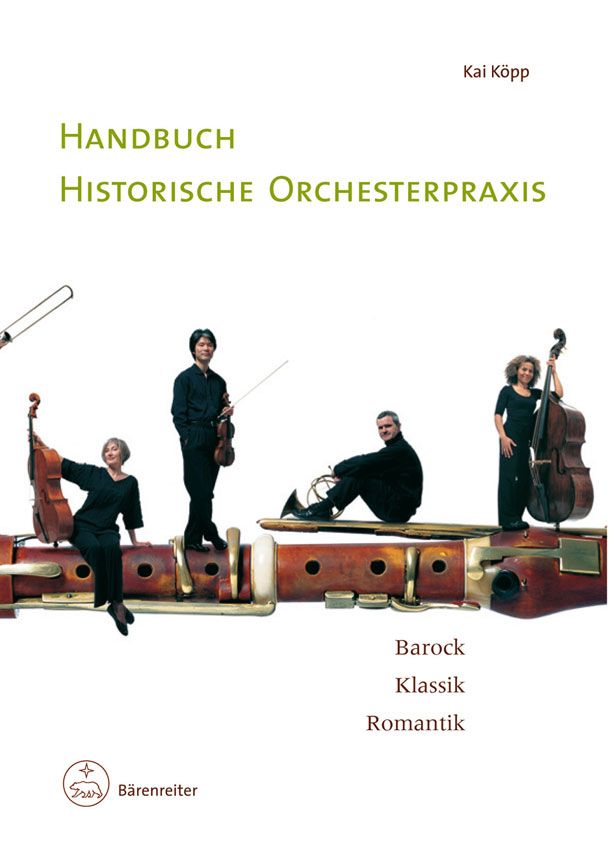
Kai Köpp
Handbook of historical orchestral practice
Baroque - Classical - Romantic
- Instrumentation Literature
- Composer Kai Köpp
- Edition Book
- Publisher Bärenreiter Verlag
- Order no. BVK1921
 ships within 2-4 working days
incl. tax,
excl. shipping costs
Not available in all countries. Learn more

Description:
For the first time, this handbook offers an overview of the art of ensemble playing in the Baroque, Classical and Romantic periods and also includes historical 'art words' (such as 'Mannheim School' or 'Viennese Classicism') in order to precisely identify musical practice in different repertoires. While historical orchestral practice has so far mainly been described from an external perspective (instrumentation, line-up, orchestral conducting), the focus here is on the question of playing practice: 'How does an orchestral musician from the 17th to the early 19th century understand the (sparse) instructions of his orchestral part and how does he execute them?'
Performance norms that were not part of the musical text and in some cases also elude exact notation play a key role. For the first time, these 'lost self-evident aspects' of orchestral playing (line organization, standard articulations, expression, ensemble playing) are systematically described and explained. This new focus means that the handbook can also be seen as a basic course in historical performance practice, a solid basis for soloistic ornamentation and improvisation practice.
Fourteen annotated and cross-referenced case studies from the Baroque, Classical and Romantic periods open up the possibility of accessing the information in the handbook from the individual repertoires. This allows the book to be read not only systematically (elements of orchestral practice) and historically (stylistic changes within the elements), but also from the perspective of a particular musical style.
This practice-oriented handbook is aimed at anyone involved in the interpretation of orchestral works: students and working musicians (with or without performance experience), conductors, but also musicologists and editors as well as interested laypeople.
> Basic course in historical performance practice for musicians, scholars and interested amateurs
> Also deals with traditional performance standards that are not part of the musical text
> With 14 case studies from the 17th to the early 19th century
Performance norms that were not part of the musical text and in some cases also elude exact notation play a key role. For the first time, these 'lost self-evident aspects' of orchestral playing (line organization, standard articulations, expression, ensemble playing) are systematically described and explained. This new focus means that the handbook can also be seen as a basic course in historical performance practice, a solid basis for soloistic ornamentation and improvisation practice.
Fourteen annotated and cross-referenced case studies from the Baroque, Classical and Romantic periods open up the possibility of accessing the information in the handbook from the individual repertoires. This allows the book to be read not only systematically (elements of orchestral practice) and historically (stylistic changes within the elements), but also from the perspective of a particular musical style.
This practice-oriented handbook is aimed at anyone involved in the interpretation of orchestral works: students and working musicians (with or without performance experience), conductors, but also musicologists and editors as well as interested laypeople.
> Basic course in historical performance practice for musicians, scholars and interested amateurs
> Also deals with traditional performance standards that are not part of the musical text
> With 14 case studies from the 17th to the early 19th century
Customers rated this product:
Manufacturer Information:
Bärenreiter-Verlag Karl Vötterle GmbH & Co. KG
Heinrich-Schütz-Allee 35-37
34131
Kassel
Deutschland
Other customers also bought:

- Literature
- Book
-
ships within 2-4 working days

- Literature
- Book
-
in stock
ships within 1-2 working days



- Rhythm
- Book
-
ships within 4-8 working days

- Literature
- Book
-
ships within 2-4 weeks