
Peter Eder, Manfred Hermann Schmid
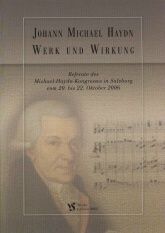
Johann Michael Haydn. Werk und Wirkung
Referate des Michael-Haydn-Kongresses in Salzburg vom 20. bis 22. Oktober 2006
PDF
view
Peter Eder, Manfred Hermann Schmid
Johann Michael Haydn. Werk und Wirkung
Referate des Michael-Haydn-Kongresses in Salzburg vom 20. bis 22. Oktober 2006
- Instrumentation Literature
- Composer Peter Eder Manfred Hermann Schmid
- Edition Book
- Publisher Strube Verlag
- Order no. STRUBE9081
 ships within 4-8 working days
incl. tax,
excl. shipping costs
Not available in all countries. Learn more

Description:
Johann Michael Haydn is one of those composers who are always worth studying anew. This conference report shows which topics are currently topical. Two questions seem to be of central importance: since the publication of the catalog raisonné compiled by Donley D. Thomas and Charles D. Sherman, the question of the authenticity of the works attributed to Michael Haydn has been raised to a new level. As long as the extent of the oeuvre has not been established with certainty, there is no reliable starting point for a serious study. A second desideratum would be to establish a canon of Michael Haydn's central works, i.e. a canon of major works; a task that has long since been accomplished for the great composers of music history. Only when it has been established which are the really relevant works of Michael Haydn can his compositional rank be assessed. The conference on the work and impact of Johann Michael Haydn was held in the 200th year since his death. The coincidence of this jubilee year with the 250th anniversary of Wolfgang Amadeus Mozart's birth caused the organizers of the symposium some concern, which in retrospect proved to be unfounded. Most of the scholars who were contacted happily agreed to take part, for which we would like to take this opportunity to express our sincere thanks. The coincidence of the jubilee years is symptomatic of Michael Haydn's position in music history. Since the 19th century, Michael Haydn has been studied primarily in the context of Mozart research. Chronologically, Michael Haydn was the third Salzburg musician after his father Leopold and Anton Cajetan Adlgasser to be influenced by Wolfgang Amadeus Mozart. Research interest was directed from Michael Haydn to Mozart. Recently, the opposite approach has also proved to be worthwhile: The results of the work on the young Mozart also have a stimulating effect on the study of the Salzburg Haydn. The research perspectives that have proved their worth in the work on Mozart also allow the figure of Michael Haydn to emerge in a fuller light. Rather coincidentally, the congress report on Michael Haydn appears in the year following the end of the Joseph Haydn Year 2009. With regard to the Haydn brothers' work, there are questions of authenticity that can only be resolved by looking at both together. The study of Michael Haydn's biography must take a back seat to his work and impact. There are still considerable gaps in the biography of Michael Haydn. The entire seventeen-seventies and eighties have, apart from sparse anecdotes, only been insufficiently dealt with by the "Biographical Sketch". It is therefore all the more gratifying that, since the Haydn Congress, we are on solid ground as far as anecdotes about Mozart's violin duos are concerned. Bernd Edelmann, whose presentation unfortunately did not reach the written form, presented an advertisement from the Gombart publishing house in which Michael Haydn's violin duos were offered together with Mozart's under the name Michael Haydn. However, according to a previously unknown document presented by Edelmann, this edition was discontinued by the publisher when it became aware of the true authorship of two of these duos. It follows from this document that the four Haydn duets and the two Mozart duets actually existed as a group of six as the work of Michael Haydn alone, but were only known to a very limited circle, which explains the publisher's error. The compilation and limited distribution can easily be explained by the anecdote. The paper by Dwight Blazin, in which he placed the Divertimenti à 3 MH 5-10 and 27 in the context of the Viennese String Trio, could also not be presented in written form. Work on Michael Haydn has not stood still in the meantime. Klaus Aringer discovered a piano divertimento arranged by an unknown arranger from the instrumental movements of Wahrheit der Natur MH 118. The author of the foreword was able to present a Salzburg find for the popular German Mass MH 560. According to this, Michael Haydn is only the arranger and completer of the German Mass, whose traces point to Prague and the efforts there to develop the German church hymn. In 2009, Blue nuit editeur published a 176-page brochure by Marc Vignal entitled "Michael Haydn". This provides the French-speaking world with a popular, up-to-date introduction to Haydn's life and, most importantly, his work. The undersigned would like to thank Prof. Dr. Manfred Hermann Schmid for organizing the congress and for his help in compiling the congress report. The authors are thanked for their patient perseverance until the publication was ready. Unfortunately, the long delays in submitting the individual contributions meant that the editorial principles could not be realized uniformly. Scholarship can only fulfill the expectations placed in it if the conditions are right: The Board of the Johann-Michael-Haydn-Gesellschaft would like to thank Eva and Franz Rutzen for their generosity in making the printing of this Congress Report possible. Fr. Petrus Eder OSB