
Bertrand Moren
The Ring Of Fate
for Brass Band
NEW
Demo
listen
PDF
view
Bertrand Moren
The Ring Of Fate
for Brass Band
- Instrumentation Brass Band
- Composer Bertrand Moren
-
Difficulty Level
- Edition Score and Parts Download
- Publisher Editions Marc Reift
- Order no. EMR82785-DL
 immediately available
Download immediately after ordering
incl. tax,
excl. shipping costs
Not available in all countries. Learn more

Description:
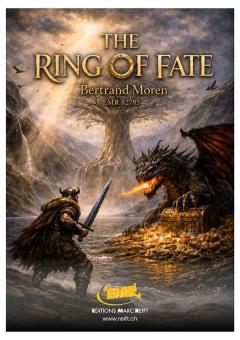
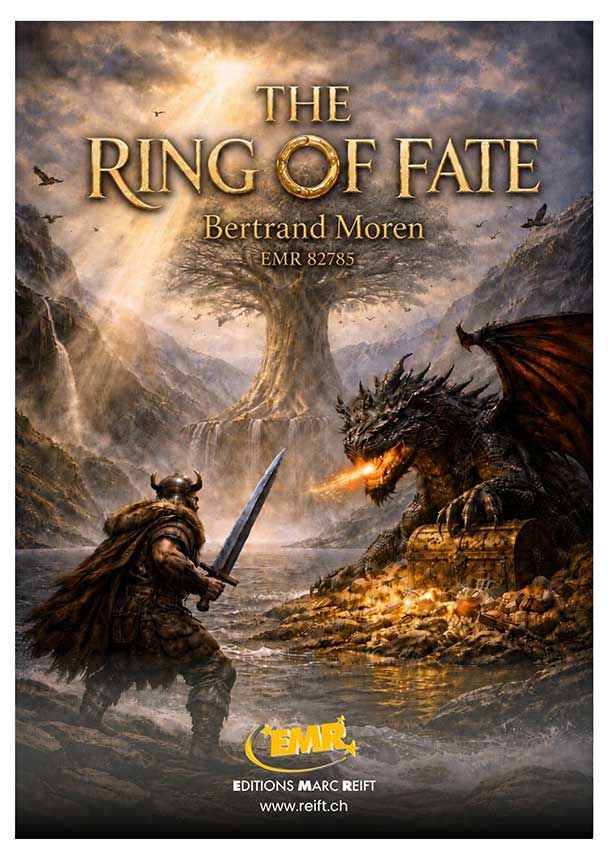
The Völsunga Saga is a Norse legend of Icelandic origin. The second cycle of tales tells the story of Sigurd, a legendary hero. Below is a summary of this tale, which inspired my work. Sigurd is raised by his adoptive father Reginn, a famous blacksmith. One day, Reginn tells Sigurd about a vast treasure—Andvari’s gold—and explains its origin. Hreidmar had three sons: Reginn, the blacksmith; Fáfnir, the warrior; and Otr, the fisherman, who possessed the ability to transform himself into an otter to catch fish. One day, the god Loki kills Otr in his otter form by pelting him with stones. As compensation for his son’s death, Hreidmar demands gold from Loki. To settle his debt, Loki uses trickery to force the dwarf Andvari to hand over his treasure. Andvari eventually gives in, but curses a magical ring as well as his entire treasure, decreeing that every owner shall suffer sorrow and death. The treasure was supposed to be divided among the two brothers and Otr’s father. But Fáfnir, driven by greed, slays his father to seize the treasure for himself. Under Andvari’s curse, he transforms into a dragon to guard his treasure. After Reginn tells this story, he persuades Sigurd to slay the dragon Fáfnir. Sigurd pierces the monster with his magical sword. As he subsequently celebrates his victory with Reginn, he accidentally tastes the dragon’s blood, which grants him the ability to understand the language of the birds. From them, he learns that Reginn intends to betray him. Sigurd then beheads Reginn and takes Andvari’s treasure for himself. Later, Sigurd meets the enchanted Valkyrie Brynhild and falls in love with her. They promise to marry, and Sigurd gives Brynhild Andvari’s ring. But after drinking a magic potion, he forgets his love for her, marries Princess Gudrun, and then helps his brother-in-law Gunnar win Brynhild’s hand by taking on Gunnar’s form. In Gunnar’s guise, he woos Brynhild and wins her hand. While she sleeps, he exchanges Andvari’s ring for another ring and gives Gudrun the dwarf’s ring. When Brynhild recognizes the rings and discovers the deception, overwhelmed by pain and grief, she causes Sigurd’s death and then takes her own life. 1. The Curse of Andvari The atmosphere and soundscape immediately transport us into the world of Norse mythology. The curse motif is introduced right at the beginning by the trombones and the flugelhorn. An intricate and ominous melody, played first by the euphonium, then by the soprano instrument and the repiano, symbolizes Loki’s cunning in stealing Andvari’s gold. The tension gradually builds to dark and menacing climaxes, symbolizing the theft of the gold and the curse. 2. The Battle Against Fáfnir The second movement begins with an extremely rhythmic and percussive section depicting the battle against the dragon. A first theme develops from a very soft beginning into a triumphant climax, symbolizing Sigurd’s victory over the dragon. The second, more lyrical theme depicts the moment when Sigurd understands the language of the birds. Subsequently, the motif of evil returns, for this understanding reveals Reginn’s betrayal to him. 3. Sigurd and Brynhild—An Impossible Love This movement is calmer and more romantic, placing the soloists at the center. The lyrical passages symbolize the love between Sigurd and Brynhild. Here, too, the motif of evil appears at the center of the movement—this time in the form of a fugue—embodying the curse that ultimately causes the deaths of Sigurd and Brynhild. 4. The Dawn of a New World Following the struggles and tragedies of the preceding movements, "The Rise of a New World" marks the end of the curse. The destructive quest for the cursed gold comes to an end, and a new beginning emerges. This movement depicts the transition from chaos to hope, portrayed through partly chaotic funk passages and virtuosic sections that symbolize a shared commitment. It concludes with an optimistic message. 5. The Light Beyond the Ring The optimistic and radiant finale celebrates the rebirth of a bright and harmonious world. This movement concludes *The Ring of Fate* on a peaceful note. After conflict and destruction, the light returns. The Ring no longer holds any power—a new balance is established. This slow and luminous moment symbolizes the end of the curse and the dawn of a new, free, and peaceful world.
-
1. The Curse of Andvari
-
2. The Fight Against Fafnir
-
3. Sigurd and Brynhild, an Impossible Love
-
4. The Rise Of A New World
-
5. The Light Beyond The Ring
Here is how the download works:
1 Buy download sheet music
Purchase the download score from our online store
2 Order confirmation with download link
Immediately after completing your order, you will receive an order confirmation by email listing all items. You will find the download link next to each item. You can use this link to start the download right away. Please also check your spam folder if necessary.
Customers rated this product:
Manufacturer Information:
Editions Marc Reift
Route du Golf 150
3963
Crans-Montana
Schweiz
Related products:
- Brass Band
- Score and Parts
- Editions Marc Reift
-
-
ships within 1-2 weeks
- Also available for download!