
CD Psalmotetten
NEW
Demo
listen
CD Psalmotetten
- Instrumentation Audio Media
- Edition CD
- Publisher Alfred Hochedlinger
- Order no. AH5033
 ships within 4-8 working days
incl. tax,
excl. shipping costs
Not available in all countries. Learn more

Description:
Contents: All 10 psalmotets in professional recordings featuring vocals and piano accompaniment. Running time: 2 x 34 min.
PSALMOTETTE—A portmanteau of "psalm" and "motet":
Psalm: Prayer/song from the Old Testament. The Bible contains 150 psalms, known as the Psalter.
Motet: A generic term for polyphonic vocal music, predominantly sacred, derived from the French "mot" (= word) or the Italian "motto" (= saying) — that is, music set to specific words.
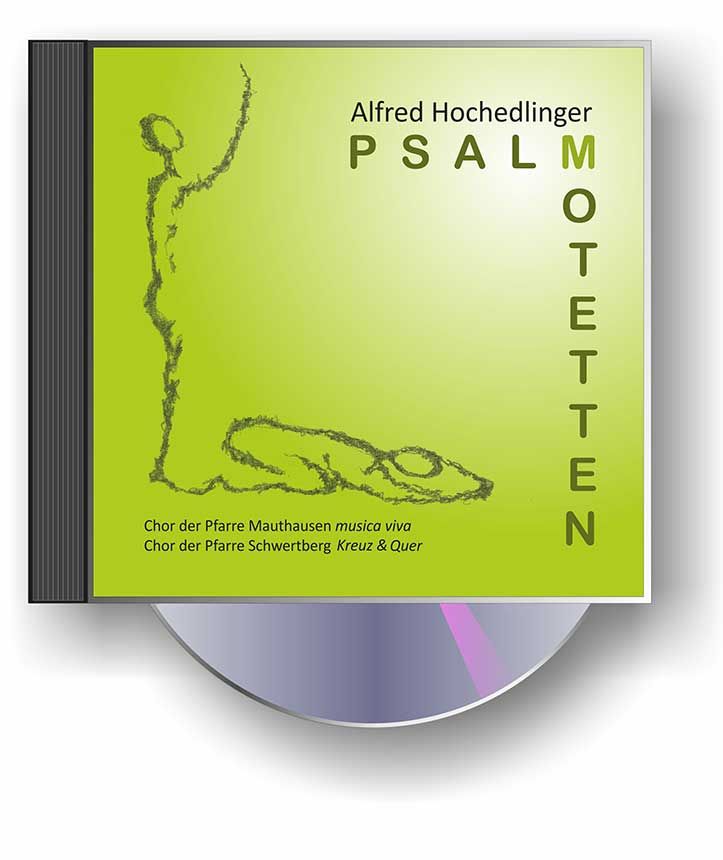
The Psalms have been and continue to be highly valued in the Jewish and Christian traditions of all denominations and form an important part of liturgical services. Jesus himself repeatedly quoted verses from the Psalms. In Islam, too, the Psalter holds the status of a prophetic book attributed to the Prophet Dawud (King David of the Old Testament). There is no collection of prayers or hymns that can unite the monotheistic religions in the same way as the Psalms. Psalms are spiritual texts that deal with and express life in all its nuances, in all its highs and lows: trust, gratitude, joy, cheerfulness, happiness, jubilation, but also sorrow, lamentation, and anger—the whole of human existence before God and with God finds a place here. The CD cover art by Sylvia Fellinger conveys this.
Over the course of more than three thousand years of reception history, the Psalms have been repeatedly reinterpreted musically. In the Christian tradition, there are countless musical settings of psalm texts. While Catholic church music throughout history tended to use Latin texts—for example, in Gregorian chant or in well-known compositions such as Mozart’s "Laudate Dominum" (Psalm 117) by Mozart—to name just two examples—Protestant church music, from the very beginning, has favored the German psalm texts or adaptations, as is the case, for example, with Heinrich Schütz’s setting of the "Becker Psalter." Many church hymns are imbued with the spirituality of the Psalms; they are adaptations or paraphrases of the Psalms. We owe outstanding examples of psalm settings in German to Felix Mendelssohn-Bartholdy, who builds a musical bridge between Judaism and Christianity.
The PSALMOTETTES presented here are compositions for mixed choir (SATB) and piano—and in some cases, orchestra—that have enjoyed great popularity. They present the timeless texts in a new, contemporary musical language influenced by elements of jazz and popular music—in a sense, a German-language counterpart to the gospel, yet rooted in the European musical tradition.
PSALMOTETTE—A portmanteau of "psalm" and "motet":
Psalm: Prayer/song from the Old Testament. The Bible contains 150 psalms, known as the Psalter.
Motet: A generic term for polyphonic vocal music, predominantly sacred, derived from the French "mot" (= word) or the Italian "motto" (= saying) — that is, music set to specific words.
The Psalms have been and continue to be highly valued in the Jewish and Christian traditions of all denominations and form an important part of liturgical services. Jesus himself repeatedly quoted verses from the Psalms. In Islam, too, the Psalter holds the status of a prophetic book attributed to the Prophet Dawud (King David of the Old Testament). There is no collection of prayers or hymns that can unite the monotheistic religions in the same way as the Psalms. Psalms are spiritual texts that deal with and express life in all its nuances, in all its highs and lows: trust, gratitude, joy, cheerfulness, happiness, jubilation, but also sorrow, lamentation, and anger—the whole of human existence before God and with God finds a place here. The CD cover art by Sylvia Fellinger conveys this.
Over the course of more than three thousand years of reception history, the Psalms have been repeatedly reinterpreted musically. In the Christian tradition, there are countless musical settings of psalm texts. While Catholic church music throughout history tended to use Latin texts—for example, in Gregorian chant or in well-known compositions such as Mozart’s "Laudate Dominum" (Psalm 117) by Mozart—to name just two examples—Protestant church music, from the very beginning, has favored the German psalm texts or adaptations, as is the case, for example, with Heinrich Schütz’s setting of the "Becker Psalter." Many church hymns are imbued with the spirituality of the Psalms; they are adaptations or paraphrases of the Psalms. We owe outstanding examples of psalm settings in German to Felix Mendelssohn-Bartholdy, who builds a musical bridge between Judaism and Christianity.
The PSALMOTETTES presented here are compositions for mixed choir (SATB) and piano—and in some cases, orchestra—that have enjoyed great popularity. They present the timeless texts in a new, contemporary musical language influenced by elements of jazz and popular music—in a sense, a German-language counterpart to the gospel, yet rooted in the European musical tradition.