
Giovanni Battista Pergolesi
Vespro della Beata Vergine
Vespers of Mary
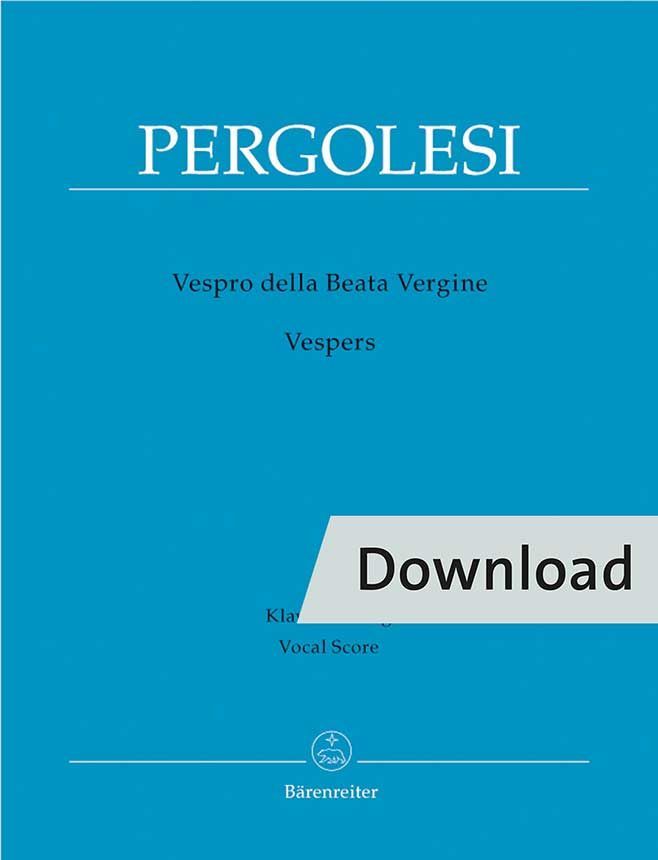

Giovanni Battista Pergolesi
Vespro della Beata Vergine
Vespers of Mary
- Instrumentation Soloists, Choir and Piano
- Composer Giovanni Battista Pergolesi
- Editor Malcolm Bruno
- Editor Edward Higginbottom Malcolm Bruno
-
Difficulty Level
- Edition Piano Reduction Download
- Publisher Bärenreiter Verlag
- Order no. BA7675-90-DL
 immediately available
Download immediately after ordering
incl. tax,
excl. shipping costs
Not available in all countries. Learn more

Description:
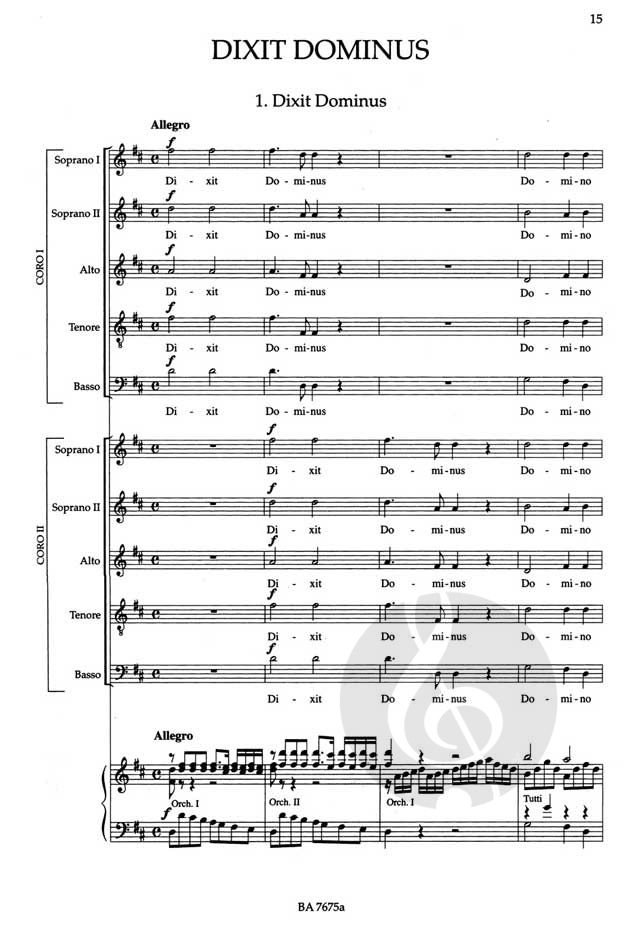
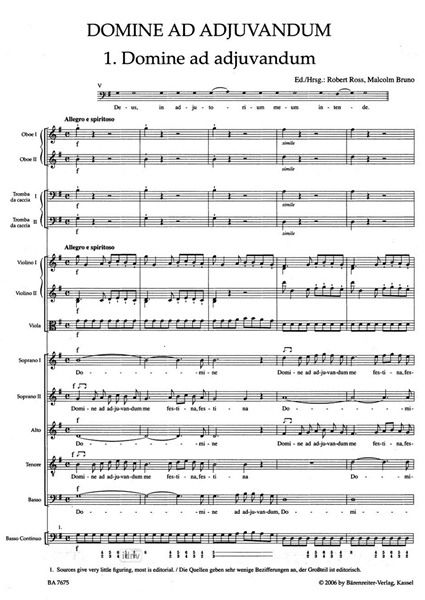
In 1732, Giovanni Battista Pergolesi composed a vesper in honor of Emidius, the patron saint of Naples who protected the city from earthquakes, which - with the vesper introit "Domine ad adjuvandum" and the three psalms "Dixit Dominus", "Laudate" and "Confitebor" - is only partially preserved.
Malcolm Bruno's reconstruction, which adds the "Hymnus" and the "Magnificat" as well as smaller instrumental interjections alongside the "Salve Regina" as contrafacts of a secular cantata by Pergolesi, presents a tonal overview of Pergolesi's compositional development with this Vespers. The reconstruction spans an arc from the early "Confitebor" with its echoes of Vivaldi to the late "Salve Regina", reminiscent of the famous "Stabat mater", from the polyphonic choral treatment to the operatic aria, from the large-scale, magnificent "Dixit" to the almost intimate "Laudate". The edition follows the original sources as far as possible and offers detailed practical performance notes in an appendix.
Malcolm Bruno's reconstruction, which adds the "Hymnus" and the "Magnificat" as well as smaller instrumental interjections alongside the "Salve Regina" as contrafacts of a secular cantata by Pergolesi, presents a tonal overview of Pergolesi's compositional development with this Vespers. The reconstruction spans an arc from the early "Confitebor" with its echoes of Vivaldi to the late "Salve Regina", reminiscent of the famous "Stabat mater", from the polyphonic choral treatment to the operatic aria, from the large-scale, magnificent "Dixit" to the almost intimate "Laudate". The edition follows the original sources as far as possible and offers detailed practical performance notes in an appendix.
Here is how the download works:
1 Buy download sheet music
Purchase the download score from our online store
2 Order confirmation with download link
Immediately after completing your order, you will receive an order confirmation by email listing all items. You will find the download link next to each item. You can use this link to start the download right away. Please also check your spam folder if necessary.
Customers rated this product:
Manufacturer Information:
Bärenreiter-Verlag Karl Vötterle GmbH & Co. KG
Heinrich-Schütz-Allee 35-37
34131
Kassel
Deutschland
Related products:
- Soloists, Choir and Piano
- Piano Reduction
- Malcolm Bruno
- Bärenreiter Verlag
-
-
ships within 2-4 working days
- Soloists, Choir and Piano
- Piano Reduction
- Malcolm Bruno
- Bärenreiter Verlag
-
-
in stock
ships within 1-2 working days - Also available for download!