
Tina Ternes
Die Seele ist wie der Wind
für Frauenchor (S1, S2, S3, A1, A2)
Tina Ternes
Die Seele ist wie der Wind
für Frauenchor (S1, S2, S3, A1, A2)
- Instrumentation Women's Choir (SSSAA)
- Composer Tina Ternes
- Edition Sheet Music
- Publisher Furore Verlag
- Order no. FUR15169
 ships within 4-8 working days
incl. tax,
excl. shipping costs
Not available in all countries. Learn more

Description:
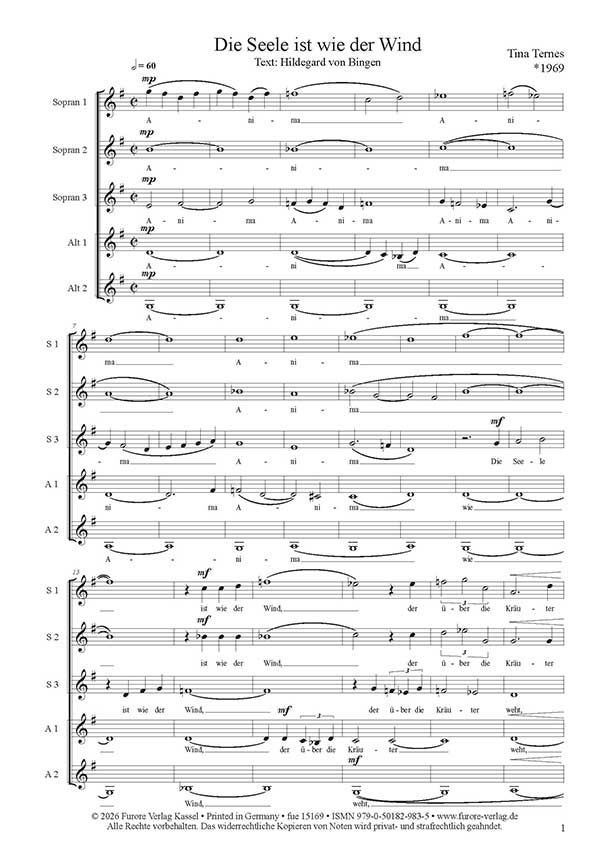
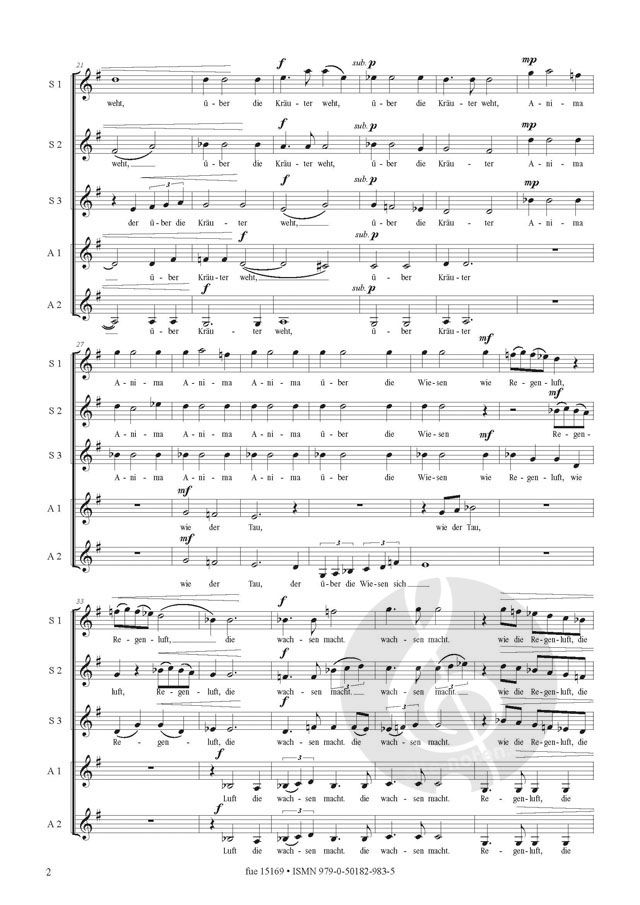
The piece was composed for the Females Featured 2 competition and sets Hildegard von Bingen's poem of the same name to music for a five-part women's choir.
The piece was composed for the Females Featured 2 competition and sets Hildegard von Bingen's poem of the same name to music for a five-part women's choir. The word "Anima" has been added to the text; it functions both as a kind of refrain and as a transition between the differently set lines of the poem. The compositional style draws somewhat on the Renaissance style of Palestrina, in that the rhythm of the individual soggetti is closely aligned with the rhythm of speech, and despite the polyphony, the aim is to ensure high intelligibility of the text.
It is quite challenging for the choir to dynamically highlight the leading soggetti against the accompanying voices, as they usually do not remain in a single voice for very long. In addition to the compositional style, the harmony plays an important role. The main key is G major, with a few extended chords that do not stand out but are woven softly and fluidly into the movement.
The piece was composed for the Females Featured 2 competition and sets Hildegard von Bingen's poem of the same name to music for a five-part women's choir. The word "Anima" has been added to the text; it functions both as a kind of refrain and as a transition between the differently set lines of the poem. The compositional style draws somewhat on the Renaissance style of Palestrina, in that the rhythm of the individual soggetti is closely aligned with the rhythm of speech, and despite the polyphony, the aim is to ensure high intelligibility of the text.
It is quite challenging for the choir to dynamically highlight the leading soggetti against the accompanying voices, as they usually do not remain in a single voice for very long. In addition to the compositional style, the harmony plays an important role. The main key is G major, with a few extended chords that do not stand out but are woven softly and fluidly into the movement.