
Ēriks Ešenvalds
Northern Lights
for Male Choir
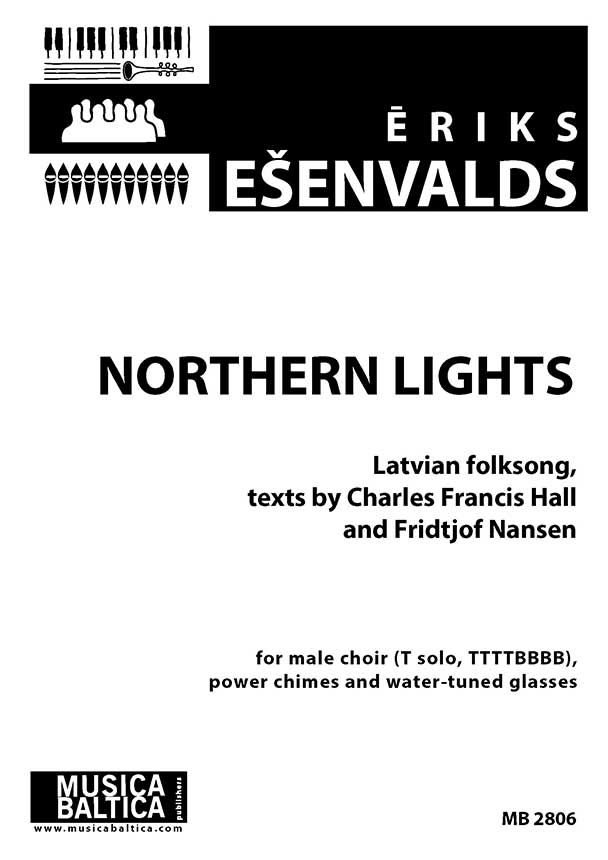
Ēriks Ešenvalds
Northern Lights
for Male Choir
- Instrumentation Male choir (TTTTBBBB) and percussion
- Composer Ēriks Ešenvalds
-
Lyricist
Charles Francis Hall
Fridtjof Nansen - Edition Choral Score
- Publisher Musica Baltica
- Order no. MBALTICA2806

Description:
Cast:
TTTTBBBB, power chimes and water-tuned glasses
"The ecstatic collision of energetic charged particles with atoms in the high altitude atmosphere known as the 'aurora borealis' is the subject of Northern Lights, commissioned in 2012 by the Choir of the West at Pacific Lutheran University in Tacoma, Washington. Named in 1621 by the French astronomer Pierre Gassendi after Aurora, the Roman goddess of dawn, and Boreas, the Greek god of the north
wind, the Northern Lights have fascinated and terrified all who have seen them from the beginning of time: many cultures have tried to account for this remarkable and beautiful sight, some seeing it as threatening, others as benign. Latvian folkore, for example, tells that the Northern Lights are the restless spirits of fallen warriors, still fighting their battles in the sky.
Ešenvalds combines a Latvian folksong, sung by a solo tenor, with less fearful, and factual, observations of the Northern Lights by two nineteenth-century Arctic explorers, Charles Francis Hall and Fridtjof Nansen.
In a lilting triple-time metre throughout, with tuned glasses played by the singers adding an unearthly aura at salient points, the music is full of wonder, with an especially dramatic moment of revelation early on. Twice, a moment of special transcendence is summoned up by the gentle sound of chimes and, after a return of the opening folksong, it is they who have the last word in a quiet, but questioning, apotheosis of magical bell-sounds.
— from notes by Gabriel Jackson © 2015"
TTTTBBBB, power chimes and water-tuned glasses
"The ecstatic collision of energetic charged particles with atoms in the high altitude atmosphere known as the 'aurora borealis' is the subject of Northern Lights, commissioned in 2012 by the Choir of the West at Pacific Lutheran University in Tacoma, Washington. Named in 1621 by the French astronomer Pierre Gassendi after Aurora, the Roman goddess of dawn, and Boreas, the Greek god of the north
wind, the Northern Lights have fascinated and terrified all who have seen them from the beginning of time: many cultures have tried to account for this remarkable and beautiful sight, some seeing it as threatening, others as benign. Latvian folkore, for example, tells that the Northern Lights are the restless spirits of fallen warriors, still fighting their battles in the sky.
Ešenvalds combines a Latvian folksong, sung by a solo tenor, with less fearful, and factual, observations of the Northern Lights by two nineteenth-century Arctic explorers, Charles Francis Hall and Fridtjof Nansen.
In a lilting triple-time metre throughout, with tuned glasses played by the singers adding an unearthly aura at salient points, the music is full of wonder, with an especially dramatic moment of revelation early on. Twice, a moment of special transcendence is summoned up by the gentle sound of chimes and, after a return of the opening folksong, it is they who have the last word in a quiet, but questioning, apotheosis of magical bell-sounds.
— from notes by Gabriel Jackson © 2015"
Customers rated this product:
Manufacturer Information:
Musica Baltica
Kalnciema iela 39
1046
Riga
Lettland
Other customers also bought:

for TTBB a Cappella
- Men's Chorus (TTBB)
- Choral Score
- Kirby Shaw
-
 ships within 2-4 weeks
- Also available for download!