
Hans-André Stamm
Christ the heavenly phoenix
Cantata for 4th Choir, Soloists (SATB), Strings, Harp, Oboe, Timpani & Organ
Demo
listen
PDF
view
Hans-André Stamm
Christ the heavenly phoenix
Cantata for 4th Choir, Soloists (SATB), Strings, Harp, Oboe, Timpani & Organ
- Instrumentation Soloists, Mixed Choir (SATB) and Orchestra
- Composer Hans-André Stamm
- Edition Piano Reduction
- Publisher Eufonia Edition
- Order no. EUFONIA401KLA
 ships within 2-4 weeks
Description:
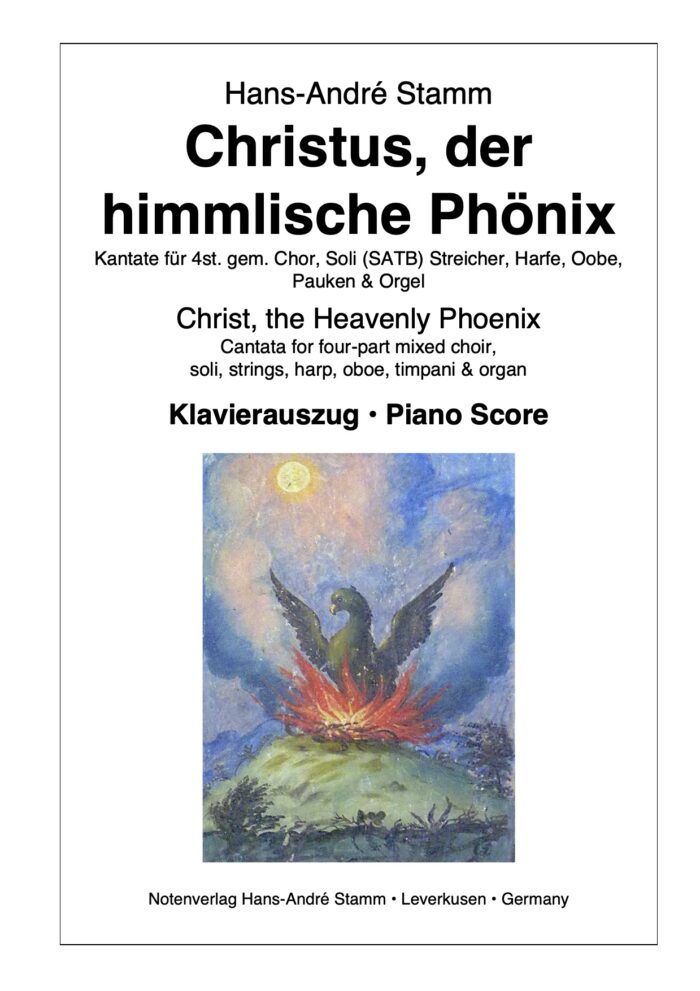
As far as I know, the cantata "Christus, der himmlische Phoenix" is – as far as I know – the only cantata so far whose text thematically refers to alchemical symbols. The composition was inspired by the eponymous title of an anonymous poem from the 17th century (in S. R. Acxtelmeier, Des aus der Unwissenheits-Finsternuss erretteten Natur-Liechts, Augsburg, 1699) and by the depiction of the phoenix in the pulpit inlays of the Ev. Church in Leverkusen Bergisch-Neukirchen.
The poet Alexander Nitzberg refrained from reproducing the myth of the phoenix and relating it to Christ as in the above-mentioned poem. Rather, he had the idea of illustrating the mystery of death and resurrection by means of five classical mysterious animals, which are arranged in a circle in old classical representations. They embody stages of spiritual soul development: four of them are bird creatures (raven, swan, pelican, phoenix), one, the basilisk (Greek: "little king") represents a crowned snake. Equipped with wings, i.e. as a dragon, it is counted among the mystery birds. The raven embodies the state of the soul's greatest immersion in matter, a lead-like state impermeable to light, as it becomes evident in the black plumage. The swan symbolizes the state of processual purification and purification (young swans are still gray). The basilisk symbolizes the forces of resistance and temptation. The pelican embodies self-sacrificing charity, while the phoenix represents the state of overcoming matter and union with the kingdom of Christ in the firepower of the Holy Spirit.
The musical design of the cantata incorporates several styles to express these characters. The return to the divine order is expressed by means of the musical form of the fugue, which evokes the old idea of a "pre-stabilized harmony" (Leibniz) in the harmonically simple, quasi-baroque tonal language.
The poet Alexander Nitzberg refrained from reproducing the myth of the phoenix and relating it to Christ as in the above-mentioned poem. Rather, he had the idea of illustrating the mystery of death and resurrection by means of five classical mysterious animals, which are arranged in a circle in old classical representations. They embody stages of spiritual soul development: four of them are bird creatures (raven, swan, pelican, phoenix), one, the basilisk (Greek: "little king") represents a crowned snake. Equipped with wings, i.e. as a dragon, it is counted among the mystery birds. The raven embodies the state of the soul's greatest immersion in matter, a lead-like state impermeable to light, as it becomes evident in the black plumage. The swan symbolizes the state of processual purification and purification (young swans are still gray). The basilisk symbolizes the forces of resistance and temptation. The pelican embodies self-sacrificing charity, while the phoenix represents the state of overcoming matter and union with the kingdom of Christ in the firepower of the Holy Spirit.
The musical design of the cantata incorporates several styles to express these characters. The return to the divine order is expressed by means of the musical form of the fugue, which evokes the old idea of a "pre-stabilized harmony" (Leibniz) in the harmonically simple, quasi-baroque tonal language.