
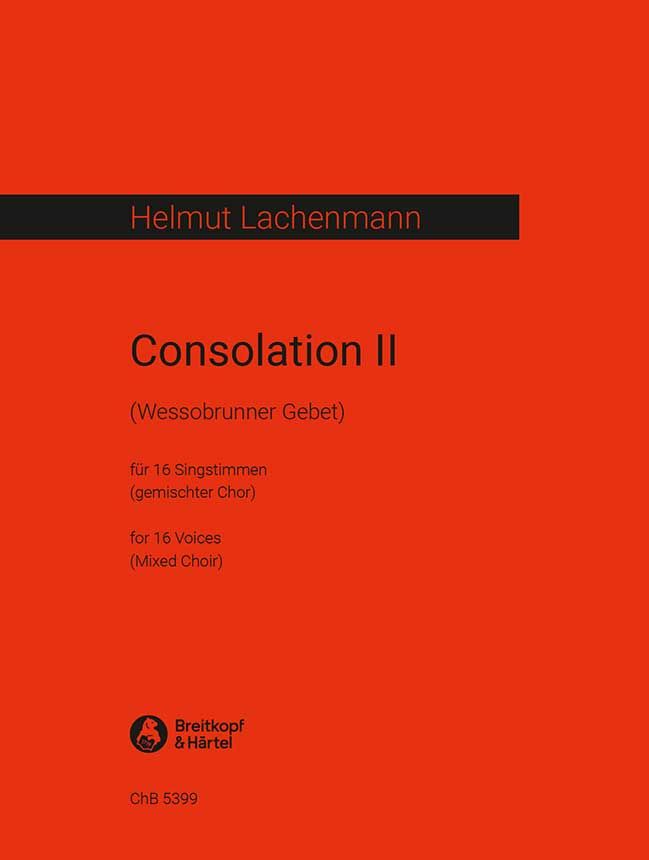
Helmut Lachenmann
Consolation II (1968)
Wessobrunner Gebet
PDF
view
Helmut Lachenmann
Consolation II (1968)
Wessobrunner Gebet
- Instrumentation Mixed Choir (16 Parts)
- Composer Helmut Lachenmann
- Edition Choral Score
- Publisher Breitkopf & Härtel
- Order no. CHB5399
 ships within 2-5 working days
incl. tax,
excl. shipping costs
Not available in all countries. Learn more

Description:
Consolation II for 16 voices is one part, or rather one layer, of a cycle for choir and percussion originally planned in four parts. Each of the texts united in it represents, from a different perspective, a realization that seeks to help us overcome our own existential limits. The underlying text here - a New High German version of the "Wessobrunn Prayer" - reads:
My mortal astonishment confessed as the highest
That earth was not, nor heaven above
Nor tree, nor any mountain was not wary
Nor the sun, nor light was
Nor the moon shone, nor the mighty sea
That nowhere was nothing in ends and turns
There was the one almighty God.
In Consolation II, the text is no longer comprehensible. Such "incomprehensibility" seems legitimate to me and hardly avoidable where music and musical form have exchanged their old linguistic-analogous laws with others, namely with laws that are opposed to the superficial coupling with a semantically oriented and grammatically directed course of language. To "compose" a text beyond setting it to music - that must mean intervening in the order established by it and reacting to it. Consolation II - like Consolation I in the past - is based on a treatment of the text in which, thanks to the characteristic economy of the phonetic material, the semantic meaning is still signaled "from afar", as it were, despite the complete isolation, alienation and rearrangement of the text particles. By making the phonetic elements within the structures thus formed not merely a means, but themselves an object of musical expression, the text and the work itself present themselves as part of the matter whose temporality is being discussed here: a spiritual work? Perhaps, but we are not talking about guilt and redemption, but about the experience that underlies all thought: the amazement of mortals
(Helmut Lachenmann, 1969)
CDs:Schola Cantorum Stuttgart, cond. Clytus GottwaldCD Cadenza 800 893Schola Heidelberg, cond. Walter NußbaumCD KAIROS 0012202KAI
Bibliography:
Hermanutz, Tobias: Avantgardistische Chormusik als komponierte Negative Theologie. György Ligeti: Lux aeterna - Dieter Schnebel: AMN - Helmut Lachenmann: Consolation II - Heinz Holliger:Psalm, Diss. Karlsruhe 2014, Marburg: tectum 2015.Lück, Hartmut: Philosophy and literature in the work of Helmut Lachenmann, in: Der Atem des Wanderers. Der Komponist Helmut Lachenmann, ed. by Hans-Klaus Jungheinrich, Mainz: Schott 2006, pp. 41-55.
Premiere: Basel, June 15, 1969 Dedicated to Clytus Gottwald and the Stuttgart Schola Cantorium
My mortal astonishment confessed as the highest
That earth was not, nor heaven above
Nor tree, nor any mountain was not wary
Nor the sun, nor light was
Nor the moon shone, nor the mighty sea
That nowhere was nothing in ends and turns
There was the one almighty God.
In Consolation II, the text is no longer comprehensible. Such "incomprehensibility" seems legitimate to me and hardly avoidable where music and musical form have exchanged their old linguistic-analogous laws with others, namely with laws that are opposed to the superficial coupling with a semantically oriented and grammatically directed course of language. To "compose" a text beyond setting it to music - that must mean intervening in the order established by it and reacting to it. Consolation II - like Consolation I in the past - is based on a treatment of the text in which, thanks to the characteristic economy of the phonetic material, the semantic meaning is still signaled "from afar", as it were, despite the complete isolation, alienation and rearrangement of the text particles. By making the phonetic elements within the structures thus formed not merely a means, but themselves an object of musical expression, the text and the work itself present themselves as part of the matter whose temporality is being discussed here: a spiritual work? Perhaps, but we are not talking about guilt and redemption, but about the experience that underlies all thought: the amazement of mortals
(Helmut Lachenmann, 1969)
CDs:Schola Cantorum Stuttgart, cond. Clytus GottwaldCD Cadenza 800 893Schola Heidelberg, cond. Walter NußbaumCD KAIROS 0012202KAI
Bibliography:
Hermanutz, Tobias: Avantgardistische Chormusik als komponierte Negative Theologie. György Ligeti: Lux aeterna - Dieter Schnebel: AMN - Helmut Lachenmann: Consolation II - Heinz Holliger:Psalm, Diss. Karlsruhe 2014, Marburg: tectum 2015.Lück, Hartmut: Philosophy and literature in the work of Helmut Lachenmann, in: Der Atem des Wanderers. Der Komponist Helmut Lachenmann, ed. by Hans-Klaus Jungheinrich, Mainz: Schott 2006, pp. 41-55.
Premiere: Basel, June 15, 1969 Dedicated to Clytus Gottwald and the Stuttgart Schola Cantorium