
Leopold Hofmann
Homo natus de muliere - Choral Score
For Choir (SATB), 2 Trombones (or Violas) and Organ (First edition)

PDF
view
Recommend
recommend item
Leopold Hofmann
Homo natus de muliere - Choral Score
For Choir (SATB), 2 Trombones (or Violas) and Organ (First edition)
- Instrumentation Mixed Choir, 2 Trombones and Organ
- Optional Instrumentation Mixed Choir (SATB), 2 Violas and Organ
- Edition Choral Score
- Composer Leopold Hofmann
- Publisher Carus-Verlag
- Editor Guido Erdmann
- Order no. CV27705-05
incl. tax,
excl. shipping costs
 ships within 2-5 working days
| from | pcs | Price |
|---|---|---|
| 40 | 40+ | 2,88 € |
| 60 | 60+ | 2,56 € |

Description:
Man that is born of woman hath but a short time to live' is one of the central biblical texts dealing with the transitoriness of human existence. Leopold Hofmann, Kapellmeister at St. Stephen's Cathedral in Vienna from 1772 to 1793, where W. A. Mozart was his church music assistant, also set this strongly expressive text.
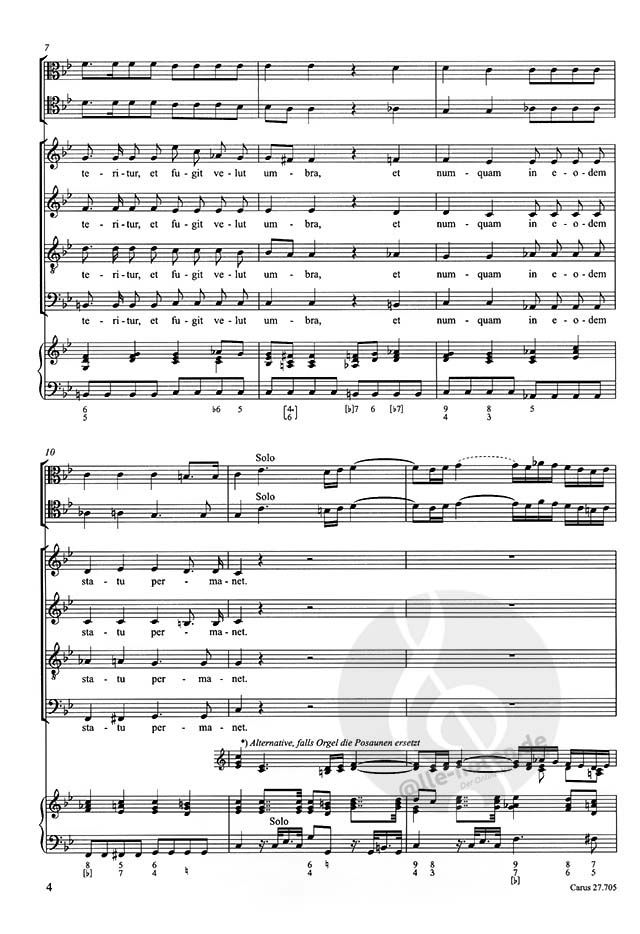
Hofmann's setting, in C minor, offers an austere harmony, characterized by suspensions in a homophonic, through-composed four-part vocal setting (soloists or SATB choir), reinforced only by two trombones and organ continuo. Four concise instrumental transitional passages between the individual verses relieve the pathos laden Viennese church style of this composition. With its tragic air, in some passages it closely resembles Mozart's Requiem K. 626.
For this first edition, the two trombone parts are available both in the original clef and in alto clef. The figured bass has been realized so that the piece can also be performed without trombones, with only organ accompaniment.
For a performance this piece could easily be combined with the Salve Regina by Pietro Cassati (CV27703) from the Vienna series.
Hofmann's setting, in C minor, offers an austere harmony, characterized by suspensions in a homophonic, through-composed four-part vocal setting (soloists or SATB choir), reinforced only by two trombones and organ continuo. Four concise instrumental transitional passages between the individual verses relieve the pathos laden Viennese church style of this composition. With its tragic air, in some passages it closely resembles Mozart's Requiem K. 626.
For this first edition, the two trombone parts are available both in the original clef and in alto clef. The figured bass has been realized so that the piece can also be performed without trombones, with only organ accompaniment.
For a performance this piece could easily be combined with the Salve Regina by Pietro Cassati (CV27703) from the Vienna series.
Customers rated this product:
Carus-Verlag GmbH & Co. KG
Sielminger Str. 51
70771
Leinfelden-Echterdingen
Deutschland
alle-noten.de: Sheet music shipping since 1969
Since 1969, over 500,000 customers have trusted us. With a huge selection of over 1,000,000 sheet music titles, we are one of the largest providers in Europe. Thanks to our large stock we can often ship sheet music within 24 hours. No matter what sheet music you are looking for: you are in the right place!
Yours, Stefanie Reichert
Head of Customer Service
Related products:

- Mixed Choir, 2 Trombones and Organ
- Score
- Carus-Verlag
-
ships within 2-5 working days

- Mixed Choir, 2 Trombones and Organ
- Instrumental Part: Organ
- Carus-Verlag
-
ships within 2-5 working days
- Mixed Choir, 2 Trombones and Organ
- Set of Parts
- Carus-Verlag
-
ships within 2-5 working days