
Ralf Klotz, Joachim von Burck
Johannespassion
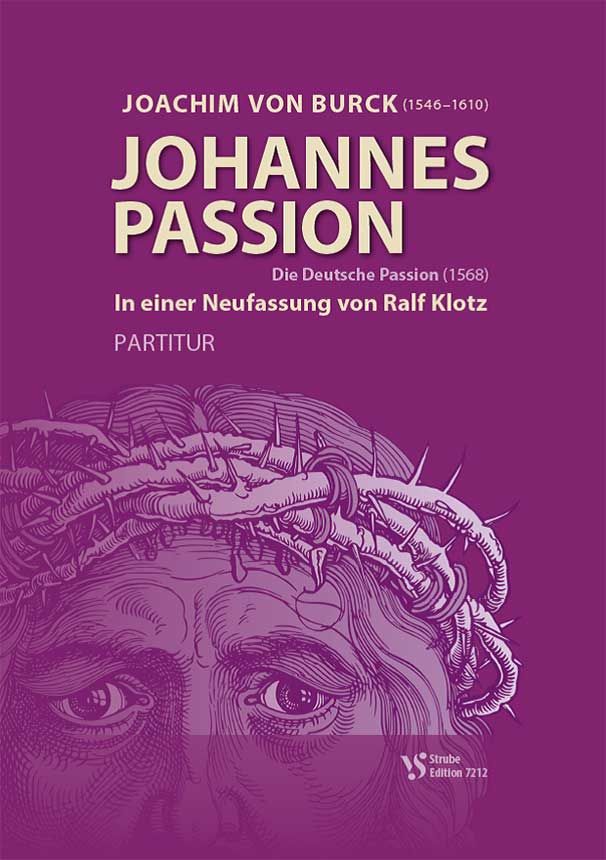
Die Deutsche Passion (1568) in einer Neufassung von Ralf Klotz (2017)
PDF
1
view
PDF
2
view
Ralf Klotz, Joachim von Burck
Johannespassion
Die Deutsche Passion (1568) in einer Neufassung von Ralf Klotz (2017)
- Instrumentation Mixed Choir (SATB)
- Optional Instrumentation Mixed Choir (SATB), Organ and Cello
- Composer Ralf Klotz Joachim von Burck
- Edition Choral Part Soprano 1
- Publisher Strube Verlag
- Order no. STRUBE3BEFB8D4F35D
 ships within 4-8 working days
incl. tax,
excl. shipping costs
Not available in all countries. Learn more

Description:
In his St. John Passion from 1568, Joachim von Burck (1546-1610) presents himself as an ardent pioneer of newly emerging Protestant church music. As the predecessor of Johann Sebastian Bach at the main church of St. Blasius in Mühlhausen, he picked up on current trends in his works.
Burck's Passion is the first Passion setting in music history to be composed in several voices throughout and - as demanded by the Reformation - in German. The 450-year-old work therefore bears the title "The German Passion". Older through-composed passions only existed in Latin. The work is a pure choral Passion without narrator or soloists.
Because of the polyphonic-figurative setting, Burck's Passion can also be called the "Motet Passion". The words of Jesus and Pilate, on the other hand, are vocally reduced, thus standing out and attracting particular attention in a varied manner.
Despite its pleasantly meditative flow, the St. John Passion surprises again and again with bold harmonic and extremely colorful turns.
Ralf Klotz adds opening and closing choruses, intermediate chorales and Passion motets in the appendix from Burck's own vocal works as well as from the pen of his famous pupil Johann Eccard (1553-1611) - known for the motet "Über's Gebirg Maria geht". This means that stylistically everything remains in one hand. In addition, literal speeches are set off and the work is rhythmically "decelerated" in some places in favor of better singability.
Burck's Passion is the first Passion setting in music history to be composed in several voices throughout and - as demanded by the Reformation - in German. The 450-year-old work therefore bears the title "The German Passion". Older through-composed passions only existed in Latin. The work is a pure choral Passion without narrator or soloists.
Because of the polyphonic-figurative setting, Burck's Passion can also be called the "Motet Passion". The words of Jesus and Pilate, on the other hand, are vocally reduced, thus standing out and attracting particular attention in a varied manner.
Despite its pleasantly meditative flow, the St. John Passion surprises again and again with bold harmonic and extremely colorful turns.
Ralf Klotz adds opening and closing choruses, intermediate chorales and Passion motets in the appendix from Burck's own vocal works as well as from the pen of his famous pupil Johann Eccard (1553-1611) - known for the motet "Über's Gebirg Maria geht". This means that stylistically everything remains in one hand. In addition, literal speeches are set off and the work is rhythmically "decelerated" in some places in favor of better singability.