
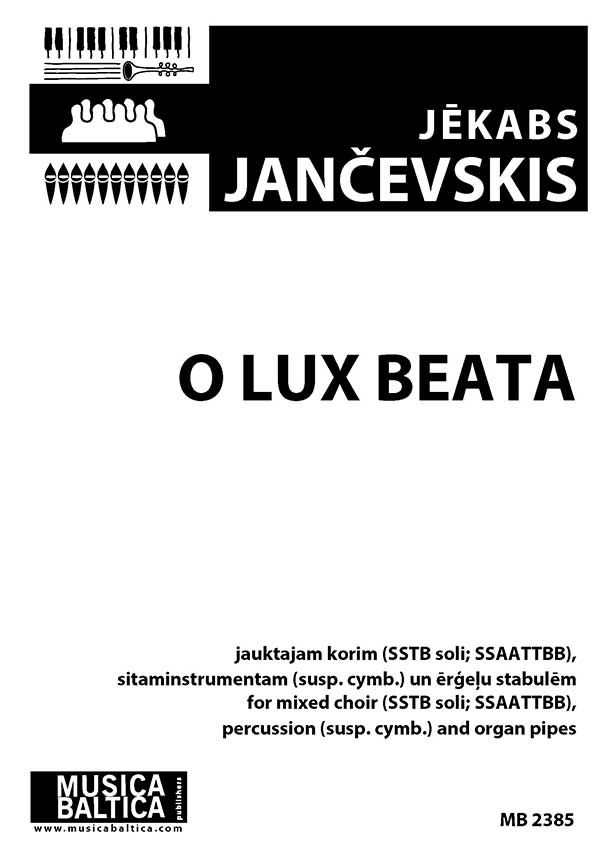
Jēkabs Jančevskis
O Lux Beata
for Mixed Choir
Video
view
Jēkabs Jančevskis
O Lux Beata
for Mixed Choir
- Instrumentation Soli (SSTB), mixed choir (SSAATTBB), susp. cymbal and organ pipes
- Composer Jēkabs Jančevskis
- Edition Score
- Publisher Musica Baltica
- Order no. MBALTICA2385
 ships within 1-2 weeks

Description:
Cast:
SSTB soli; SSAATTBB, susp.cymb., org.pipes
The motet O lux beata Trinitas is inspired by an historical event from the early thirteenth century when the Letts (Latgallians) of Beverīna in Northern Latvia were besieged by Estonian attackers. This was described by the Catholic priest Henry of Latvia in the document known as the Livonian Chronicle of Henry. At that point in time the Latgallians had already been converted to Christianity, while the Estonians were still considered 'barbarians'. In the heat of battle the Latgallian priest stepped up to the castle wall and prayed to God while playing an unnamed musical instrument. Upon hearing this instrument the Estonians ceased fighting, and instead began to enquire about the reason for such rejoicing. The Latgalians replied that they were praising the Lord who was defending them. A period of silence ensued before the Estonians began speaking of peace. In this composition I wanted to depict historic events, the brutal spirit of battle and,principally, the magical power of music in the victory over sin and violence.
— from notes by Jēkabs Jančevskis © 2020
SSTB soli; SSAATTBB, susp.cymb., org.pipes
The motet O lux beata Trinitas is inspired by an historical event from the early thirteenth century when the Letts (Latgallians) of Beverīna in Northern Latvia were besieged by Estonian attackers. This was described by the Catholic priest Henry of Latvia in the document known as the Livonian Chronicle of Henry. At that point in time the Latgallians had already been converted to Christianity, while the Estonians were still considered 'barbarians'. In the heat of battle the Latgallian priest stepped up to the castle wall and prayed to God while playing an unnamed musical instrument. Upon hearing this instrument the Estonians ceased fighting, and instead began to enquire about the reason for such rejoicing. The Latgalians replied that they were praising the Lord who was defending them. A period of silence ensued before the Estonians began speaking of peace. In this composition I wanted to depict historic events, the brutal spirit of battle and,principally, the magical power of music in the victory over sin and violence.
— from notes by Jēkabs Jančevskis © 2020