
Anton Bruckner
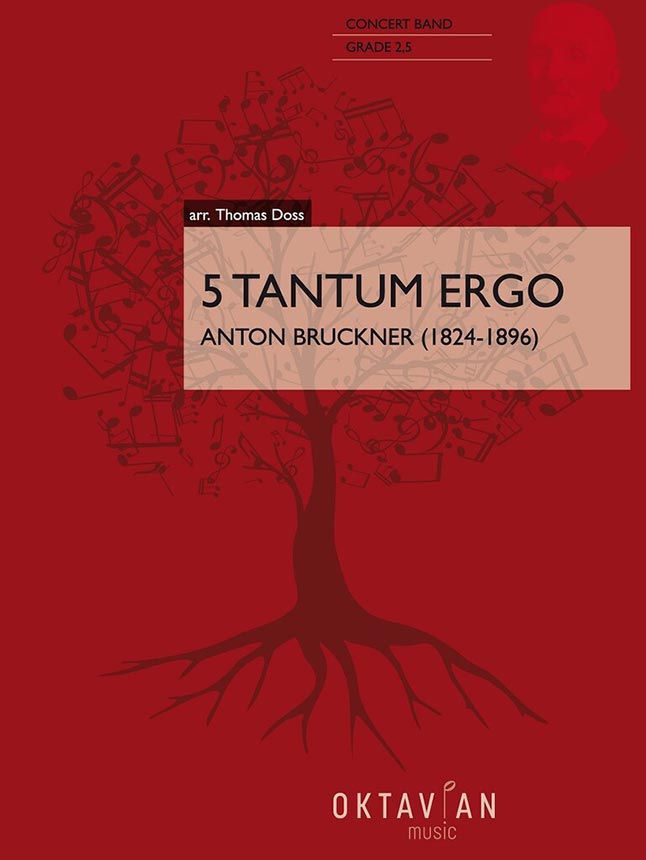
5 Tantum Ergo
PDF
view
Anton Bruckner
5 Tantum Ergo
- Instrumentation Concert Band
- Composer Anton Bruckner
- Editor Thomas Doss
-
Difficulty Level
- Edition Score and Parts
- Publisher Oktavian Music
- Order no. OKTA009-23-02
 ships within 3-6 working days
incl. tax,
excl. shipping costs
Not available in all countries. Learn more

Description:
Anton Bruckner (* 4.9.1824, Ansfelden; † 11.10.1896, Vienna) did not have it easy. Throughout his life, the Austrian composer was plagued by self-doubt. Anton Bruckner came from a simple, rural background. In 1837, after the death of his father, he was accepted as a singing boy at the monastery of Sankt Florian. After several years as a school assistant and self-taught organ and piano studies, he first worked as organist in Sankt Florian, then from 1855 as cathedral organist in Linz. Introduced to music theory and instrumentation via Simon Sechter and Otto Kitzler, he discovered Richard Wagner as an artistic role model, whom he admired throughout his life and also visited several times in Bayreuth. In 1868 Anton Bruckner became professor of basso continuo, counterpoint and organ at the Vienna Conservatory, ten years later court organist, and finally in 1891 honorary doctor of the University of Vienna. He was considered an important organ virtuoso of an era, but had to wait a long time for recognition as a composer. It was not until the "Symphony No.7, E major", composed between 1881 and 1883, with the famous "Adagio" written under the impression of Wagner's death, that the hoped-for recognition came, even if he did not want to accept it in view of his tendency to skepticism and self-criticism. Anton Bruckner was a loner who did not want to follow any school or doctrine. He composed numerous sacred vocal works such as his three masses, the "Missa Solemnis in B-flat minor" (1854), the "Te Deum" (1881-84) and numerous motets. As a symphonic composer, he wrote a total of nine symphonies and many symphonic studies from 1863 onward, tending to revise finished versions several times. Bruckner's orchestral works were long considered unplayable, but they were merely unusually bold for the tonal language of their time, uniting traditions from Beethoven to Wagner to folk music, on the border of late Romanticism and modernism. Hymns for four-part mixed choir a cappella - 1846 in St. Florian No. 1 in E-flat major (WAB 41/3): "Ziemlich langsam" No. 2 in C major (WAB 41/4): "Andante" No. 3 in B-flat major (WAB 41/1): "Langsam" No. 4 in A-flat major (WAB 41/2): "Langsam" Hymn for five-part (2 S, A, T, B-flat) mixed choir and organ No. 5 in D major, "Feierlich" These are simple works, completely subordinate to liturgical use, but they already show numerous characteristics of personal expression. The small pieces could still stand up to the stern gaze of the mature master: in 1888, Bruckner subjected them to a revision, in which, however, he made only minor corrections.
Related products:
Customers rated this product:
Manufacturer Information:
Hal Leonard
Businesspark friesland west 15
8521 SL
Heerenveen
Niederlande
Other customers also bought:
- Concert Band
- Director's Score and Parts
-
ships within 2-5 working days
- Concert Band
- Director's Score and Parts
-
ships within 1-2 weeks
Steven Bryant
- Concert Band
- Score and Parts
-
ships within 3-6 working days
Rossano Galante
- Concert Band
- Score and Parts
-
in stock
ships within 1-2 working days - Also available for download!
Dieter Kanzleiter
- Concert Band
- Score
-
in stock
ships within 1-2 working days