
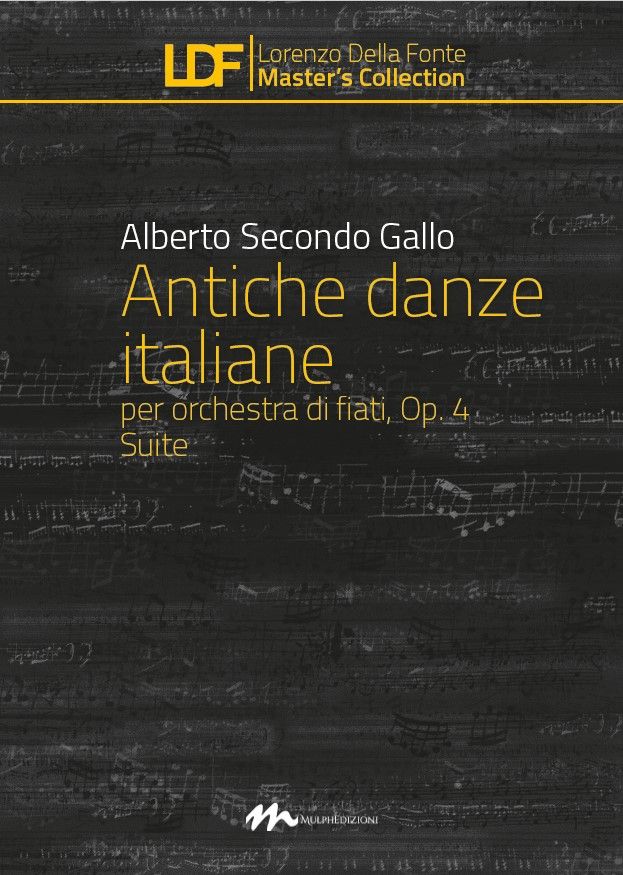
Alberto Secondo Gallo
Antiche danze italiane
Suite Op. 4
Demo
listen
PDF
view
Alberto Secondo Gallo
Antiche danze italiane
Suite Op. 4
- Instrumentation Concert Band
- Composer Alberto Secondo Gallo
-
Difficulty Level
- Edition Score and Parts Download
- Publisher MULPH EDIZIONI srl
- Order no. MULPH205-DL
 immediately available
Download immediately after ordering
incl. tax,
excl. shipping costs
Not available in all countries. Learn more

Description:
Ancient Italian Dances for Wind Orchestra is a three-movement suite based on folk melodies and dance music by Italian authors who lived between the 16th and 17th centuries.
The first movement is a counterpoint piece elaborated on the theme of the Ballo di Mantova (Mantuan Dance), a folk song dating back to the end of the 16th century attributed to Giuseppino del Biado, a Mantuan author who lived between the 16th and 17th centuries. This melody originated at the Gonzaga court, but it spread throughout Europe, giving rise to many versions in different countries. It is possible to find traces of it also in well-known pieces of the classic repertoire, such as the famous The Moldau (Vltava) by Bedrich Smetana (1824 - 1884), and even in the Israeli national anthem (the Yiddisch song Hatikvah), clearly based on the tune attributed to del Biado.
The second movement is taken from the melody of the Ballo del fiore (Flower Dance), a dance music by Fabrizio Caroso (Sermoneta, between 1526 and 1531 - after 1605), who was active as a writer, composer, choreographer and dance teacher. Caroso's fame, actually, is linked above all to important treatises on the art of dance. The melody of the dance, originally in binary time and fast, was modified in the metrics (which became ternary) and slowed down to become an Andante maestoso.
The third movement is developed in the form of a march. The main theme is taken from the Aria "su una bergamasca" (Air on a bergamasca) by Marco Uccellini (Forlimpopoli, c.1603 - 1680), composer and violinist active in Modena and Parma in the mid-seventeenth century. Uccellini wrote mainly instrumental music, including sonatas and concertos for violin, operas and ballets. The bergamasca consists of a dance music in binary time, composed in form of variations on a ground bass (such as the passacaglia and the chaconne, which however are mainly in ternary time). The melody of the Aria was chosen as theme for the march, and some variations were used as material for the exposition and the development. The Trio, in Bb major, opens with an original melody, derived from the initial theme.
The first movement is a counterpoint piece elaborated on the theme of the Ballo di Mantova (Mantuan Dance), a folk song dating back to the end of the 16th century attributed to Giuseppino del Biado, a Mantuan author who lived between the 16th and 17th centuries. This melody originated at the Gonzaga court, but it spread throughout Europe, giving rise to many versions in different countries. It is possible to find traces of it also in well-known pieces of the classic repertoire, such as the famous The Moldau (Vltava) by Bedrich Smetana (1824 - 1884), and even in the Israeli national anthem (the Yiddisch song Hatikvah), clearly based on the tune attributed to del Biado.
The second movement is taken from the melody of the Ballo del fiore (Flower Dance), a dance music by Fabrizio Caroso (Sermoneta, between 1526 and 1531 - after 1605), who was active as a writer, composer, choreographer and dance teacher. Caroso's fame, actually, is linked above all to important treatises on the art of dance. The melody of the dance, originally in binary time and fast, was modified in the metrics (which became ternary) and slowed down to become an Andante maestoso.
The third movement is developed in the form of a march. The main theme is taken from the Aria "su una bergamasca" (Air on a bergamasca) by Marco Uccellini (Forlimpopoli, c.1603 - 1680), composer and violinist active in Modena and Parma in the mid-seventeenth century. Uccellini wrote mainly instrumental music, including sonatas and concertos for violin, operas and ballets. The bergamasca consists of a dance music in binary time, composed in form of variations on a ground bass (such as the passacaglia and the chaconne, which however are mainly in ternary time). The melody of the Aria was chosen as theme for the march, and some variations were used as material for the exposition and the development. The Trio, in Bb major, opens with an original melody, derived from the initial theme.