
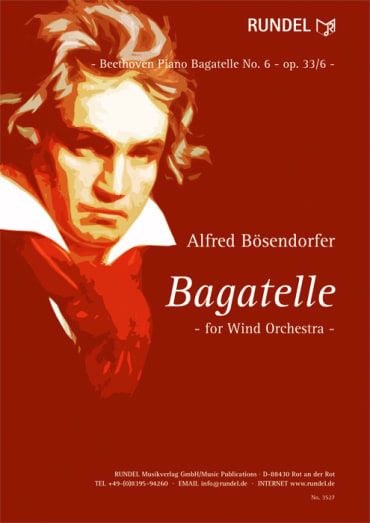
Ludwig van Beethoven
Bagatelle
for Wind Orchestra
Demo
listen
Video
view
PDF
view
Ludwig van Beethoven
Bagatelle
for Wind Orchestra
- Instrumentation Concert Band
- Composer Ludwig van Beethoven
- Editor Alfred Bösendorfer
- Series Rundel Basic Sound Serie
-
Difficulty Level
- Edition Score and Parts
- Publisher Musikverlag Rundel
- Order no. MVSR3527
 ships within 2-5 working days
incl. tax,
excl. shipping costs
Not available in all countries. Learn more

Description:
The term "bagatelle" generally is used to describe an insignificant triviality. However, when it is used in a musical context, it refers to a short composition resulting from improvisation. The German composer Ludwig van Beethoven (1770-1827) is primarily associated with his opulent nine symphonies for orchestra. But if one assumes that the composer’s numerous bagatelles for piano are only "casual pieces", written more or less in passing between one symphony and the next, one would be seriously mistaken. Instead, the bagatelles for piano represent an important part of the master's artistic oeuvre. He even decided to give them opus numbers and thus include them in the list of his "great works".
The Bagatelle No. 6 (Opus 33/6) demonstrates Beethoven's delight in "playing about" with the basic musical material and his special ability to achieve enormous musical depth with supposed simplicity. Composer and arranger Alfred Bösendorfer – like Beethoven an excellent, passionate pianist - chose this work as the basis for his wind orchestra work. With flying colours, he mastered the very challenging task of creating a new piano piece for wind orchestra. Prepared with extreme sensitivity and care, he composed a piece that is excellently suited for (chamber) musical work in the wind orchestra. It trains the common musical sensibility in many ways.
The Bagatelle No. 6 (Opus 33/6) demonstrates Beethoven's delight in "playing about" with the basic musical material and his special ability to achieve enormous musical depth with supposed simplicity. Composer and arranger Alfred Bösendorfer – like Beethoven an excellent, passionate pianist - chose this work as the basis for his wind orchestra work. With flying colours, he mastered the very challenging task of creating a new piano piece for wind orchestra. Prepared with extreme sensitivity and care, he composed a piece that is excellently suited for (chamber) musical work in the wind orchestra. It trains the common musical sensibility in many ways.