
Alberto Secondo Gallo
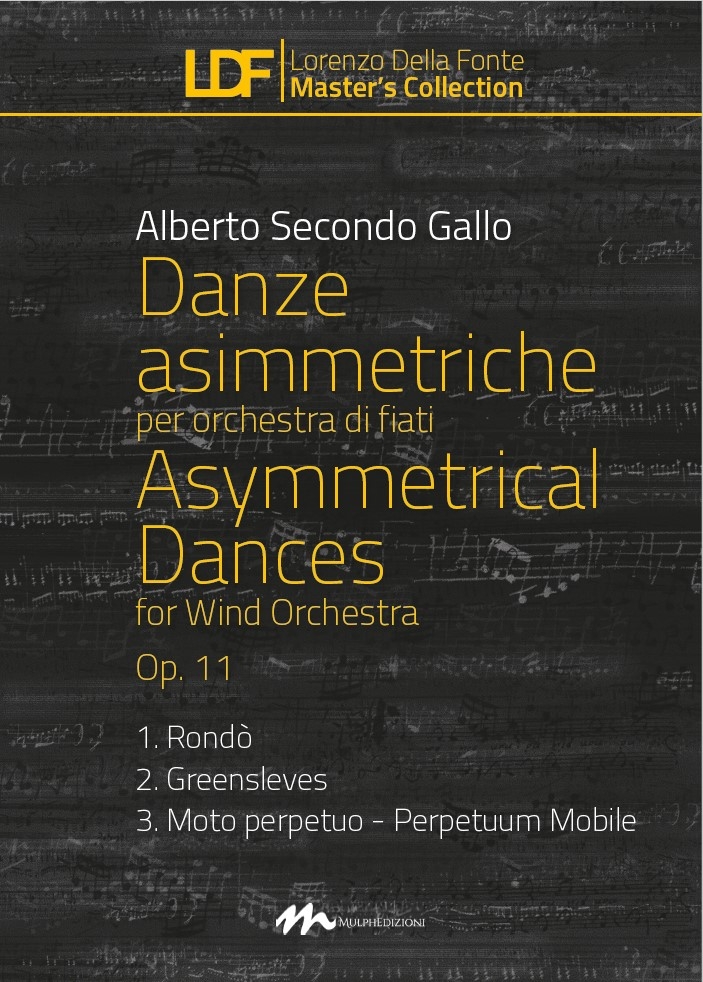
Danze asimmetriche Vol. 2
Asymmetrical Dances op. 11 for wind orchestra
Demo
listen
PDF
view
Alberto Secondo Gallo
Danze asimmetriche Vol. 2
Asymmetrical Dances op. 11 for wind orchestra
- Instrumentation Concert Band
- Composer Alberto Secondo Gallo
- Edition Score and Parts Download
- Publisher MULPH EDIZIONI srl
- Order no. MULPH011-DL
 immediately available
Download immediately after ordering
incl. tax,
excl. shipping costs
Not available in all countries. Learn more

Description:
1. Rondò
2. Greensleeves
3. Moto perpetuo - Perpetuum Mobile
This second volume of Asymmetric Dances follows the first, published by Mulph in 2023. The new collection includes three more short pieces for concert band (degree of difficulty 4 - 4.5), with a tonal and discursive musical language. All of the dances are designed for the study of asymmetrical tempos, and thus provide valuable rhythmic practice for conducting and instrument students. Asymmetrical tempi (5/8, 7/8, 10/8, etc.) are metrical indications consisting of combinations of two- and three-octave movements. It should be remembered that in these rhythmic situations the octave always retains the same duration, so the movement with three quavers is actually longer than an octave, and should not be made into a triplet. The presence of many optional instruments allows the Danze to be performed even with limited instrumental groups, thanks to the substitutions provided in the ensemble. The total duration of the pieces is within the nine-minute range.
2. Greensleeves
3. Moto perpetuo - Perpetuum Mobile
This second volume of Asymmetric Dances follows the first, published by Mulph in 2023. The new collection includes three more short pieces for concert band (degree of difficulty 4 - 4.5), with a tonal and discursive musical language. All of the dances are designed for the study of asymmetrical tempos, and thus provide valuable rhythmic practice for conducting and instrument students. Asymmetrical tempi (5/8, 7/8, 10/8, etc.) are metrical indications consisting of combinations of two- and three-octave movements. It should be remembered that in these rhythmic situations the octave always retains the same duration, so the movement with three quavers is actually longer than an octave, and should not be made into a triplet. The presence of many optional instruments allows the Danze to be performed even with limited instrumental groups, thanks to the substitutions provided in the ensemble. The total duration of the pieces is within the nine-minute range.
Here is how the download works:
1 Buy download sheet music
Purchase the download score from our online store
2 Order confirmation with download link
Immediately after completing your order, you will receive an order confirmation by email listing all items. You will find the download link next to each item. You can use this link to start the download right away. Please also check your spam folder if necessary.
Customers rated this product:
Manufacturer Information:
MULPH EDIZIONI srl
Via Garibaldi, n. 157
01036
Nepi (VT)
Italien
Other customers also bought:
Franco Cesarini
- Concert Band
- Score
-
in stock
ships within 1-2 working days
Kees Vlak
- Concert Band
- Score
-
in stock
ships within 1-2 working days
Philip Sparke
- Concert Band
- Score
-
in stock
ships within 1-2 working days
Philip Sparke
- Concert Band
- Score
-
ships within 3-6 working days

Andrew Boysen Jr.
- Concert Band
- Score
-
in stock
ships within 1-2 working days