
Pierre-Antoine Savoyat
Farewell
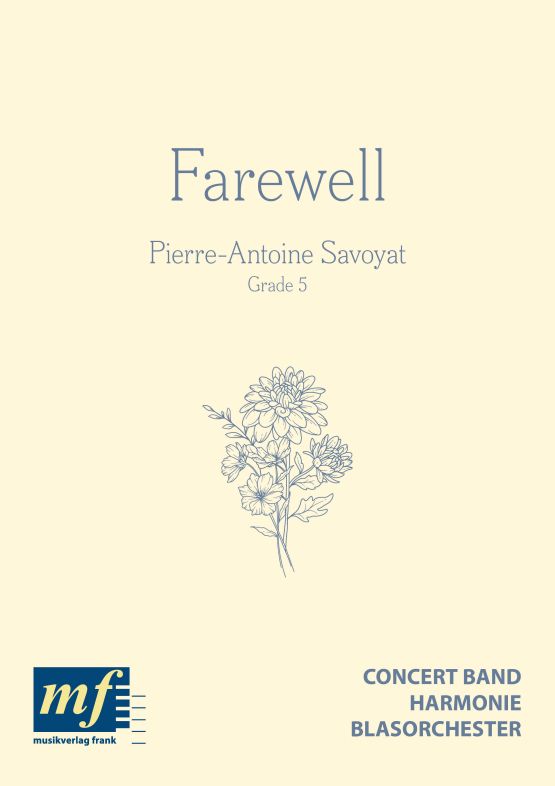
Demo
listen
PDF
view
Pierre-Antoine Savoyat
Farewell
- Instrumentation Concert Band
- Composer Pierre-Antoine Savoyat
-
Difficulty Level
- Edition Score and Parts
- Publisher Musikverlag Frank
- Order no. FRNK48474
 ships within 1-2 weeks

Description:
In 2023, I suddenly lost two close friends. I had met both of them in important bands in which I played, and they were both important for my development as a composer. Florent Bonnetain was a conductor and brass player, Alexandre Comble was a tuba player and director of a music school. Both were extremely dedicated and moved mountains to realize incredible projects. They always supported their colleagues as well as young professional musicians in realizing their dreams.
It is therefore only logical that I chose one of Puccini's few chamber music works: Crisantemi. Puccini wrote this elegy for string quartet in a single night after learning of the death of his friend, the Duke of Savoy.
There is no concrete description of the piece, its structure consists of five parts in arch form. You can also hear some other motifs from Puccini's music, such as the three chords (but in minor) of Scarpia from Tosca, which always remind me of an inescapable fate.
The piece begins in darkness, with the lowest instruments playing Crisantemi's coda while the trombones quote the beginning of the work. After a mysterious cluster, the second part begins abruptly with the chords of Scarpia. We hear some "fanfares" using Crisantemi's B section, and I develop this section further with a theme inspired by Puccini's operas (perhaps some chord progressions are reminiscent of E lucevan le stelle from Tosca).
In the slow middle section, I decided to give the first solo to the tuba, which plays Crisantemi's second theme. Then - after another version by the soprano voice - a personal theme appears, which is first heard as a flugelhorn solo. The slow movement ends with a reprise of the Crisantemi theme, played by muted brass, building to a dramatic crescendo.
The fourth section adopts the same atmosphere as the second, but increasingly builds in tension (with dissonances and a kind of polytonal process). The climax reaches its dramatic expression when the personal theme from the slow movement returns gloriously.
At the end, the last part takes up the idea of the first section, but in a bright and peaceful way (even the motif, which was initially played by the low instruments, now appears in the high woodwinds). For it is time to say goodbye. In the last chord, I opted for an unclear harmony: the woodwinds play C# minor chords, while the low instruments play an open fifth between E and B, which can result in an E major chord with an added sixth. I wanted to symbolize that despite the grief, we must continue to live without the physical presence of those we have lost. But they live on as long as we don't stop thinking about them.
It is therefore only logical that I chose one of Puccini's few chamber music works: Crisantemi. Puccini wrote this elegy for string quartet in a single night after learning of the death of his friend, the Duke of Savoy.
There is no concrete description of the piece, its structure consists of five parts in arch form. You can also hear some other motifs from Puccini's music, such as the three chords (but in minor) of Scarpia from Tosca, which always remind me of an inescapable fate.
The piece begins in darkness, with the lowest instruments playing Crisantemi's coda while the trombones quote the beginning of the work. After a mysterious cluster, the second part begins abruptly with the chords of Scarpia. We hear some "fanfares" using Crisantemi's B section, and I develop this section further with a theme inspired by Puccini's operas (perhaps some chord progressions are reminiscent of E lucevan le stelle from Tosca).
In the slow middle section, I decided to give the first solo to the tuba, which plays Crisantemi's second theme. Then - after another version by the soprano voice - a personal theme appears, which is first heard as a flugelhorn solo. The slow movement ends with a reprise of the Crisantemi theme, played by muted brass, building to a dramatic crescendo.
The fourth section adopts the same atmosphere as the second, but increasingly builds in tension (with dissonances and a kind of polytonal process). The climax reaches its dramatic expression when the personal theme from the slow movement returns gloriously.
At the end, the last part takes up the idea of the first section, but in a bright and peaceful way (even the motif, which was initially played by the low instruments, now appears in the high woodwinds). For it is time to say goodbye. In the last chord, I opted for an unclear harmony: the woodwinds play C# minor chords, while the low instruments play an open fifth between E and B, which can result in an E major chord with an added sixth. I wanted to symbolize that despite the grief, we must continue to live without the physical presence of those we have lost. But they live on as long as we don't stop thinking about them.