
Johannes Brahms
Guten Abend, gute Nacht
Wiegenlied
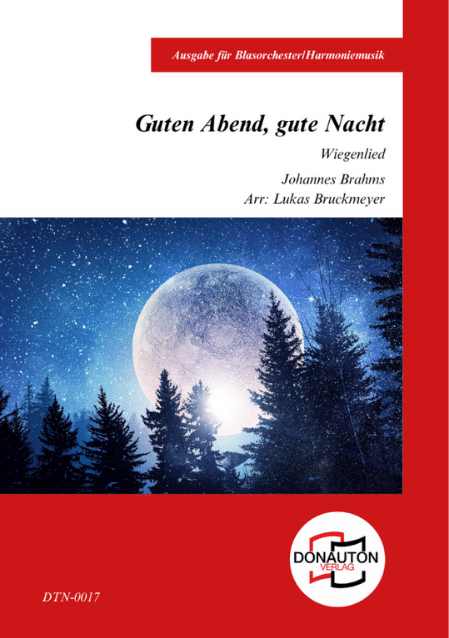
Demo
listen
PDF
view
Johannes Brahms
Guten Abend, gute Nacht
Wiegenlied
- Instrumentation Concert Band
- Composer Johannes Brahms
- Editor Lukas Bruckmeyer
-
Difficulty Level
- Edition Score and Parts
- Publisher Donauton Verlag
- Order no. DTN-0017
 ships within 3-6 working days
incl. tax,
excl. shipping costs
Not available in all countries. Learn more

Description:
The world-famous lullaby by Johannes Brahms (1868) is based on texts from "Des Knaben Wunderhorn". In this finely crafted wind orchestra version, the classic unfolds with sensitive detail in all parts. The solo part can be played by oboe, alto saxophone or trumpet - ideal for symphonic ensembles.
The lullaby, known in English as "Brahm's Lullaby" and better known as "Guten Abend, gut' Nacht", was composed by the famous composer Johannes Brahms in 1 868. The text comes from the German folk poetry of the same name, "Guten Abend, gute Nacht", which became popular in the middle of the 19th century. However, the text of the lullaby first appeared in 1808 under the title "Gute Nacht, mein Kind!" in the collection "Des Knaben Wunderhorn". Here you have a wind orchestra edition for symphonic instrumentation which impresses with its refined attention to detail in all parts. All movements have been thought through and arranged down to the last quaver. Either an oboe, an alto saxophone or a trumpet can serve as the solo part.
The lullaby, known in English as "Brahm's Lullaby" and better known as "Guten Abend, gut' Nacht", was composed by the famous composer Johannes Brahms in 1 868. The text comes from the German folk poetry of the same name, "Guten Abend, gute Nacht", which became popular in the middle of the 19th century. However, the text of the lullaby first appeared in 1808 under the title "Gute Nacht, mein Kind!" in the collection "Des Knaben Wunderhorn". Here you have a wind orchestra edition for symphonic instrumentation which impresses with its refined attention to detail in all parts. All movements have been thought through and arranged down to the last quaver. Either an oboe, an alto saxophone or a trumpet can serve as the solo part.