
Federico Agnello
La Montagna d'Oro (The Golden Mountain)
Adventure Overture
Video
view
PDF
view
Federico Agnello
La Montagna d'Oro (The Golden Mountain)
Adventure Overture
- Instrumentation Concert Band
- Composer Federico Agnello
-
Difficulty Level
- Edition Score and Parts
- Publisher Scomegna Edizioni Musicali
- Order no. SCO-B1751-18
 ships within 1-2 weeks

Description:
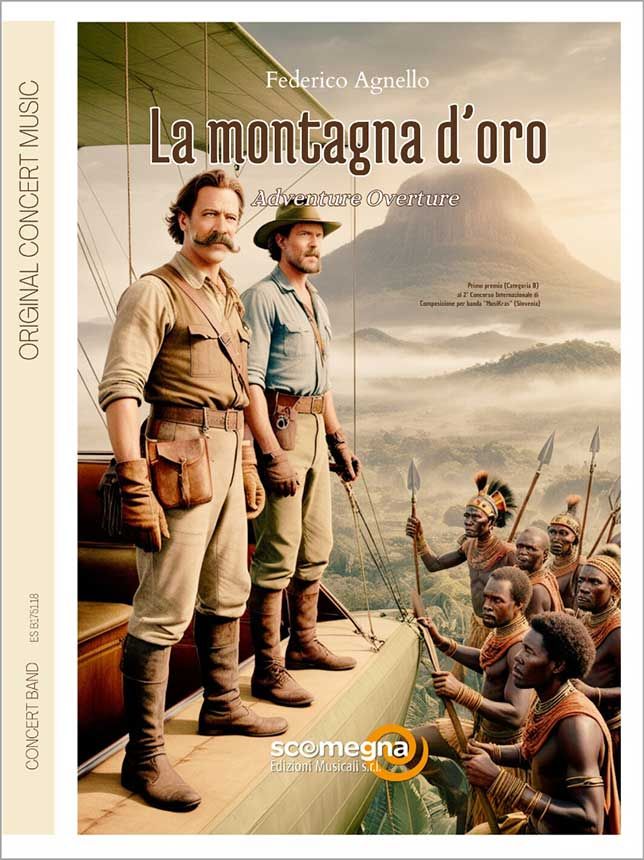
The Gold Mountain tells the adventures of Ottone Steker and Matteo Kopeki, the heroes of Salgari's 1901 novel. With their airship "Germania", they search for the legendary Gold Mountain in the heart of Africa. They are accompanied by the Arab El-Kabir, who has found a document pointing to the treasure. But on their journey they encounter the merchant Altarik and the Sultan of Mhonda, who are also determined to reach the treasure's hiding place before they do.
First prize (category B) at the 2nd International Composition Competition for Wind Orchestra "MusiKras" (Slovenia).
"The Gold Mountain" describes the adventures of the protagonists of Emilio Salgari's 1901 adventure novel of the same name. This overture, which has a narrative character, describes the adventures of Ottone Steker, a German, and his Greek friend Matteo Kopeki, who are traveling in the heart of sub-Saharan Africa in a revolutionary aircraft, the airship Germania, designed by Steker himself, called "The Flying Train". The two airmen are searching for the legendary treasure of the "Golden Mountain", the existence of which they learned from a document written by the British traveler John Kambert, who disappeared without a trace two years ago. The document was found by chance by El-Kabir, an Arab and friend of the two, who joins them on their adventurous search. Kambert, who is being held captive by a tribe of wild natives, promises in the document to reveal the secret of the "Golden Mountain" to whoever rescues him. The crew of the airship are confronted by the cruel and unscrupulous trader Altarik, who, having learned the secret, wants to be the first to reach the hidden treasure with a caravan, and the corrupt Sultan of Mhonda, a tyrannical ruler of a small Central African state.
The composition is divided into two parts: The first emphasizes the heroic and adventurous character of the protagonists, with European and Arabic cultural elements playing a central role in terms of harmony and style. The second part describes the scene of the action, with the African character in the foreground. The incessant rhythm of the percussion transports us into an atmosphere of indigenous rituals and forms an interesting counterpart to the previous heroic theme.
First prize (category B) at the 2nd International Composition Competition for Wind Orchestra "MusiKras" (Slovenia).
"The Gold Mountain" describes the adventures of the protagonists of Emilio Salgari's 1901 adventure novel of the same name. This overture, which has a narrative character, describes the adventures of Ottone Steker, a German, and his Greek friend Matteo Kopeki, who are traveling in the heart of sub-Saharan Africa in a revolutionary aircraft, the airship Germania, designed by Steker himself, called "The Flying Train". The two airmen are searching for the legendary treasure of the "Golden Mountain", the existence of which they learned from a document written by the British traveler John Kambert, who disappeared without a trace two years ago. The document was found by chance by El-Kabir, an Arab and friend of the two, who joins them on their adventurous search. Kambert, who is being held captive by a tribe of wild natives, promises in the document to reveal the secret of the "Golden Mountain" to whoever rescues him. The crew of the airship are confronted by the cruel and unscrupulous trader Altarik, who, having learned the secret, wants to be the first to reach the hidden treasure with a caravan, and the corrupt Sultan of Mhonda, a tyrannical ruler of a small Central African state.
The composition is divided into two parts: The first emphasizes the heroic and adventurous character of the protagonists, with European and Arabic cultural elements playing a central role in terms of harmony and style. The second part describes the scene of the action, with the African character in the foreground. The incessant rhythm of the percussion transports us into an atmosphere of indigenous rituals and forms an interesting counterpart to the previous heroic theme.