
Luciano Feliciani
Le Aquile della Steppa (The Eagles of the Steppe)
Video
view
PDF
view
Luciano Feliciani
Le Aquile della Steppa (The Eagles of the Steppe)
- Instrumentation Concert Band
- Composer Luciano Feliciani
-
Difficulty Level
- Edition Score and Parts
- Publisher Scomegna Edizioni Musicali
- Order no. SCO-B1750-19
 ships within 1-2 weeks

Description:
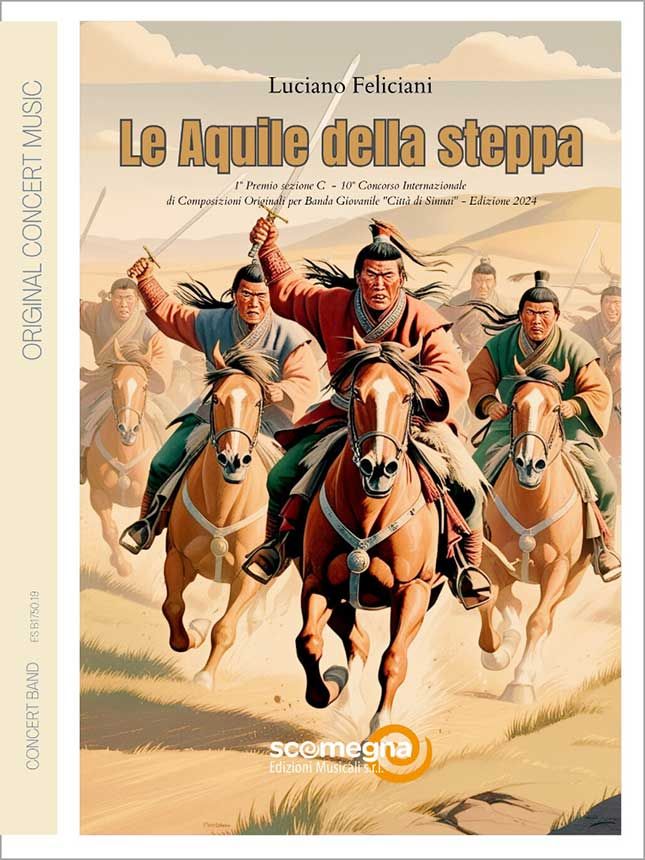
The Eagles of the Steppe by Emilio Salgari, set in the Asian steppes in 1875, tells the story of bandits, the "Eagles of the Steppe", who kidnap Hossein's fiancée. The novel explores fights, chases and the rivalry between men for the love of a woman. The music by Luciano Feliciani, inspired by this work, reflects these themes through impressive and dramatic melodies.
1st Prize, Category C - 10th International Competition for Original Compositions for Youth Wind Orchestra "City of Sinnai" - Edition 2024.
"The Eagles of the Steppe" is a thrilling novel by Emilio Salgari, published in 1905 and set in the vast steppes between Turkmenistan and Uzbekistan around the year 1875. The steppe is the true protagonist of the novel and presents the protagonists with extreme challenges, forcing them to contend with extreme conditions such as lack of water, scorching heat and wild animals. The novel deals with two main themes: Firstly, the battles, kidnappings and hunts involving the "eagles of the steppe", and secondly, the rivalry between two men for the love of the same woman.Inspired by this work, Luciano Feliciani composed music that captures the endless landscapes of Central Asia and the dramatic actions of the raiders. The first part is lively and descriptive, with melodies reminiscent of typical regional sounds. The middle section, slower and more melancholic, introduces the love theme of Hossein for Talmà, his fiancée, who is abducted by the eagles during their wedding. The piece ends with the return of the eagle theme and a triumphant finale celebrating Hossein's victory and his marriage to Talmà.
1st Prize, Category C - 10th International Competition for Original Compositions for Youth Wind Orchestra "City of Sinnai" - Edition 2024.
"The Eagles of the Steppe" is a thrilling novel by Emilio Salgari, published in 1905 and set in the vast steppes between Turkmenistan and Uzbekistan around the year 1875. The steppe is the true protagonist of the novel and presents the protagonists with extreme challenges, forcing them to contend with extreme conditions such as lack of water, scorching heat and wild animals. The novel deals with two main themes: Firstly, the battles, kidnappings and hunts involving the "eagles of the steppe", and secondly, the rivalry between two men for the love of the same woman.Inspired by this work, Luciano Feliciani composed music that captures the endless landscapes of Central Asia and the dramatic actions of the raiders. The first part is lively and descriptive, with melodies reminiscent of typical regional sounds. The middle section, slower and more melancholic, introduces the love theme of Hossein for Talmà, his fiancée, who is abducted by the eagles during their wedding. The piece ends with the return of the eagle theme and a triumphant finale celebrating Hossein's victory and his marriage to Talmà.