
Enrico Tiso
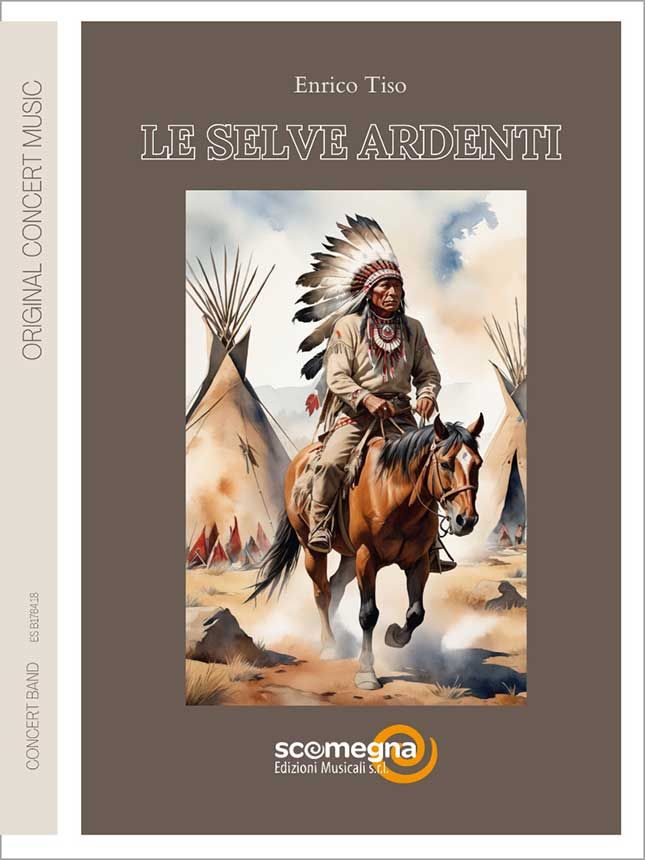
Le Selve Ardenti (The Burning Forests)
Video
view
PDF
view
Enrico Tiso
Le Selve Ardenti (The Burning Forests)
- Instrumentation Concert Band
- Composer Enrico Tiso
-
Difficulty Level
- Edition Score and Parts
- Publisher Scomegna Edizioni Musicali
- Order no. SCO-B1764-18
 ships within 1-2 weeks

Description:
Enrico Tiso sets The Burning Woods, Salgari's last western novel, to music. The surviving Sioux flee to Canada under the leadership of Minnehaha, pursued by the US army and other characters. Pursuits and bloody battles show the deep hatred between Sioux and Americans.
The play is inspired by Emilio Salgari's 1910 novel Le Selve Ardenti, the last of the three novels in the Far West cycle (the others in the trilogy are On the Frontiers of the Wild West and The Scalper).
It is divided into four seamlessly linked sections.
The opening Adagio, which begins with a flute solo, is intended to describe the atmospheric setting of the first narrative passage, near the frozen banks of the Middle Loup. Winter has covered the prairies and forests of Nebraska with a thick layer of snow.
This is followed by the Allegro, which is characterized by an urgent rhythm on a bass ostinato and short melodic and rhythmic-melodic motifs that alternate one after the other. The chases and battles between the Selve Ardenti (as the Sioux are called) and the group around the Indian agent John, Colonel Devandel, Harry, Sandy-Hook and others are described here.
The music calms down and a five-bar diminuendo transitional phase leads into the Adagio. After a short trumpet phrase, a gentle melody entrusted to flutes and clarinets begins. It embodies the image of the beautiful Minehaha, the Sakem, who leads the Selve Ardenti together with her father Red Cloud.
A molto ritenuto leads into the second Allegro, which takes up the themes and melodies of the first, but with slight variations. A short crescendo introduces a six-bar coda that brings the piece to a close. It is the final confrontation between the parties, the destruction of the last Selve Ardenti.
The play is inspired by Emilio Salgari's 1910 novel Le Selve Ardenti, the last of the three novels in the Far West cycle (the others in the trilogy are On the Frontiers of the Wild West and The Scalper).
It is divided into four seamlessly linked sections.
The opening Adagio, which begins with a flute solo, is intended to describe the atmospheric setting of the first narrative passage, near the frozen banks of the Middle Loup. Winter has covered the prairies and forests of Nebraska with a thick layer of snow.
This is followed by the Allegro, which is characterized by an urgent rhythm on a bass ostinato and short melodic and rhythmic-melodic motifs that alternate one after the other. The chases and battles between the Selve Ardenti (as the Sioux are called) and the group around the Indian agent John, Colonel Devandel, Harry, Sandy-Hook and others are described here.
The music calms down and a five-bar diminuendo transitional phase leads into the Adagio. After a short trumpet phrase, a gentle melody entrusted to flutes and clarinets begins. It embodies the image of the beautiful Minehaha, the Sakem, who leads the Selve Ardenti together with her father Red Cloud.
A molto ritenuto leads into the second Allegro, which takes up the themes and melodies of the first, but with slight variations. A short crescendo introduces a six-bar coda that brings the piece to a close. It is the final confrontation between the parties, the destruction of the last Selve Ardenti.