
Angelo Sormani
Magic Moon
Solo Alto Sax
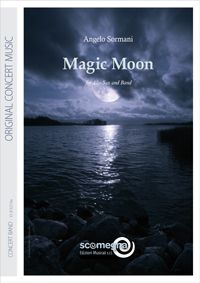
Demo
listen
PDF
view
Angelo Sormani
Magic Moon
Solo Alto Sax
- Instrumentation Concert Band (Solo/Feature: Alto Saxophone)
- Composer Angelo Sormani
-
Difficulty Level
- Edition Score and Parts
- Publisher Scomegna Edizioni Musicali
- Order no. SCO1327-18A
 ships within 1-2 weeks

Description:
Magic Moon is that secret place that lives in everyone's imagination.
It can be tied to the memory of a particular moment or refer to a situation
never experienced in reality but much desired.
The fact is that the moon, or more accurately the phases of the moon
or lunations, has always been a model and principle on which to base
rituals, spells, and proverbs.
Since time immemorial, the phases of the moon regulate activities of
peasants, priests, and wizards. Some argue that this is superstition; others,
by contrast, argue that lunar activity directly affects the entire cycle of nature.
In ancient Egypt and China, in imperial Rome, and even at the court of the great
Charlemagne, there were officials responsible for observing the moon's motions
(some argue that even papal Rome has sporadically queried 'lunar observers' to
adjust political and economic activities). And, 400 years before Christ, the great
Greek physician Hippocrates divided the solar year into thirteen lunar phases.
From mythological and religious points of view, the moon-sun duality corresponds
to male and female human personalities: the moon complements and balances the
sun. The sun is all about spirit, the male principle, and the moon is all about soul,
the feminine principle. The sun rules the individual and the moon rules the collective,
the crowds, and generally groups of people. Lacking its own light, the moon
simply reflects the sunlight. In this sense, the sun is the active principle, or Yang
principle, and the moon the passive principle, or Yin principle.
The charm of the moon inspired this composition. The choice of the alto saxophone
as a solo instrument was not accidental: this instrument represents the moon, which
surrounds itself with other symbolic elements, in this case the wind band, to create
the magic. The piece begins with a stubborn and repetitive pattern, which becomes
the generating cell of the entire composition. On top of this pattern, the soloist
draws melodic lines loaded with lyricism, which sometimes feel suspended but
which are always full of energy and intensity. The harmonic background is rather
open-ended and seems to discreetly wink to jazz music, or at least at its 'magical'
influence.
It can be tied to the memory of a particular moment or refer to a situation
never experienced in reality but much desired.
The fact is that the moon, or more accurately the phases of the moon
or lunations, has always been a model and principle on which to base
rituals, spells, and proverbs.
Since time immemorial, the phases of the moon regulate activities of
peasants, priests, and wizards. Some argue that this is superstition; others,
by contrast, argue that lunar activity directly affects the entire cycle of nature.
In ancient Egypt and China, in imperial Rome, and even at the court of the great
Charlemagne, there were officials responsible for observing the moon's motions
(some argue that even papal Rome has sporadically queried 'lunar observers' to
adjust political and economic activities). And, 400 years before Christ, the great
Greek physician Hippocrates divided the solar year into thirteen lunar phases.
From mythological and religious points of view, the moon-sun duality corresponds
to male and female human personalities: the moon complements and balances the
sun. The sun is all about spirit, the male principle, and the moon is all about soul,
the feminine principle. The sun rules the individual and the moon rules the collective,
the crowds, and generally groups of people. Lacking its own light, the moon
simply reflects the sunlight. In this sense, the sun is the active principle, or Yang
principle, and the moon the passive principle, or Yin principle.
The charm of the moon inspired this composition. The choice of the alto saxophone
as a solo instrument was not accidental: this instrument represents the moon, which
surrounds itself with other symbolic elements, in this case the wind band, to create
the magic. The piece begins with a stubborn and repetitive pattern, which becomes
the generating cell of the entire composition. On top of this pattern, the soloist
draws melodic lines loaded with lyricism, which sometimes feel suspended but
which are always full of energy and intensity. The harmonic background is rather
open-ended and seems to discreetly wink to jazz music, or at least at its 'magical'
influence.