
Franco Arrigoni
Old Medieval Town
Demo
listen
Video
view
PDF
view
Franco Arrigoni
Old Medieval Town
- Instrumentation Concert Band
- Composer Franco Arrigoni
-
Difficulty Level
- Edition Score and Parts
- Publisher Scomegna Edizioni Musicali
- Order no. SCO-B1668-21
 ships within 1-2 weeks

Description:
Commissioned by the "Corpo Musicale San Michele Arcangelo" of Mapello (BG)to celebrate its 175th anniversary
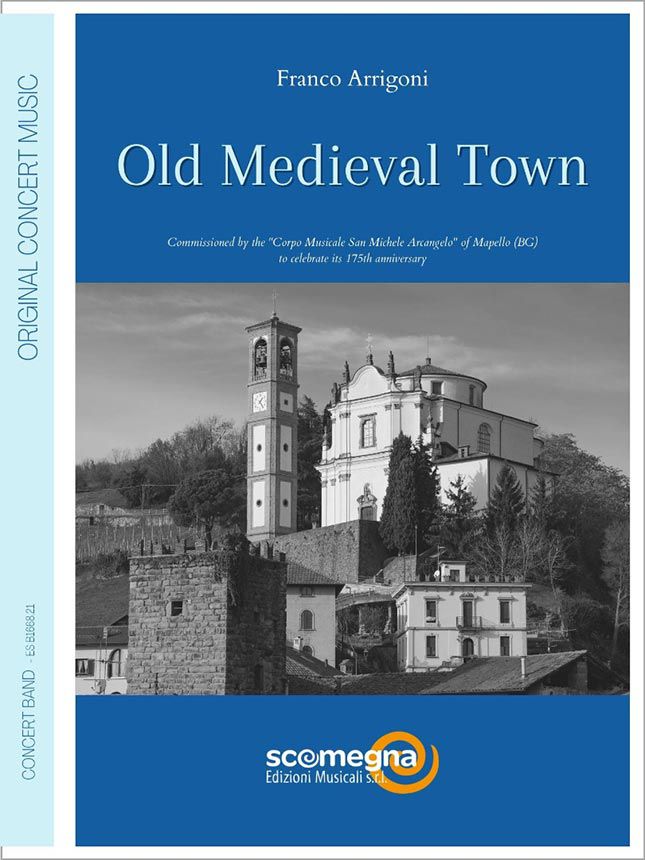
Old Medieval Town was commissioned by the “Corpo Musicale San Michele Arcangelo” of Mapello (Bergamo) to celebrate its 175th year of foundation. Mapello, a small town at the feet of Mount Canto, is characterized by the presence of several towers of medieval origin.The composition is written in Dorian mode. In the Middle Ages a traveler arrives in Mapello walking on the footpaths of Mount Canto (bars 1-7) and sees the walls of the town (8-14); his attention immediately shifts to the imposing towers (14-38).Upon entering the city, he is struck by the industriousness and liveliness of the people (“A tempo di Danza,” 38-77).Once out of the town, he finds himself on a long tree-lined avenue (78-102), which takes him to the sanctuary of the Madonna di Prada (“Madonna dei prati,” 103-120).The composition continues by resuming, alternating, and superimposing the themes of the towers and of the city life up to the concluding Coda.
Old Medieval Town was commissioned by the “Corpo Musicale San Michele Arcangelo” of Mapello (Bergamo) to celebrate its 175th year of foundation. Mapello, a small town at the feet of Mount Canto, is characterized by the presence of several towers of medieval origin.The composition is written in Dorian mode. In the Middle Ages a traveler arrives in Mapello walking on the footpaths of Mount Canto (bars 1-7) and sees the walls of the town (8-14); his attention immediately shifts to the imposing towers (14-38).Upon entering the city, he is struck by the industriousness and liveliness of the people (“A tempo di Danza,” 38-77).Once out of the town, he finds himself on a long tree-lined avenue (78-102), which takes him to the sanctuary of the Madonna di Prada (“Madonna dei prati,” 103-120).The composition continues by resuming, alternating, and superimposing the themes of the towers and of the city life up to the concluding Coda.