
Lorenzo Pusceddu
Terra Rossa
Demo
listen
Video
view
PDF
view
Lorenzo Pusceddu
Terra Rossa
- Instrumentation Concert Band
- Composer Lorenzo Pusceddu
-
Difficulty Level
- Edition Score and Parts
- Publisher Scomegna Edizioni Musicali
- Order no. SCO-B1644-19A

Description:
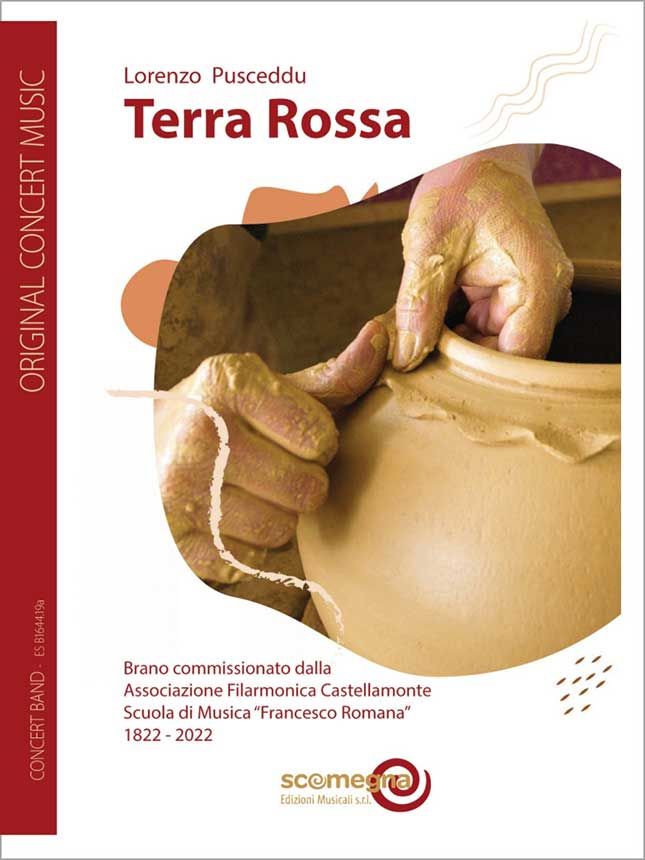
In the year 2022, the Castellamonte Philharmonic Association - "Francesco Romana" School of Music celebrates its 200th anniversary, and President Giacomo Spiller with Maestro Dino Domatti proposed to composer Lorenzo Pusceddu the creation of a piece celebrating the event, which would also evoke the typical products and legends of the tradition of the area.Red earth is the clay that is mined from the hills of Castellamonte and is the raw material with which the potters, with their skilled hands, create their works of art, build the famous stoves and shape the crockery that has made Castellamonte famous all over the world.The first movement of the suite is joyful and recalls the euphoria of Carnival to which popular traditions and legends such as that of the Bela Pignatera are linked. The pignatta, also called tofeja or cupèt, is the symbol of Castellamonte: an earthenware pot in which beans with pork rinds are cooked at Carnival, and it is precisely at Carnival that the legend of the Bela Pignatera, the comely Isabella of Montebello, a generous and affable young woman who rebelled against the tyrant ruler Count Uguccione, managed to escape from Castellamonte Castle through a secret dungeon during the fire set in 1836 by the Tuchini during the revolt against the tyrannical count, is evoked. For more than a century, the carnival celebration has closed, by bishop's dispensation, on Ash Wednesday, with the Bela Pignatera setting fire to the great papier-mâché King Pignatun, and only at the end of the burning does Lent begin. The suite's second movement, nostalgic and meditative in character, is meant to depict the hill behind the Castle, where even today, in the woods, there is a wooden cross that indicates the place, in a distant time, where leprosy patients were brought and where, every day, the townspeople donated food inside terracotta bowls that were not collected. Thus were found the remains of thousands of these red earthen bowls, the shards of which were called "ciàp." Hence the name of the place: "La crus dal Ciàp" (The cross of the crock).The third movement contains a rhetorical celebratory fanfare and a sprightly, euphoric theme, ideal for recalling the theme of the celebration that all bands organize on the occasion of their anniversaries, in this specific case the 200th anniversary of the founding of the Castellamonte Philharmonic Association - "Francesco Romana" School of Music. In 1922, during the celebration of its 100th anniversary, the members of the Castellamonte Philharmonic decided to build a venue for band rehearsals and music school lessons: within only three years, a stunning villa was built, which is now part of the Piedmontese Art Nouveau routes. The land was made available by the town administration, and much of the money needed for the work was donated by the Romana family, after whom the association, erected Ente Morale by Royal Decree of 1925 signed by King Victor Emmanuel III, was named.
Customers rated this product:
Manufacturer Information:
Scomegna Edizioni Musicali S.r.l.
Via Campassi 41
10040
LA LOGGIA
Italien
Other customers also bought:
Philip Sparke
- Concert Band
- Score and Parts
-
 ships within 3-6 working days