
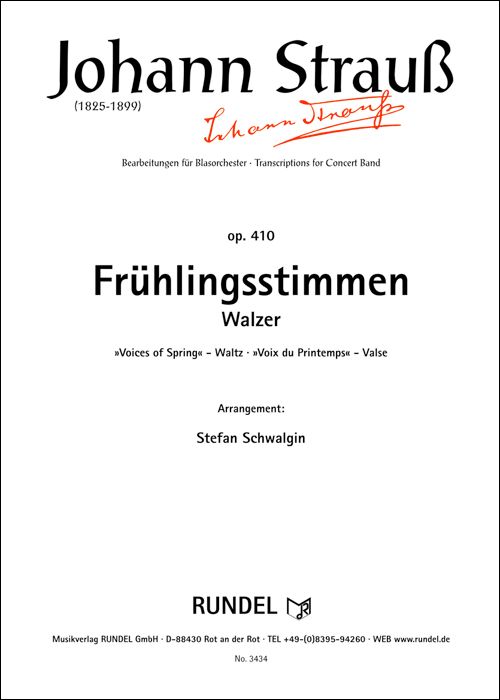
Johann Strauss (Sohn)
Voices of Spring op. 410
Waltz
Demo
listen
Video
view
PDF
view
Johann Strauss (Sohn)
Voices of Spring op. 410
Waltz
- Instrumentation Concert Band
- Composer Johann Strauss (Sohn)
- Editor Stefan Schwalgin
-
Difficulty Level
- Edition Score and Parts
- Publisher Musikverlag Rundel
- Order no. MVSR3434
 ships within 2-5 working days
incl. tax,
excl. shipping costs
Not available in all countries. Learn more

Description:
Probably every one of the 180 or so waltzes by Johann Strauss (son) (1825-1899) is still worth playing. Nevertheless, perhaps a dozen of his concert waltzes clearly stand out among his creations in terms of popularity and dominate concert programs. In addition to waltzes such as "An der schönen blauen Donau", "Kaiserwalzer" and "Rosen aus dem Süden", his "Frühlingsstimmen" (op. 410) is certainly also part of this immovable canon of Strauss literature.
The waltz deals musically and thematically with spring, its sounds and emotions. The first main melody already sets a clear accent: a sinuous ascending quaver line followed by a gentle descent of the notes describes the "flight path" of a lark. And subsequently, bird-call-like figures and melodies are heard again and again, especially in the high wood. The whole work breathes the lightness and buoyancy of spring; this is ensured by numerous "jubilant" interval leaps in the melody as well as lucid instrumentation.
Johann Strauss wrote two versions of the "Frühlingsstimmen": a version for full orchestra and a version for orchestra with solo coloratura soprano. (An optional vocal part is included in the edition.) Stefan Schwalgin based his arrangement closely on the score of the orchestral version, transferring the lightness of the original to the wind orchestra.
NOTE: The audio sample is a MIDI recording!
The waltz deals musically and thematically with spring, its sounds and emotions. The first main melody already sets a clear accent: a sinuous ascending quaver line followed by a gentle descent of the notes describes the "flight path" of a lark. And subsequently, bird-call-like figures and melodies are heard again and again, especially in the high wood. The whole work breathes the lightness and buoyancy of spring; this is ensured by numerous "jubilant" interval leaps in the melody as well as lucid instrumentation.
Johann Strauss wrote two versions of the "Frühlingsstimmen": a version for full orchestra and a version for orchestra with solo coloratura soprano. (An optional vocal part is included in the edition.) Stefan Schwalgin based his arrangement closely on the score of the orchestral version, transferring the lightness of the original to the wind orchestra.
NOTE: The audio sample is a MIDI recording!