
Richard Strauss
Wiener Philharmoniker Fanfare
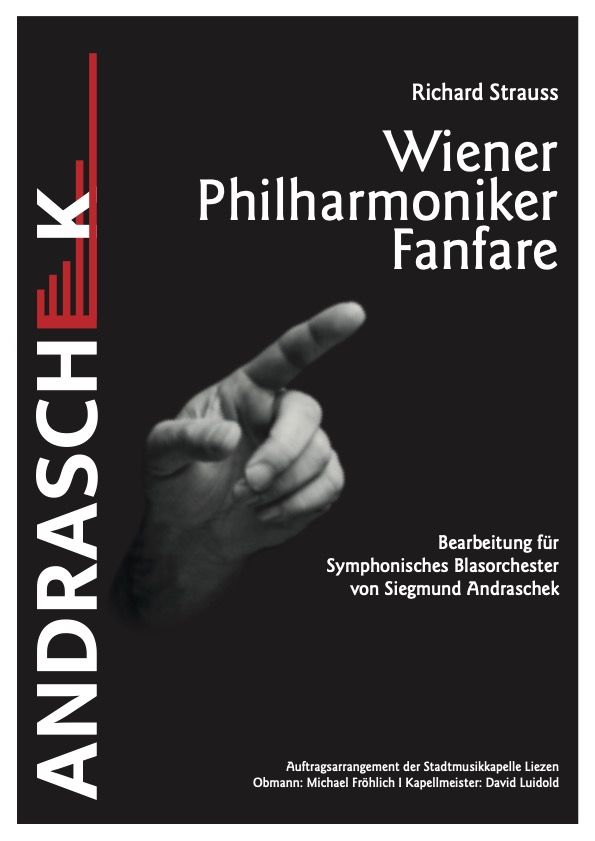
PDF
view
Richard Strauss
Wiener Philharmoniker Fanfare
- Instrumentation Concert Band
- Composer Richard Strauss
- Editor Siegmund Andraschek
-
Difficulty Level
- Edition Sheet Music
- Publisher Andraschek Musikverlag
- Order no. AND00065
 ships within 4-8 working days
incl. tax,
excl. shipping costs
Not available in all countries. Learn more

Description:
The "Vienna Philharmonic Fanfare" was composed by Richard Strauss (1864-1949) for the Vienna Philharmonic Ball and premiered on March 4, 1924. In the score it is noted: "Dedicated to the dear and wonderful Vienna Philharmonic Orchestra".
In his statements on his orchestrations, Richard Strauss is said to have been tempted to "play down the complex connections between composing and orchestration to a routine process based primarily on technical craftsmanship, which did not even begin to do justice to the very complex artistic processes involved in writing the score". (Aringer, Klaus)
Richard Strauss naturally devoted his entire life to the "art of orchestration" in order to be able to make his conception of sound "visible" in the score - orchestrated accordingly. He continued to develop and is one of those composers who have had a lasting influence on this area of the artistic process.
The aim in creating this arrangement was therefore to "preserve" the original sound of the original instrumentation for 22 brass instruments and timpani as far as possible. The woodwind players can therefore primarily "only" be given tasks to enrich the sound of the main parts. The "Austrian" traditional instruments (flugelhorn and tenor horn/baritone), which are obligatory for this arrangement, find their special area of responsibility in supporting the horn, trumpet and/or trombone parts. Precise dynamic markings and articulation instructions are given in the score for these registers, which - if performed successfully - should help to achieve the desired, optimal tonal blend. Designations such as mfp (mezzoforte-piano) instead of fp (forte-piano) were therefore chosen deliberately. All in all, the aim is to make the trumpet, horn and trombone parts sound their best and come as close as possible to the original sound despite the lack of instrumentation.
In his statements on his orchestrations, Richard Strauss is said to have been tempted to "play down the complex connections between composing and orchestration to a routine process based primarily on technical craftsmanship, which did not even begin to do justice to the very complex artistic processes involved in writing the score". (Aringer, Klaus)
Richard Strauss naturally devoted his entire life to the "art of orchestration" in order to be able to make his conception of sound "visible" in the score - orchestrated accordingly. He continued to develop and is one of those composers who have had a lasting influence on this area of the artistic process.
The aim in creating this arrangement was therefore to "preserve" the original sound of the original instrumentation for 22 brass instruments and timpani as far as possible. The woodwind players can therefore primarily "only" be given tasks to enrich the sound of the main parts. The "Austrian" traditional instruments (flugelhorn and tenor horn/baritone), which are obligatory for this arrangement, find their special area of responsibility in supporting the horn, trumpet and/or trombone parts. Precise dynamic markings and articulation instructions are given in the score for these registers, which - if performed successfully - should help to achieve the desired, optimal tonal blend. Designations such as mfp (mezzoforte-piano) instead of fp (forte-piano) were therefore chosen deliberately. All in all, the aim is to make the trumpet, horn and trombone parts sound their best and come as close as possible to the original sound despite the lack of instrumentation.