
Johann Sebastian Bach
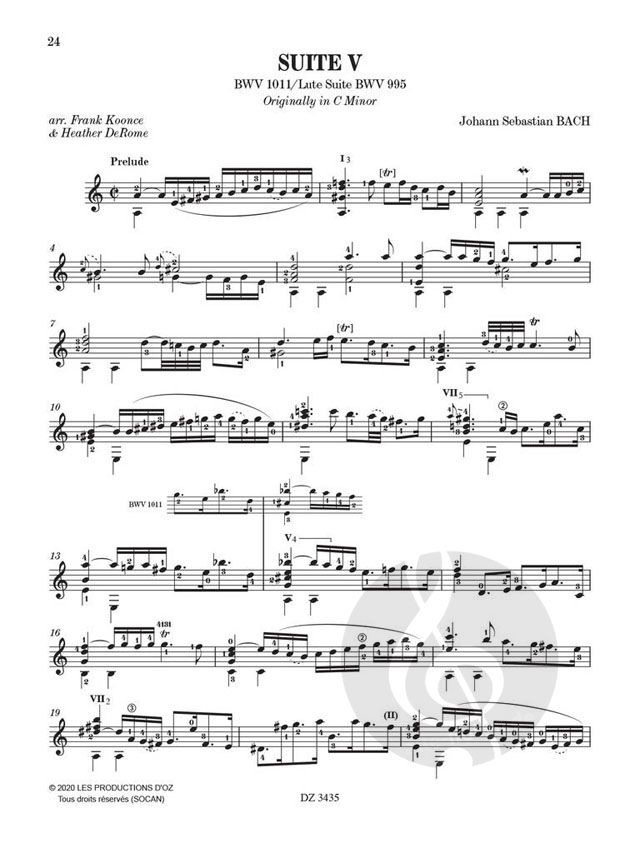
Cello Suites No. 1, 2, 3
for Guitar

Johann Sebastian Bach
Cello Suites No. 1, 2, 3
for Guitar
- Instrumentation Classical Guitar
- Edition Sheet Music
-
Difficulty Level
- Composer Johann Sebastian Bach
- Editor Frank Koonce
- Publisher Les Productions d'Oz
- Order no. DOZ4598
incl. tax,
excl. shipping costs
 ships within 2-4 weeks
Description:
The first three Suites for cello by J.S. Bach, BWV 1007-1008-1009, are arranged here for classical guitar by the renowned musicologist and guitarist Frank Koonce. Bach wrote his six suites for unaccompanied cello while serving as Kapellmeister at the court of Anhalt-Cöthen between 1717 and 1723. An original manuscript of these suites in Bach’s handwriting has not been found; however, four eighteenth-century copies are known to exist. Three of these are preserved at the Staatsbib- liothek zu Berlin - Preußischer Kulturbesitz: source A (Mus. ms. Bach P 269), in the handwriting of Anna Magdalena Bach; source B (Mus. ms. Bach P 804), made by organist and composer Johann Peter Kellner; and source C (Mus. ms. Bach P 289), an anonymous copy that dates from the second half of the eighteenth century. The fourth copy, source D (Mus. Hs. 5007), is another anonymous version from the late eighteenth century, now held at the Nationalbibliothek in Vienna. Facsimiles of the four manuscripts are published as part of the Neue Bach-Ausgabe (New Bach Edition), abbre- viated as NBA.1 This important collection supersedes the Bach Gesellschaft-Ausgabe (BGA), the first com- prehensive edition of Bach’s complete works. Under separate covers, the NBA also includes the Kritischer Bericht (Critical Report)2 of the solo cello works and an engraved edition,3 both by Hans Eppstein. However, the latter has received criticism and is considered by some to not uphold the editorial standards of other NBA volumes because it combines, and therefore obfuscates the source material. Specifically, each of the six suites is presented in two versions, the first being a mixture of the Anna Magdalena Bach and Kellner manuscripts, and the second a mixture of the two anonymous versions. Evidence suggests that there may have been two auto- graphs, an early draft and a fair copy. The former may have been the basis for Kellner’s copy, and the latter for that of Anna Magdalena, while the two anony- mous manuscripts appear to derive from another lost intermediate manuscript.4 Newly introduced into the discussion is yet another source, E, the first published edition (Paris: Janet et Cotelle, ca. 1824), which merits closer attention. This early printed edition shares char- acteristics with sources C and D, yet there are enough differences to justify calling it an independent version.5 Most modern editions of Bach’s solo cello works, in- cluding those edited for guitar, are based on source A. For years, it was the only known manuscript and was mistaken for the original because of its similarity to Bach’s handwriting. Today, most scholars still regard it as being the most faithful copy, but acknowledge that Anna Magdalena made mistakes and that she was especially unclear in her slurring/bowing notation. Source B is also very valuable because of Kellner’s close association with Bach and his circle. As noted, differences in his manuscript suggest that he worked from a different model, but it may also have come directly from Bach. For serious scholars, all of the sur- viving sources should be compared for similarities and differences.6 Even so, it will still be open to subjective interpretation as to whether the differences represent copying mistakes or genuine alternative readings. No matter what your perspective may be, unless/until an autograph manuscript surfaces, an "authentic" reading of these works will continue to be the subject of debate.
Customers rated this product:
Les Productions d'Oz
2220 Chemin du Fleuve
G6W 1Y4
Lévis, QC
Kanada
alle-noten.de: Sheet music shipping since 1969

Since 1969, over 500,000 customers have trusted us. With a huge selection of over 1,000,000 sheet music titles, we are one of the largest providers in Europe. Thanks to our large stock we can often ship sheet music within 24 hours. No matter what sheet music you are looking for: you are in the right place!
Yours, Stefanie Reichert
Head of Customer Service
Other customers also bought:

- Classical Guitar
- Sheet Music
- Frank Koonce
-
ships within 2-4 weeks