
Ferenc Farkas
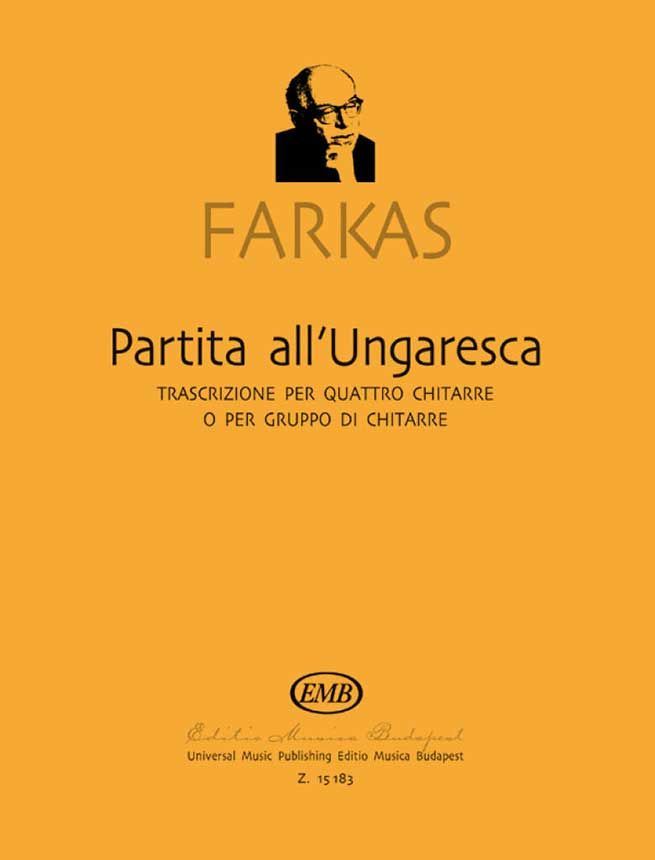
Partita all'ungaresca
transcription for four guitars for guitar group
Ferenc Farkas
Partita all'ungaresca
transcription for four guitars for guitar group
- Instrumentation Guitar Quartet
- Composer Ferenc Farkas
- Editor András Farkas
- Edition Score and Parts
- Publisher Editio Musica Budapest
- Order no. EMB15183
 ships within 3-6 working days
incl. tax,
excl. shipping costs
Not available in all countries. Learn more

Description:
The work is an arrangement of three movements (1., 2., 6.) of the dance series of the same title originally composed in 1974 for string orchestra. The arrangements were made in 1995 by the composer's son András Farkas.
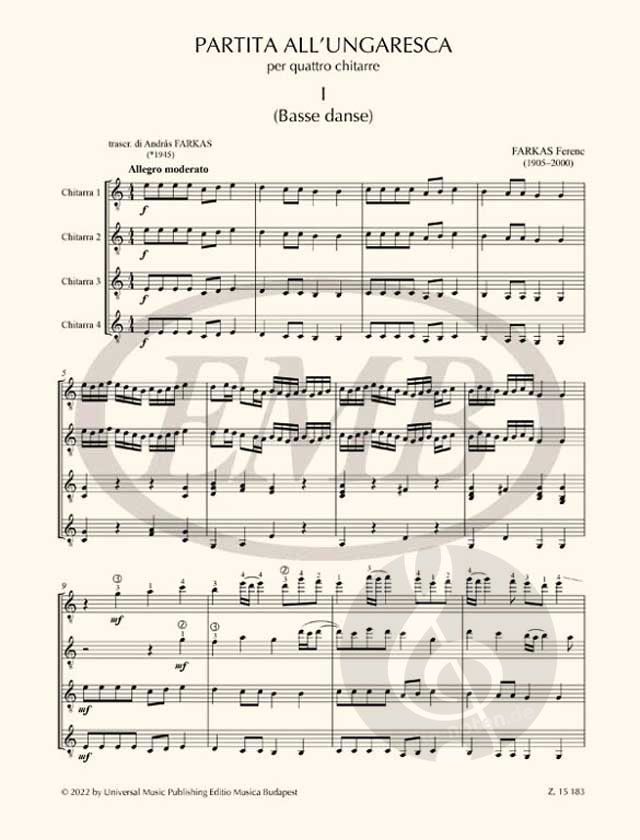
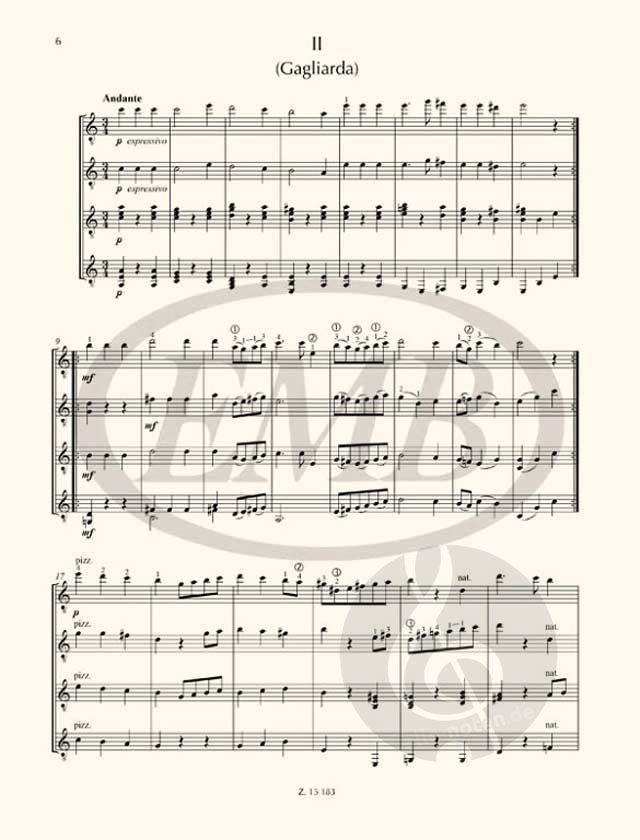
The first movement extends the two bars of ''Bátya, bátya, melly az út...'' noted down by Fülöp Pominóczky in 1520 to four bars, and on this basis devises variations in the manner of the basse danse of that period. The second movement is a rendering of a piece by Bálint Bakfark, entitled ''Non dite mai''.
The musical structure of ''Hajdútánc'' (''Heyduck-dance'') is a rondo. Its theme dates from 1592 (Dresdner Zithertabulatur, Heyducken Dantz). The same melody is also to be found in Nörmiger (1598). The first episode, titled ''Erster Ungrischr Aufftzugkh'', is from this collection - it extends the final three bars of the melody to four; the second episode, ''Báthory tánca'' (from Jakobides' tabulature manuscript), reconstructs the presumed original by modifying an obvious misprint.
This edition includes the full score and one copy of each part. For performances with orchestra, further printed parts can be ordered separately.
The first movement extends the two bars of ''Bátya, bátya, melly az út...'' noted down by Fülöp Pominóczky in 1520 to four bars, and on this basis devises variations in the manner of the basse danse of that period. The second movement is a rendering of a piece by Bálint Bakfark, entitled ''Non dite mai''.
The musical structure of ''Hajdútánc'' (''Heyduck-dance'') is a rondo. Its theme dates from 1592 (Dresdner Zithertabulatur, Heyducken Dantz). The same melody is also to be found in Nörmiger (1598). The first episode, titled ''Erster Ungrischr Aufftzugkh'', is from this collection - it extends the final three bars of the melody to four; the second episode, ''Báthory tánca'' (from Jakobides' tabulature manuscript), reconstructs the presumed original by modifying an obvious misprint.
This edition includes the full score and one copy of each part. For performances with orchestra, further printed parts can be ordered separately.