
Wendelin Gläser
2 Kantaten
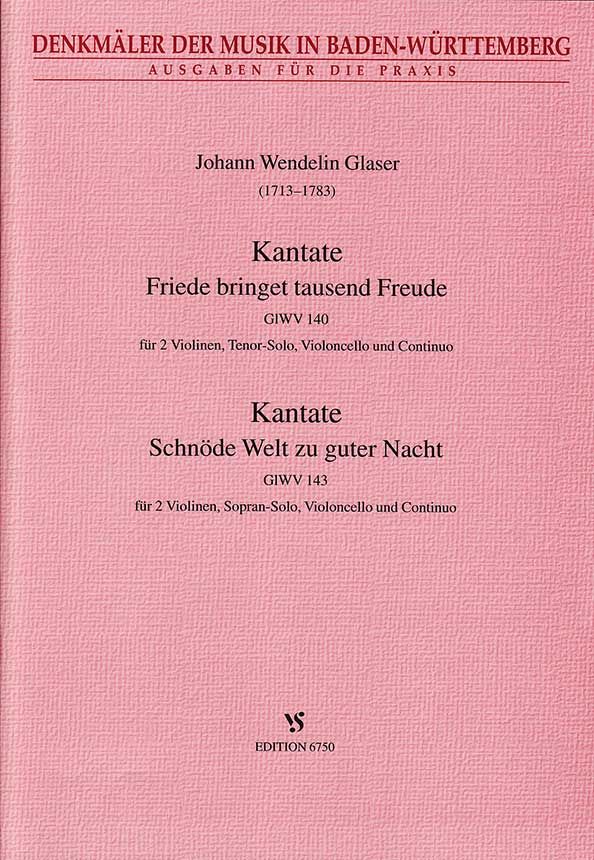
Friede bringet tausend Freude, Schnöde Welt zu guter Nacht
PDF
view
Wendelin Gläser
2 Kantaten
Friede bringet tausend Freude, Schnöde Welt zu guter Nacht
- Composer Wendelin Gläser
- Editor Andreas Traub
- Edition Score and Parts
- Publisher Strube Verlag
- Order no. STRUBE6750
 ships within 4-8 working days
incl. tax,
excl. shipping costs
Not available in all countries. Learn more
Description:
Monuments of music in Baden-Württemberg, practical editions. Cantata "Friede bringet tausend Freude" and cantata "Schnöde Welt zu guter Nacht". Edited by Andreas Traub.
The practical edition contains two cantatas: "Friede bringet tausend Freude" (GlWV 140) for 2 violins, tenor solo, violoncello and continuo and "Schnöde Welt zu guter Nacht" (GlWV 143) for 2 violins, soprano solo, violoncello and continuo. The score is accompanied by the parts for violin I, violin II, violoncello and continuo.
Johann Wendelin Glaser (1713-1783) came from Ostheim vor der Rhön and worked as a schoolmaster, organist and cantor in Wertheim am Main from 1744. He left behind almost 300 cantatas, the autograph scores of which he - or his widow after his death - hid behind the organ of Wertheim's town church, where they were discovered in 1910. The two cantatas presented here for the feasts of the Apostles Thomas (No. 140) and Matthew (No. 143) are composed for a solo part, two solo violins and basso continuo, performed by cello and harpsichord or organ. The solo voice is the tenor in the first cantata and the soprano in the second. However, it is possible to swap them; Glaser himself occasionally made such exchanges, as the surviving performance material shows, and both cantatas are published critically in volume 6 of Denkmäler der Musik in Baden-Württemberg (Strube Edition 9104, pp. 146 and 160). The original notation and spelling are documented there, and the Practical Edition offers a supplement or clarification in two places. No. 140, 1st Aria, m. 8: The loss in violin I should be added in comparison with m. 29. No. 143, 1st Aria, mm. 1, 6 and 27: The unclear source in the bass in the second half of the bar is standardized as a sequence of notes D sharp B flat.
The practical edition contains two cantatas: "Friede bringet tausend Freude" (GlWV 140) for 2 violins, tenor solo, violoncello and continuo and "Schnöde Welt zu guter Nacht" (GlWV 143) for 2 violins, soprano solo, violoncello and continuo. The score is accompanied by the parts for violin I, violin II, violoncello and continuo.
Johann Wendelin Glaser (1713-1783) came from Ostheim vor der Rhön and worked as a schoolmaster, organist and cantor in Wertheim am Main from 1744. He left behind almost 300 cantatas, the autograph scores of which he - or his widow after his death - hid behind the organ of Wertheim's town church, where they were discovered in 1910. The two cantatas presented here for the feasts of the Apostles Thomas (No. 140) and Matthew (No. 143) are composed for a solo part, two solo violins and basso continuo, performed by cello and harpsichord or organ. The solo voice is the tenor in the first cantata and the soprano in the second. However, it is possible to swap them; Glaser himself occasionally made such exchanges, as the surviving performance material shows, and both cantatas are published critically in volume 6 of Denkmäler der Musik in Baden-Württemberg (Strube Edition 9104, pp. 146 and 160). The original notation and spelling are documented there, and the Practical Edition offers a supplement or clarification in two places. No. 140, 1st Aria, m. 8: The loss in violin I should be added in comparison with m. 29. No. 143, 1st Aria, mm. 1, 6 and 27: The unclear source in the bass in the second half of the bar is standardized as a sequence of notes D sharp B flat.