
Uri Rom, Antonio Vivaldi, Carlo Tessarini
Concerto L'Olimpiade in C major for oboe, strings and continuo
Quasi-Pasticcio after Antonio Vivaldi & Carlo Tessarini
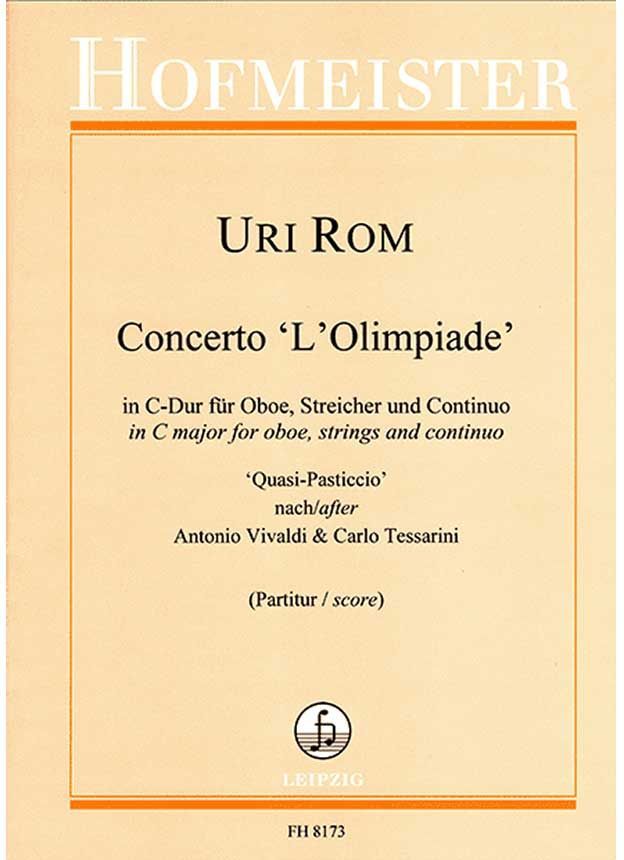
Uri Rom, Antonio Vivaldi, Carlo Tessarini
Concerto L'Olimpiade in C major for oboe, strings and continuo
Quasi-Pasticcio after Antonio Vivaldi & Carlo Tessarini
- Instrumentation Oboe, Strings and Continuo
- Composer Uri Rom Antonio Vivaldi Carlo Tessarini
-
Difficulty Level
- Edition Score
- Publisher Friedrich Hofmeister Musikverlag
- Order no. FH8173
 ships within 2-4 weeks

Description:
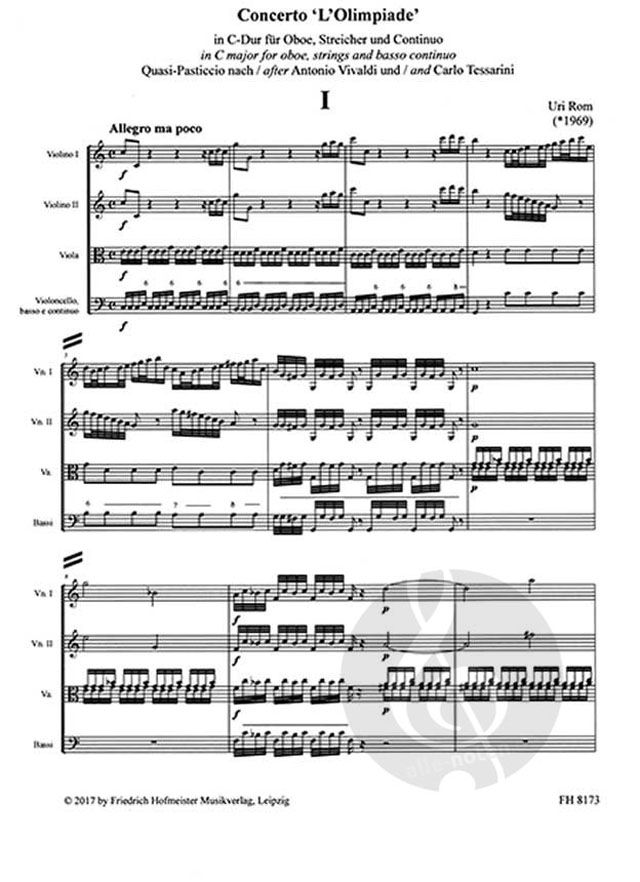
Is it even possible to write "baroque" today - i.e. more than 200 years after the actual stylistic epoch? Insofar as such stylistic imitations are faced with the challenge of creating their own musical-logical context, the answer must be that an exact stylistic copy - be it of a musical epoch or of a historical composer personality - remains virtually impossible.
This oboe concerto therefore refrains from being a hypothetical reconstruction of what could have come from the pen of an Italian composer around 1730.
Rather, the work enters into a dialog with a series of high baroque masters - above all Antonio Vivaldi (1678- 1741) - in order to find a style that is definitely connected to the high baroque, but does not copy it.
This dialog character is present in all three movements of the concerto - each in a different way.
In terms of performance practice, this oboe concerto is a baroque work. In addition to the usual string instruments, the basso continuo section should include at least one harmony instrument, whereby a combination of keyboard and plucked instruments is particularly recommended. The addition of a bassoon in the outer movements is also recommended.
Performance material available on loan - please contact the publisher directly.
This oboe concerto therefore refrains from being a hypothetical reconstruction of what could have come from the pen of an Italian composer around 1730.
Rather, the work enters into a dialog with a series of high baroque masters - above all Antonio Vivaldi (1678- 1741) - in order to find a style that is definitely connected to the high baroque, but does not copy it.
This dialog character is present in all three movements of the concerto - each in a different way.
In terms of performance practice, this oboe concerto is a baroque work. In addition to the usual string instruments, the basso continuo section should include at least one harmony instrument, whereby a combination of keyboard and plucked instruments is particularly recommended. The addition of a bassoon in the outer movements is also recommended.
Performance material available on loan - please contact the publisher directly.