
Marie Jaëll
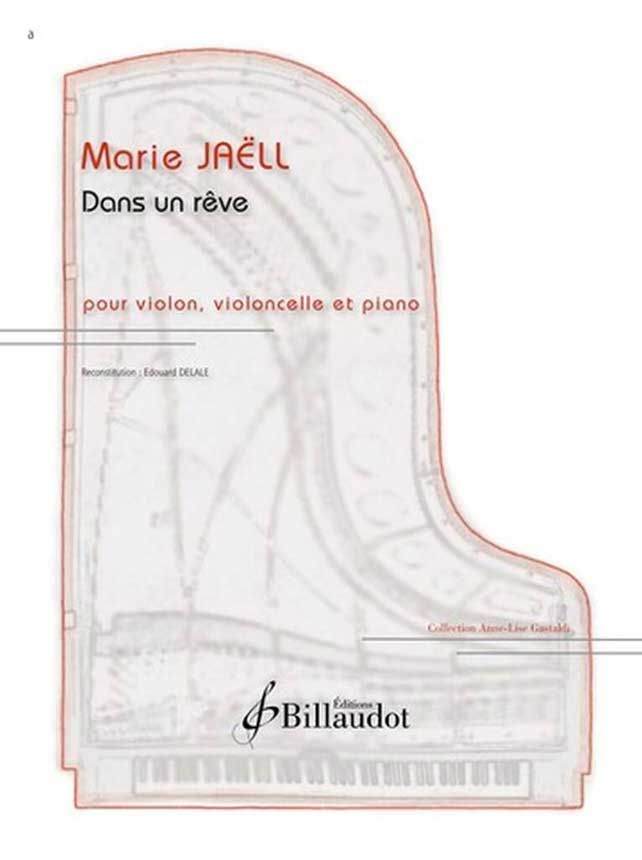
Dans Un Reve
for violin, cello and piano
PDF
view
Marie Jaëll
Dans Un Reve
for violin, cello and piano
- Instrumentation Violin, Cello and Piano
- Composer Marie Jaëll
- Edition Set of Parts
- Publisher Gerard Billaudot
- Order no. BILL10529
 ships within 4-8 working days
incl. tax,
excl. shipping costs
Not available in all countries. Learn more

Description:
Marie Jaëll (1846-1925), French pianist and composer, admired by Saint-Saëns and Liszt, had attracted the attention of Anne-Lise Gastaldi, pianist of the George Sand trio, who discovered in the catalogue of the Jaëll collection of the Bibliothèque Nationale et Universitaire (BNU) in Strasbourg the existence of a piano trio entitled Dans un rêve, composed in 1881, but not published.
The work is in three movements. The manuscripts present different versions of certain passages, witnesses to the evolution of the composer's thought. As two examples of facsimiles attached to the score prove, some pages are copied cleanly while others seem to be only drafts. The separate parts have the same characteristics as the driver, with passages crossed out and corrected.
Accompanied by Édouard Delale, they tried, by listening to the musical result, by studying the calligraphy of the different passages and the questions of coherence between the different conductors and separate parts, to determine what was certainly a draft abandoned later on what could be the final version.
The present score is therefore not a scientific edition but a reconstruction presenting the version that seemed to us the most accurate and coherent after having cross-checked all the documents we had in our possession.
This trio with an enigmatic title and on which the composer spent time is not a major work of her production, but it invites us to immerse ourselves in her research, in the dreamlike universe she loved and in her time. Listening to the score reinforced our idea that it represented a real interest and fully deserved to be played in public and published.
The work is in three movements. The manuscripts present different versions of certain passages, witnesses to the evolution of the composer's thought. As two examples of facsimiles attached to the score prove, some pages are copied cleanly while others seem to be only drafts. The separate parts have the same characteristics as the driver, with passages crossed out and corrected.
Accompanied by Édouard Delale, they tried, by listening to the musical result, by studying the calligraphy of the different passages and the questions of coherence between the different conductors and separate parts, to determine what was certainly a draft abandoned later on what could be the final version.
The present score is therefore not a scientific edition but a reconstruction presenting the version that seemed to us the most accurate and coherent after having cross-checked all the documents we had in our possession.
This trio with an enigmatic title and on which the composer spent time is not a major work of her production, but it invites us to immerse ourselves in her research, in the dreamlike universe she loved and in her time. Listening to the score reinforced our idea that it represented a real interest and fully deserved to be played in public and published.
Customers rated this product:
Manufacturer Information:
Gérard Billaudot Éditeur, S.A.S.
14, rue de l’Échiquier
75010
Paris
Deutschland
Other customers also bought:

- String Orchestra
- Score and Parts
-
in stock
ships within 1-2 working days

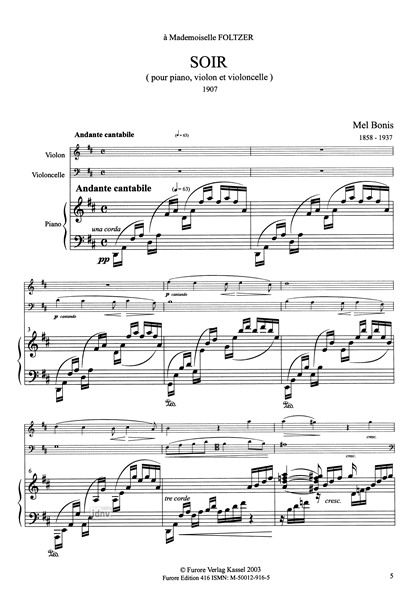
Mel Bonis
- Violin, Cello and Piano
- Score and Parts
-
in stock
ships within 1-2 working days
Marie Jaëll
- Piano and Voice
- Sheet Music
-
ships within 3-6 working days
Marie Jaëll
- Piano and Voice
- Sheet Music
-
ships within 3-6 working days