
Johann Sebastian Bach
Day of reck'ning! Judgment Day BWV 168
Cantata for the 9th Sunday after Trinity (Vocal Score)

Johann Sebastian Bach
Day of reck'ning! Judgment Day BWV 168
Cantata for the 9th Sunday after Trinity (Vocal Score)
- Instrumentation 4 Soloists (SATB), Mixed Choir (SATB), 2 Oboes d'Amore, 2 Violins, Viola and Continuo
- Edition Piano Reduction (Urtext)
- Composer Johann Sebastian Bach
- Publisher Carus-Verlag
- Editor Ulrich Bartels
- Lyricist Salomon Franck Henry S. Drinker
- Order no. CV31168-03
incl. tax,
excl. shipping costs
 ships within 2-5 working days

Description:
For soli (SATB), choir (SATB) 2 oboes d'amore, 2 violins, viola and basso continuo.
The text of Bach's cantata 'Tue Rechnung! Donnerwort' was published in 1715, that is during Bach's Weimar period, in the 'Evangelisches Andachts-Opffer' by Salomon Frank. This concisely-written but powerful work was, however, only composed ten years later in Leipzig, and was heard for the first time on 29 July 1725, the 9th Sunday after Trinity.
Its main dramatic-musical emphasis lies clearly in the first movement, a dark, almost operatic movement for baritone and string orchestra in B minor. By contrast, the ensuing aria for tenor with obbligato oboe accompaniment is distinctly more intimate, and the duet between soprano and alto - just accompanied by continuo - is more restrained in its musical language and expression than the first movement. In between there are two extended recitatives, the first of which leads into an arioso.
The breadth of expression within the cantata is striking, its opening movement a masterpiece of Bach's dramatic writing.
-
Tue Rechnung! Donnerwort Day of reck'ning! Judgment Day
-
Es ist nur fremdes Gut This life is not my own
-
Kapital und Interessen Principal and interest also
-
Jedoch, erschrocknes Herz Take heart and tremble not
-
Herz, zerreiß des Mammons Ketten Heart, break free of Mammons's shackles
-
Stärk mich mit deinem Freudengeist By your atonement make me strong
Customers rated this product:
Carus-Verlag GmbH & Co. KG
Sielminger Str. 51
70771
Leinfelden-Echterdingen
Deutschland
Sheet music shipping since 1969

Since 1969, over 500,000 customers have trusted us. With a huge selection of over 1,000,000 sheet music titles, we are one of the largest providers in Europe. Thanks to our large stock we can often ship sheet music within 24 hours. No matter what sheet music you are looking for: you are in the right place!
Yours, Stefanie Reichert
Head of Customer Service
Other customers also bought:

Johann Sebastian Bach
Kantate BWV 157 für eine Trauerfeier bzw. zum Fest Mariae Reinigung
- Soloists, Mixed Choir (SATB) and Chamber Orchestra
- Piano Reduction
-
ships within 2-5 working days
- Also available for download!

- Soloists, Mixed Choir (SATB) and Chamber Orchestra
- Piano Reduction
-
in stock
|
ships within 1-2 working days

Johann Sebastian Bach
Kantate BWV 99 zum 15. Sonntag nach Trinitatis
- Soloists, Mixed Choir (SATB) and Chamber Orchestra
- Piano Reduction
-
in stock
|
ships within 1-2 working days
- Also available for download!

Johann Sebastian Bach
Kantate BWV 113 zum 11. Sonntag nach Trinitatis
- Soloists, Mixed Choir (SATB) and Chamber Orchestra
- Piano Reduction
-
in stock
|
ships within 1-2 working days

- Soloists, Mixed Choir (SATB) and Chamber Orchestra
- Piano Reduction
-
in stock
|
ships within 1-2 working days
- Also available for download!

- Soloists, Mixed Choir (SATB) and Chamber Orchestra
- Piano Reduction
-
ships within 2-5 working days
- Also available for download!

- Soloists (SAB), Mixed Choir (SATB), 2 Oboes, 2 Violins, Viola and Continuo
- Piano Reduction (Urtext)
-
ships within 2-5 working days
- Also available for download!

Johann Sebastian Bach
Kantate BWV 177 zum 4. Sonntag nach Trinitatis
- Soloists, Mixed Choir (SATB) and Ensemble
- Piano Reduction
-
ships within 2-5 working days
- Also available for download!

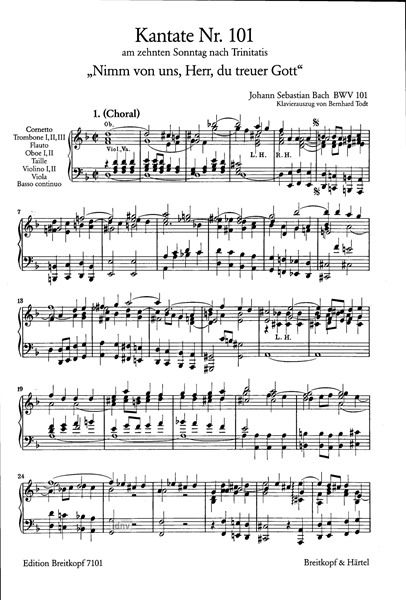

Johann Sebastian Bach
Kantate BWV 77 zum 13. Sonntag nach Trinitatis
- Soloists, Mixed Choir (SATB) and Chamber Orchestra
- Piano Reduction
-
in stock
|
ships within 1-2 working days
- Also available for download!

Johann Sebastian Bach
Kantate BWV 178 zum 8. Sonntag nach Trinitatis
- Soloists, Mixed Choir (SATB) and Chamber Orchestra
- Piano Reduction
-
ships within 2-5 working days
- Also available for download!

- Soloists, Mixed Choir (SATB) and Chamber Orchestra
- Piano Reduction
-
ships within 2-5 working days
- Also available for download!