
Hans Winterberg
Dort und hier
Zyklus nach Franz Werfel für Violine, Violoncello, Klavier und Gesang
Video
view
PDF
view
Hans Winterberg
Dort und hier
Zyklus nach Franz Werfel für Violine, Violoncello, Klavier und Gesang
- Instrumentation Voice, Violin, Cello and Piano
- Composer Hans Winterberg
-
Difficulty Level
- Edition Piano Score and Part(s)
- Publisher Bote & Bock
- Order no. BB3917
 in stock
ships within 1-2 working days
incl. tax,
excl. shipping costs
Not available in all countries. Learn more

Description:
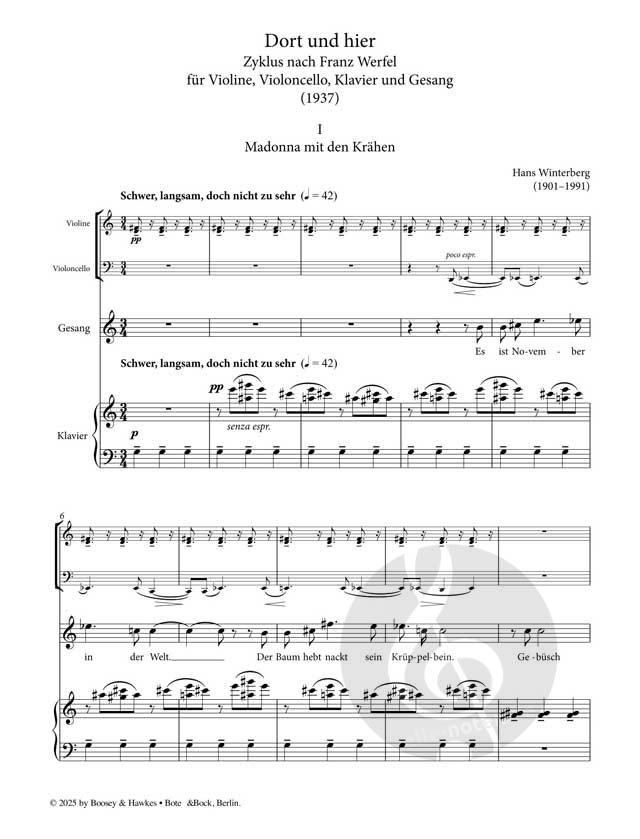
Hans Winterberg, born in Prague in 1901, belonged to the assimilated Jewish bourgeoisie of Prague, which was part of the Austro-Hungarian Empire until 1918. Until 1918, Prague was part of the Austro-Hungarian Monarchy, a cultural metropolis in which German was spoken until the middle of the 19th century. The Prague writers Kafka, Rilke and Werfel published in German. And Winterberg, who lived just a few meters from the Café Arco, the meeting place of Prague's literary avant-garde, was – primarily – German-speaking. Winterberg's literary fixed star was Franz Werfel. He dedicated several cycles to him, with Dort und Hier marking a highlight not only among his own song settings – it is a masterpiece of the genre of vocal music with ensemble accompaniment, comparable to the Chansons madécasses by Ravel, written 10 years earlier with similar instrumentation. Winterberg chose four poems by Werfel from different publications and cleverly wove them into a cycle that deals with things of this world and the hereafter in surprising images. Winterberg finds congenial musical correspondences to Werfel's lyrical expressionist tone, which is interwoven with a subtle, surreal-ironic note that is so typical of Czech modernism in the interwar period.