
Matthias Drude
Dreiklang
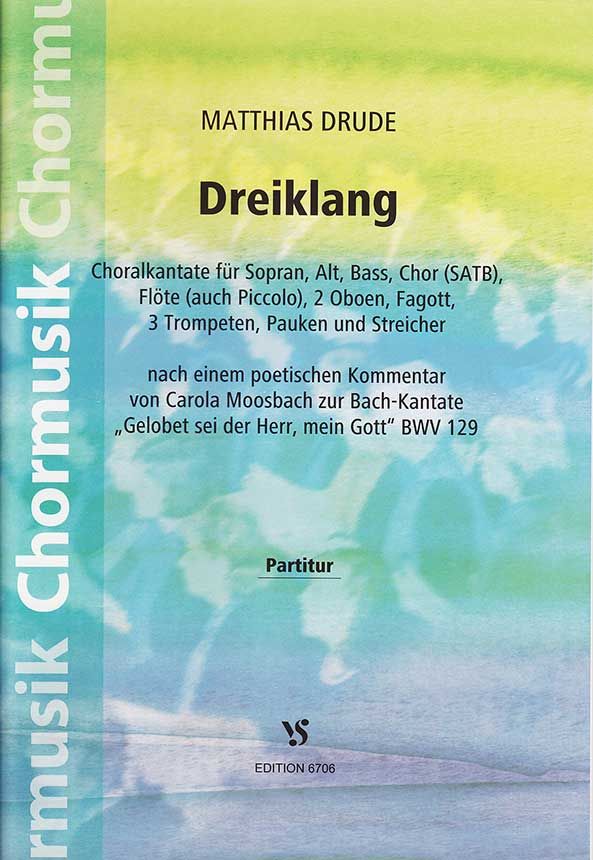
Choralkantate für Sopran, Alt, Bass, Chor (SATB), Flöte (auch Piccolo), 2 Oboen, Fagott, 3 Trompeten, Pauken und Streicher
PDF
view
Matthias Drude
Dreiklang
Choralkantate für Sopran, Alt, Bass, Chor (SATB), Flöte (auch Piccolo), 2 Oboen, Fagott, 3 Trompeten, Pauken und Streicher
- Composer Matthias Drude
- Edition Instrumental Part: Oboe 2
- Publisher Strube Verlag
- Order no. STRUBE6706-04
 ships within 4-8 working days
incl. tax,
excl. shipping costs
Not available in all countries. Learn more
Description:
Dreiklang is the title of Carola Moosbach's poetic commentary on Johann Sebastian Bach's Trinitatis cantata "Gelobet sei der Herr, mein Gott" BWV 129. In her three verses, each beginning with "Praised be", the Cologne-based author follows the bar form typical of Baroque song poetry, which is also the basis of the choral text by Johann Olearius set to music by Bach. Three poetic variations are added to the traditional names of the Trinity (Father, Son and Holy Spirit). As a triad, Life, Stranger and Silence allude to the one God, for whom all names are always too small.
The Dresden composer Matthias Drude composed a new melody especially for this five-minute choral cantata (see p. 23), which is used - with certain changes and in different keys - in all three verses. However, the verses are not separated by movement endings, but are connected by transitional orchestral interludes. While Bach's cantata dramaturgically follows an inverted arch form ("U-form") - with the dynamic climaxes in the outer movements - Drude's setting is more akin to the concept of a continuous decrescendo in line with the text (from "life" to "silence"): The beginning is loudest, the end fades away in pianissimo. The tempi also become increasingly calmer. There are no direct Bach quotations. However, a rather abstract reference to the Bach cantata results from the order of the vocal parts. As with Bach, the choir sings the first and last verses. The middle verse is divided between the three solo parts - bass, soprano and alto - in the same sequence as Bach intended for his three separate middle movements (arias). However, Bach's arch form is also realized through a reminiscence of the trumpet motif from the beginning, which is to be heard in the final bars "from afar", i.e. with musicians positioned further away. (Carola Moosbach and Matthias Drude)
The Dresden composer Matthias Drude composed a new melody especially for this five-minute choral cantata (see p. 23), which is used - with certain changes and in different keys - in all three verses. However, the verses are not separated by movement endings, but are connected by transitional orchestral interludes. While Bach's cantata dramaturgically follows an inverted arch form ("U-form") - with the dynamic climaxes in the outer movements - Drude's setting is more akin to the concept of a continuous decrescendo in line with the text (from "life" to "silence"): The beginning is loudest, the end fades away in pianissimo. The tempi also become increasingly calmer. There are no direct Bach quotations. However, a rather abstract reference to the Bach cantata results from the order of the vocal parts. As with Bach, the choir sings the first and last verses. The middle verse is divided between the three solo parts - bass, soprano and alto - in the same sequence as Bach intended for his three separate middle movements (arias). However, Bach's arch form is also realized through a reminiscence of the trumpet motif from the beginning, which is to be heard in the final bars "from afar", i.e. with musicians positioned further away. (Carola Moosbach and Matthias Drude)