
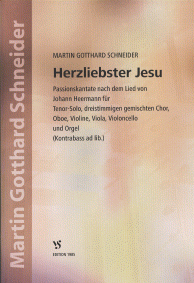
Martin Gotthard Schneider
Herzliebster Jesu
Passionskantate nach dem Lied von Johann Heermann für Tenor-Solo, 3st. gem. Chor, Oboe, Violine, Viola, Violoncello und Orgel (Kontrabass ad lib.)
Martin Gotthard Schneider
Herzliebster Jesu
Passionskantate nach dem Lied von Johann Heermann für Tenor-Solo, 3st. gem. Chor, Oboe, Violine, Viola, Violoncello und Orgel (Kontrabass ad lib.)
- Instrumentation High Voice, Mixed Choir (3-Part), Oboe, Violin, Viola, Cello and Organ
- Optional Instrumentation High Voice, Mixed Choir (3-Part), Oboe, Violin, Viola, Cello, Organ and Double Bass
- Composer Martin Gotthard Schneider
-
Difficulty Level
- Edition Set of Parts
- Publisher Strube Verlag
- Order no. STRUBE1985-02
 ships within 4-8 working days
incl. tax,
excl. shipping costs
Not available in all countries. Learn more

Description:
Edition: instrumental parts.
Divided into a prelude and nine verses (verses 1-8 and 11 of the chorale are set to music), Martin Gotthard Schneider develops a cantata that is extremely compelling and direct in the urgency of its message. He sets each verse in its own musical style, not only varying the instrumentation, but also analyzing the cantus firmus in order to change it, adapt it to the message of the text and comment on it musically. The result is a work that is highly expressive despite (or perhaps because of) the low demands on the performers, as this choral cantata captivates the listener through the urgency of the interpretation. "The choral writing is very vocal in its harmonies and sounds good. Despite the small instrumentation, Schneider succeeds in speaking a very colorful, tonally varied language." (Musik und Gottesdienst, 4/2005)
Divided into a prelude and nine verses (verses 1-8 and 11 of the chorale are set to music), Martin Gotthard Schneider develops a cantata that is extremely compelling and direct in the urgency of its message. He sets each verse in its own musical style, not only varying the instrumentation, but also analyzing the cantus firmus in order to change it, adapt it to the message of the text and comment on it musically. The result is a work that is highly expressive despite (or perhaps because of) the low demands on the performers, as this choral cantata captivates the listener through the urgency of the interpretation. "The choral writing is very vocal in its harmonies and sounds good. Despite the small instrumentation, Schneider succeeds in speaking a very colorful, tonally varied language." (Musik und Gottesdienst, 4/2005)