
Hannes Pohlit
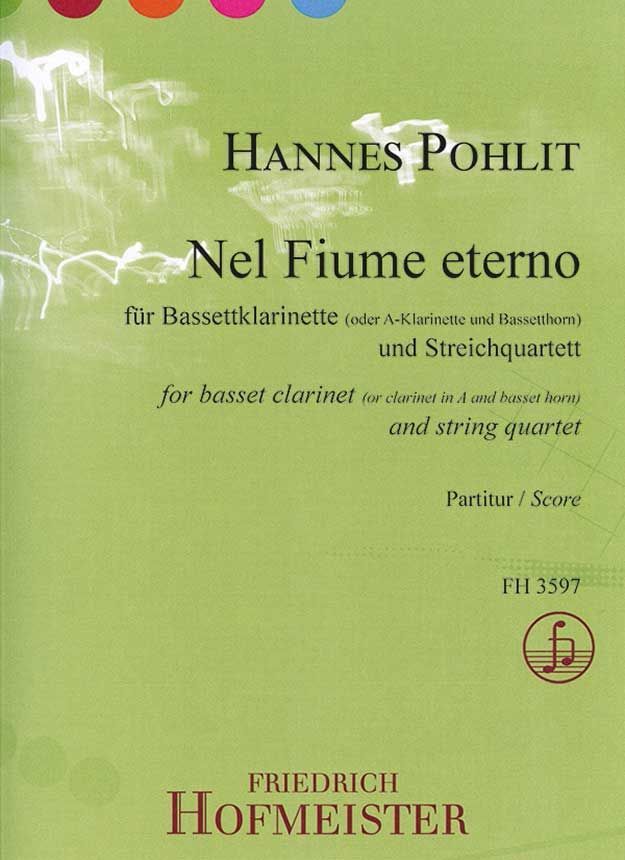
Nel Fiume Eterno
for basset clarinet and string quartet
Video
1
view
Video
2
view
Video
3
view
Hannes Pohlit
Nel Fiume Eterno
for basset clarinet and string quartet
- Instrumentation Bass Clarinet, 2 Violins, Viola and Cello
- Composer Hannes Pohlit
-
Difficulty Level
- Edition Score
- Publisher Friedrich Hofmeister Musikverlag
- Order no. FH3597
 ships within 2-4 working days
incl. tax,
excl. shipping costs
Not available in all countries. Learn more

Description:
Nel Fiume eterno - time drifts forward in an eternal river, sometimes in invigorating currents, sometimes so slowly that it no longer seems to exist. In this little symphony for clarinet quintet about life, death and rebirth, the traditional Mozart instrumentation is expanded in that the main instrument is the basset clarinet: an A clarinet with an extended range up to a resounding capital A.
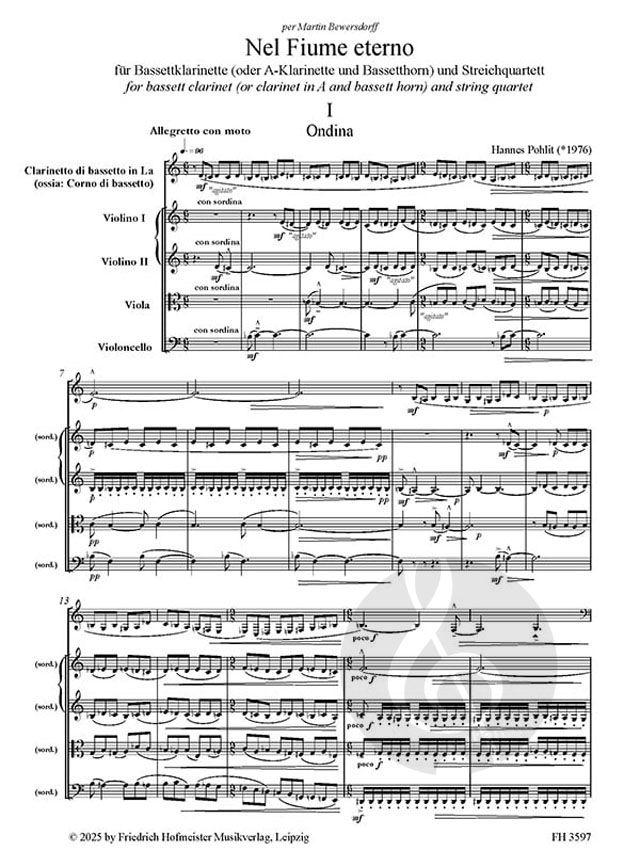
The first movement is dedicated to the water fairy Undine, a fantastic natural creature that can appear with animal fins and tentacles as well as in human form, in which it is capable of seductively wooing song. Undine's movements are taken up by the water element (represented by the string quartet) and continue as a stream until they encompass the space from the bottom to the water level and become a fountain.
The second movement ("The Invisible Stream") leads into the deep immersion of the dream, in which the river - suspended between movement and weightlessness - has become slow and shapeless. Motivic figures blur into a purely vegetative swelling and subsiding and gather in a single tone, from which a fleeting, shadowy polyphony emerges. The unification of the voices into tremolo chords leads to the "awakening", which allows the indistinct motifs to be summed up in a song of mourning and farewell.
The poetic setting of the third movement ("Butterfly") is based on a scene from a traditional Cantonese opera: according to ancient belief, the soul of a deceased person appears as a butterfly in the night. Carried by the vibrating air of a summer night garden, it flutters - still gray and almost invisible - and begins to make cautious circles, while the air responds with a warm hum. This dialogue becomes livelier and more cheerful and the butterfly - now brightly colored - dives into the water, transforms back into a water fairy and lets the stream bubble up. Undine's song becomes a redemptive final hymn, everything dissolves into elemental waves and pulses and the whole spook dissipates.
The solo part can also be played with the normal A clarinet alternating with basset horn. The ossia indications in the score and an additional part excerpt serve this purpose.
The first movement is dedicated to the water fairy Undine, a fantastic natural creature that can appear with animal fins and tentacles as well as in human form, in which it is capable of seductively wooing song. Undine's movements are taken up by the water element (represented by the string quartet) and continue as a stream until they encompass the space from the bottom to the water level and become a fountain.
The second movement ("The Invisible Stream") leads into the deep immersion of the dream, in which the river - suspended between movement and weightlessness - has become slow and shapeless. Motivic figures blur into a purely vegetative swelling and subsiding and gather in a single tone, from which a fleeting, shadowy polyphony emerges. The unification of the voices into tremolo chords leads to the "awakening", which allows the indistinct motifs to be summed up in a song of mourning and farewell.
The poetic setting of the third movement ("Butterfly") is based on a scene from a traditional Cantonese opera: according to ancient belief, the soul of a deceased person appears as a butterfly in the night. Carried by the vibrating air of a summer night garden, it flutters - still gray and almost invisible - and begins to make cautious circles, while the air responds with a warm hum. This dialogue becomes livelier and more cheerful and the butterfly - now brightly colored - dives into the water, transforms back into a water fairy and lets the stream bubble up. Undine's song becomes a redemptive final hymn, everything dissolves into elemental waves and pulses and the whole spook dissipates.
The solo part can also be played with the normal A clarinet alternating with basset horn. The ossia indications in the score and an additional part excerpt serve this purpose.