
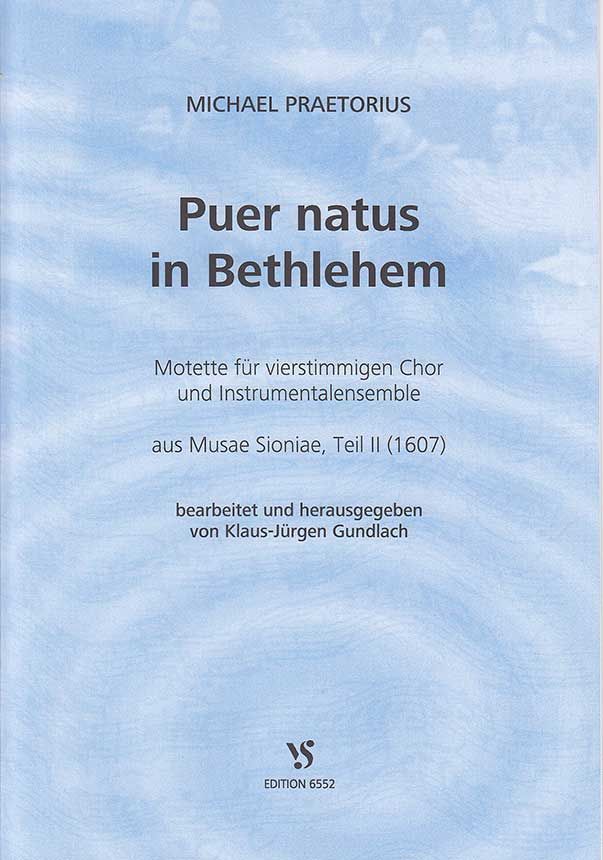
Michael Praetorius
Puer natus in Bethlehem
Motette für vierstimmigen Chor und Instrumentalensemble. Aus Musae Sioniae, Teil II (1607)
PDF
view
Michael Praetorius
Puer natus in Bethlehem
Motette für vierstimmigen Chor und Instrumentalensemble. Aus Musae Sioniae, Teil II (1607)
- Instrumentation Choir (4-Part) and Ensemble
- Composer Michael Praetorius
- Edition Score and Parts
- Publisher Strube Verlag
- Order no. STRUBE6552
 ships within 4-8 working days
incl. tax,
excl. shipping costs
Not available in all countries. Learn more

Description:
There is no doubt that Michael Praetorius, alongside Heinrich Schütz, Samuel Scheidt and Johann Hermann Schein, is one of the most important musicians of 17th century Protestant church music. Firmly anchored in the church music of the Reformation period and very open to the new musical developments of the 17th century, his work set the trend for the development of Protestant church music in the 17th century. In the further development of the motet form, the tonal unfolding of choirs in various vocal and instrumental formations and the processing of Italian influences, Praetorius developed a new dimension of sonorous music that incorporated the church space. Although a complete edition of the works of Michael Praetorius was published between 1928 and 1960 under the direction of Friedrich Blume, his compositions, apart from a few very well-known choral movements, tend to play a subordinate role in church music practice.
In his theoretical writings, the composer explains his intentions. The term "Kantoreipraxis" describes the arrangement of a composition to given conditions. This practice can be read in detail in "Syntagma musicum", the important theoretical work by Michael Praetorius. This arrangement of the double-choir motet "Puer natus in Bethlehem" is intended to make the composition suitable for performances in modest circumstances where an eight-part choir is not available. The suggested scoring with strings is by no means binding. It can also be performed by a recorder quartet or other wind instruments. A violone (double bass) in the basso continuo is desirable, but can also be realized with a 16-foot registration of the organ. The realization of the continuo is by the editor. The truncated word endings in the "Halleluja" ("Hal-Ie.") are rudiments of the medieval Hoquetus and are reproduced in the original. I would like to thank the Bibliotheque Royale de Belgique for permission to publish this work.
Dr. Klaus-Jürgen Gundlach Templin, June 2009 Performance time: approx. 6 min.
In his theoretical writings, the composer explains his intentions. The term "Kantoreipraxis" describes the arrangement of a composition to given conditions. This practice can be read in detail in "Syntagma musicum", the important theoretical work by Michael Praetorius. This arrangement of the double-choir motet "Puer natus in Bethlehem" is intended to make the composition suitable for performances in modest circumstances where an eight-part choir is not available. The suggested scoring with strings is by no means binding. It can also be performed by a recorder quartet or other wind instruments. A violone (double bass) in the basso continuo is desirable, but can also be realized with a 16-foot registration of the organ. The realization of the continuo is by the editor. The truncated word endings in the "Halleluja" ("Hal-Ie.") are rudiments of the medieval Hoquetus and are reproduced in the original. I would like to thank the Bibliotheque Royale de Belgique for permission to publish this work.
Dr. Klaus-Jürgen Gundlach Templin, June 2009 Performance time: approx. 6 min.