
Camilla Frydan, Clara Schumann, Dora Pejačević, Teresa Carreño
Salonmusik
für 2 Violinen, Violoncello, Kontrabass und Klavier
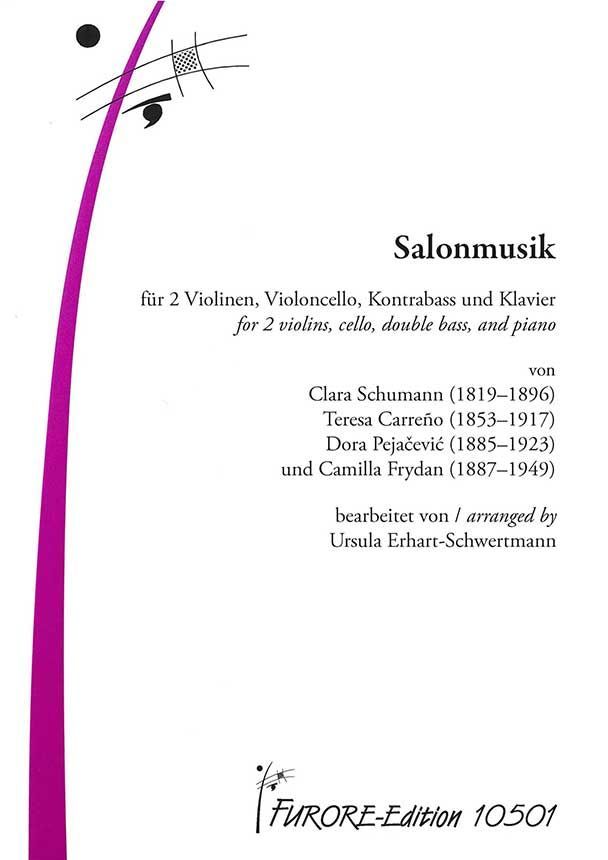
Camilla Frydan, Clara Schumann, Dora Pejačević, Teresa Carreño
Salonmusik
für 2 Violinen, Violoncello, Kontrabass und Klavier
- Instrumentation 2 Violins, Cello, Double Bass and Piano
- Composer Camilla Frydan Clara Schumann Dora Pejačević Teresa Carreño
- Editor Ursula Erhart-Schwertmann
- Edition Score and Parts
- Publisher Furore Verlag
- Order no. FUR10501
 ships within 4-8 working days
incl. tax,
excl. shipping costs
Not available in all countries. Learn more

Description:
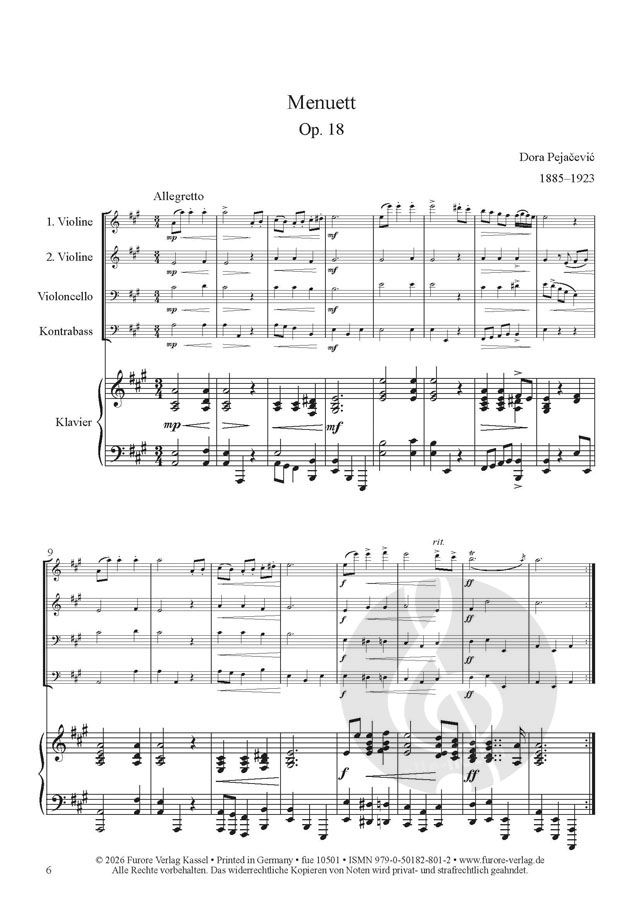
This collection of arrangements showcases the diversity of the salon music genre—ranging from Clara Schumann's "classically" conceived dances to Camilla Frydan's "Walzerlied," which falls within the realm of the chanson. The instrumentation of a string ensemble with piano allows for tonal variety through shifting solo parts, thereby showcasing this diversity.
Today, the term "salon music" is understood to mean light, not entirely serious music that has acquired a negative connotation. At the time of its origin, the meaning was different: it referred to music played in salons and not intended for large concert stages. These are primarily character pieces for piano or songs—short, easily accessible works. Women were always present in the salons—as hostesses, so-called "salonières," as performers, and also as composers. The selection of arrangements in this booklet is intended to showcase the diversity of this genre—ranging from "classically" conceived dances by Clara Schumann to Camilla Frydan's "Walzerlied," which falls within the realm of the chanson. The instrumentation of a string ensemble with piano makes it possible to achieve tonal variety through alternating solo parts and to showcase this diversity.
Today, the term "salon music" is understood to mean light, not entirely serious music that has acquired a negative connotation. At the time of its origin, the meaning was different: it referred to music played in salons and not intended for large concert stages. These are primarily character pieces for piano or songs—short, easily accessible works. Women were always present in the salons—as hostesses, so-called "salonières," as performers, and also as composers. The selection of arrangements in this booklet is intended to showcase the diversity of this genre—ranging from "classically" conceived dances by Clara Schumann to Camilla Frydan's "Walzerlied," which falls within the realm of the chanson. The instrumentation of a string ensemble with piano makes it possible to achieve tonal variety through alternating solo parts and to showcase this diversity.