
Wolfgang Amadeus Mozart
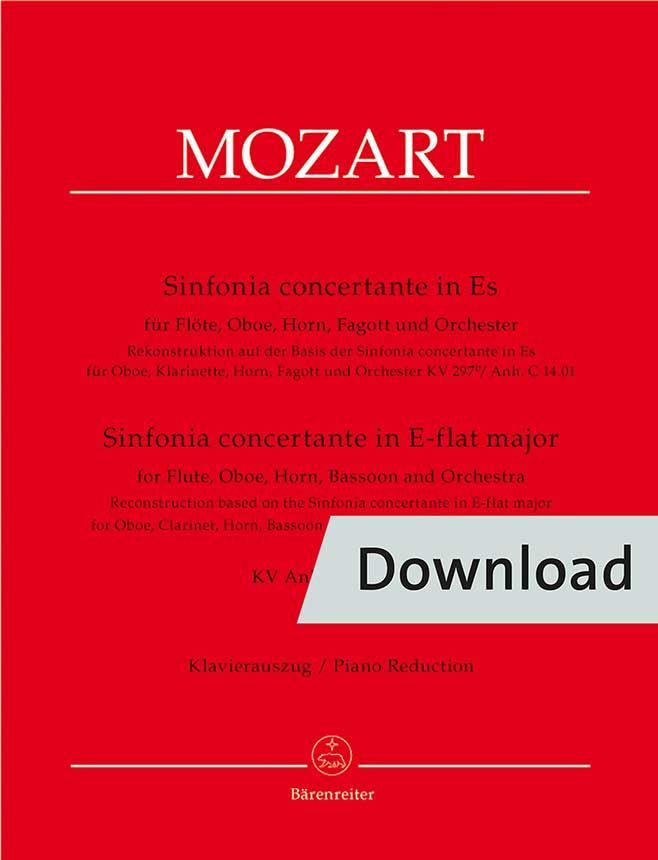
Sinfonia concertante KV Anh I/9 (297b)
for flute, oboe, horn, bassoon and orchestra - edition for solo parts and piano reduction

PDF
view
Wolfgang Amadeus Mozart
Sinfonia concertante KV Anh I/9 (297b)
for flute, oboe, horn, bassoon and orchestra - edition for solo parts and piano reduction
- Instrumentation Flute, Oboe, Horn, Bassoon and Piano
- Composer Wolfgang Amadeus Mozart
- Editor Robert D. Levin Michael Töpel
-
Difficulty Level
- Edition Piano reduction with part(s) Download
- Publisher Bärenreiter Verlag
- Order no. BA7137-90-DL
 immediately available
Download immediately after ordering
incl. tax,
excl. shipping costs
Not available in all countries. Learn more

Description:
We know from letters to his father that Mozart wrote a Sinfonia concertante for flute, oboe, horn, bassoon and orchestra during his stay in Paris in 1778 for a quartet of wind soloists who were also present there - Mozart's autograph was lost and the work has disappeared.
In the 19th century, a copy of a Sinfonia concertante in E flat for oboe, clarinet, horn, bassoon and orchestra emerged. In the 19th century, a copy of a Sinfonia concertante in E flat for oboe, clarinet, horn, bassoon and orchestra emerged, for which Mozart's authorship was claimed and which - despite the different instrumentation of the wind quartet - was associated with the Sinfonia concertante, which was believed to be lost. The work was long regarded as genuine, but for around 25 years doubts have been vehemently raised about its authenticity, not only with regard to the scoring of the solo quartet but also the orchestral parts.
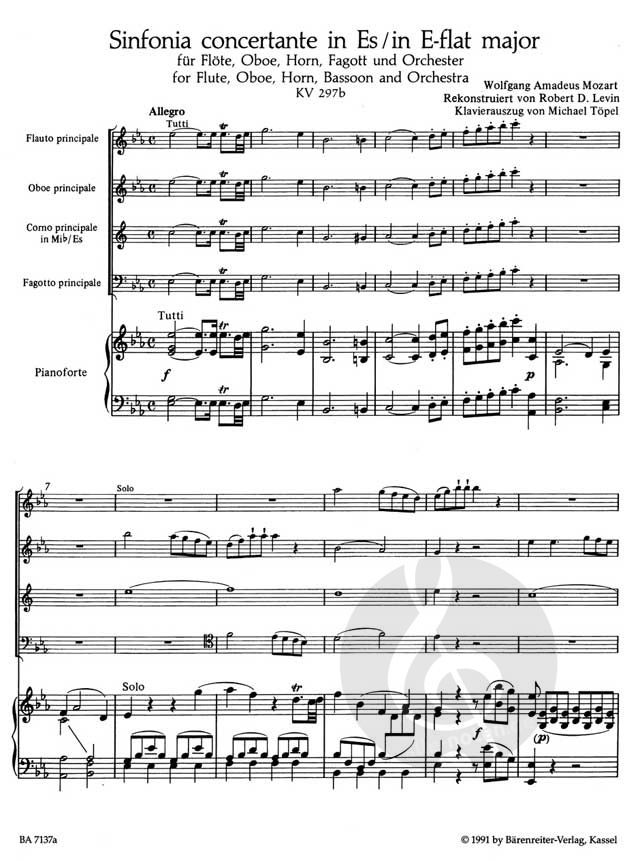
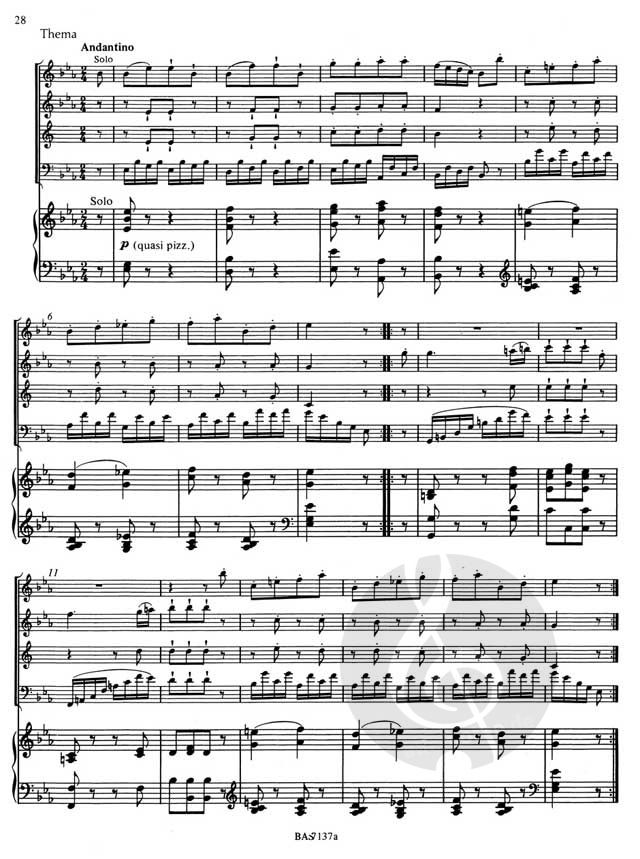
Robert Levin's reconstruction is based on the assumption that the solo parts are genuine in essence and have been reorchestrated by a different arranger (flute to oboe, oboe to clarinet). Levin considers the orchestral parts to be spurious. In his reconstruction, Levin restored the instrumentation of the soloist quartet with flute, oboe, horn and bassoon mentioned in Mozart's letters and rewrote the orchestral parts. Thorough analysis of Mozart's style and a precise knowledge of Mozart's writing enabled Levin to take the risk of this reconstruction. It is available for hire (BA 7137) and is part of the popular repertoire for solo winds.
In the 19th century, a copy of a Sinfonia concertante in E flat for oboe, clarinet, horn, bassoon and orchestra emerged. In the 19th century, a copy of a Sinfonia concertante in E flat for oboe, clarinet, horn, bassoon and orchestra emerged, for which Mozart's authorship was claimed and which - despite the different instrumentation of the wind quartet - was associated with the Sinfonia concertante, which was believed to be lost. The work was long regarded as genuine, but for around 25 years doubts have been vehemently raised about its authenticity, not only with regard to the scoring of the solo quartet but also the orchestral parts.
Robert Levin's reconstruction is based on the assumption that the solo parts are genuine in essence and have been reorchestrated by a different arranger (flute to oboe, oboe to clarinet). Levin considers the orchestral parts to be spurious. In his reconstruction, Levin restored the instrumentation of the soloist quartet with flute, oboe, horn and bassoon mentioned in Mozart's letters and rewrote the orchestral parts. Thorough analysis of Mozart's style and a precise knowledge of Mozart's writing enabled Levin to take the risk of this reconstruction. It is available for hire (BA 7137) and is part of the popular repertoire for solo winds.
Here is how the download works:
1 Buy download sheet music
Purchase the download score from our online store
2 Order confirmation with download link
Immediately after completing your order, you will receive an order confirmation by email listing all items. You will find the download link next to each item. You can use this link to start the download right away. Please also check your spam folder if necessary.
Customers rated this product:
Manufacturer Information:
Bärenreiter-Verlag Karl Vötterle GmbH & Co. KG
Heinrich-Schütz-Allee 35-37
34131
Kassel
Deutschland
Other customers also bought:
Wolfgang Amadeus Mozart
- Flute and Piano
- Piano reduction with part(s)
-
in stock
ships within 1-2 working days

Wolfgang Amadeus Mozart
Edition for Flute and Piano (Piano Reduction)
- Flute and Piano
- Piano reduction with part(s) (Urtext)
-
in stock
ships within 1-2 working days
- Piano
- Sheet Music
-
ships within 2-4 weeks
per pianoforte
- Piano
- Score
-
ships within 3-6 working days
Edgar Meyer
- Violin and Orchestra
- Score
-
ships within 2-4 weeks