
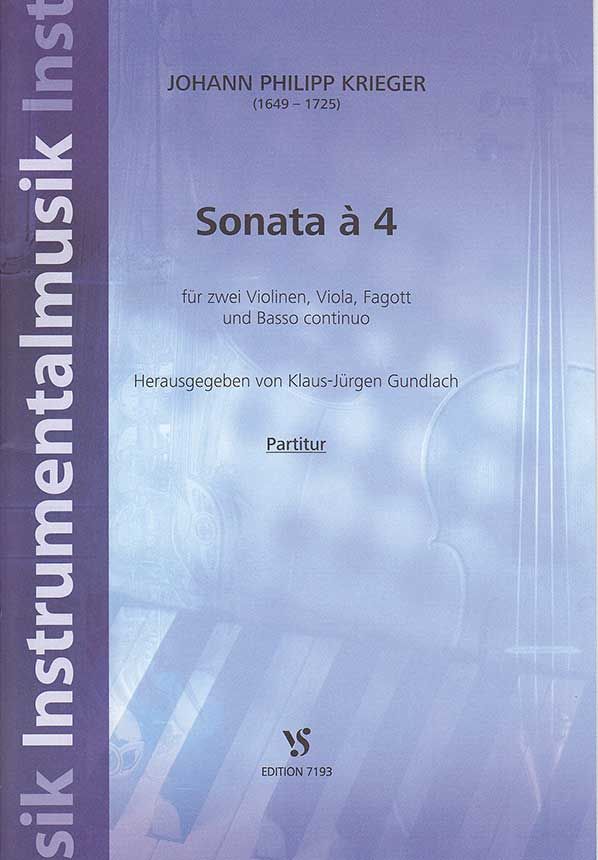
Johann Philipp Krieger
Sonata à 4
für 2 Violinen, Viola, Fagott und Basso continuo
Demo
listen
PDF
view
Johann Philipp Krieger
Sonata à 4
für 2 Violinen, Viola, Fagott und Basso continuo
- Instrumentation 2 Violins, Viola, Bassoon and Continuo
- Composer Johann Philipp Krieger
- Editor Klaus-Jürgen Gundlach
- Edition Score and Parts
- Publisher Strube Verlag
- Order no. STRUBE7193
 ships within 4-8 working days
incl. tax,
excl. shipping costs
Not available in all countries. Learn more

Description:
After his first musical lessons with Johann Drechsel and Gabriel Schütz in his home town of Nuremberg, Johann Philipp Krieger continued his musical studies with the Royal Danish chamber organist Johann Schröder in Copenhagen from around 1663 to 1667. As a "skillful vicario" (Mattheson), Krieger must have received thorough instruction in the art of polyphonic composition from Johann Schröder. On a study trip to Italy in 1672, Krieger completed his musical education with lessons from Johann Rosenmüller in Venice, among others.
Krieger's lifetime achievement lies in sacred vocal music, with over 2,500 documented compositions. As court conductor at Neu-Augustusburg Palace, Krieger was responsible for providing music for the court opera and all musical festivities at court in addition to his duties in the church. His list of all the works he performed (see Klaus-Jürgen Gundlach: Das Weißenfeiser Aufführungsverzeichnis Johann Phillip Kriegers und seines Sohnes Johann Gotthilf Krieger [1684-1732], Sinzig 2001) lists a whole series of large-scale instrumental music, some of which was composed for several choirs. None of these compositions have survived. The two printed collections "XII. Suonate ä due Violini" op. 1, Nuremberg 1688 and "XII. Suonata ä doi, Violino a Va. da Gamba", op. 2 (Nuremberg 1693) have survived. The "Lustige Feld-Music. Auf vier blasende oder andere Instrumenta gerichtet" (Nuremberg 1704) is one of the war losses (excerpts preserved in: Johann Philipp Krieger, Partie F-Dur, ed. by Max Seiffert, Kistner & Siegel Co, Lippstadt, O.J.).
The two printed collections convey an unmistakable personal style in which German counterpoint, concertante style and Italian cantabile merge into a synthesis. Alongside the instrumental compositions by Dietrich Buxtehude and Johann Rosenmüller, the trio sonatas are among the most important examples of German instrumental music of the 17th century.
This Sonata ä 4 is the earliest evidence of an instrumental composition by Johann Philipp Krieger. The only surviving copy of the sonata is in a manuscript of the set of parts in the Uppsala University Library. At the end of the continuo part is the copyist's note: "C. G. scr. Hafnia ms. Augusto." This probably refers to Christian Geist, who was in Copenhagen from May 1669 to 1670 and sang as a bass in the Danish court chapel. Hafnia is the Latin name for the old trading city of Copenhagen. The date for the month of August is missing, but due to Christian Geist's stay in Copenhagen, it is likely to be 1669 or 1670. From 1663 (Doppelmayr) or 1665 (Mattheson) Johann Philipp Krieger studied with Johann Schröder in Copenhagen until 1667. The sonata was probably composed between 1663 and 1667.
The unusual formal arrangement of the sonata indicates that the young composer was keen to experiment: ensemble movement - a solo for each part - passacaglia - da capo of the opening movement. The solos of violin 1 and bassoon are identical in the musical text, but set to different basses. The violin 2 and viola solos are identical, apart from the octaves. The designation "viola da brazzo" is to be equated with viola.
There is no separate violone part, only the figured bass part for the organist. However, amplification of the basso continuo should not be dispensed with during the performance, as the bassoon is thematically integrated and pauses in places. I would like to thank the Uppsala University Library for their kind permission to publish this work and Dr. Lars Berglund for his kind advice on the dating of the sonata.
Krieger's lifetime achievement lies in sacred vocal music, with over 2,500 documented compositions. As court conductor at Neu-Augustusburg Palace, Krieger was responsible for providing music for the court opera and all musical festivities at court in addition to his duties in the church. His list of all the works he performed (see Klaus-Jürgen Gundlach: Das Weißenfeiser Aufführungsverzeichnis Johann Phillip Kriegers und seines Sohnes Johann Gotthilf Krieger [1684-1732], Sinzig 2001) lists a whole series of large-scale instrumental music, some of which was composed for several choirs. None of these compositions have survived. The two printed collections "XII. Suonate ä due Violini" op. 1, Nuremberg 1688 and "XII. Suonata ä doi, Violino a Va. da Gamba", op. 2 (Nuremberg 1693) have survived. The "Lustige Feld-Music. Auf vier blasende oder andere Instrumenta gerichtet" (Nuremberg 1704) is one of the war losses (excerpts preserved in: Johann Philipp Krieger, Partie F-Dur, ed. by Max Seiffert, Kistner & Siegel Co, Lippstadt, O.J.).
The two printed collections convey an unmistakable personal style in which German counterpoint, concertante style and Italian cantabile merge into a synthesis. Alongside the instrumental compositions by Dietrich Buxtehude and Johann Rosenmüller, the trio sonatas are among the most important examples of German instrumental music of the 17th century.
This Sonata ä 4 is the earliest evidence of an instrumental composition by Johann Philipp Krieger. The only surviving copy of the sonata is in a manuscript of the set of parts in the Uppsala University Library. At the end of the continuo part is the copyist's note: "C. G. scr. Hafnia ms. Augusto." This probably refers to Christian Geist, who was in Copenhagen from May 1669 to 1670 and sang as a bass in the Danish court chapel. Hafnia is the Latin name for the old trading city of Copenhagen. The date for the month of August is missing, but due to Christian Geist's stay in Copenhagen, it is likely to be 1669 or 1670. From 1663 (Doppelmayr) or 1665 (Mattheson) Johann Philipp Krieger studied with Johann Schröder in Copenhagen until 1667. The sonata was probably composed between 1663 and 1667.
The unusual formal arrangement of the sonata indicates that the young composer was keen to experiment: ensemble movement - a solo for each part - passacaglia - da capo of the opening movement. The solos of violin 1 and bassoon are identical in the musical text, but set to different basses. The violin 2 and viola solos are identical, apart from the octaves. The designation "viola da brazzo" is to be equated with viola.
There is no separate violone part, only the figured bass part for the organist. However, amplification of the basso continuo should not be dispensed with during the performance, as the bassoon is thematically integrated and pauses in places. I would like to thank the Uppsala University Library for their kind permission to publish this work and Dr. Lars Berglund for his kind advice on the dating of the sonata.