
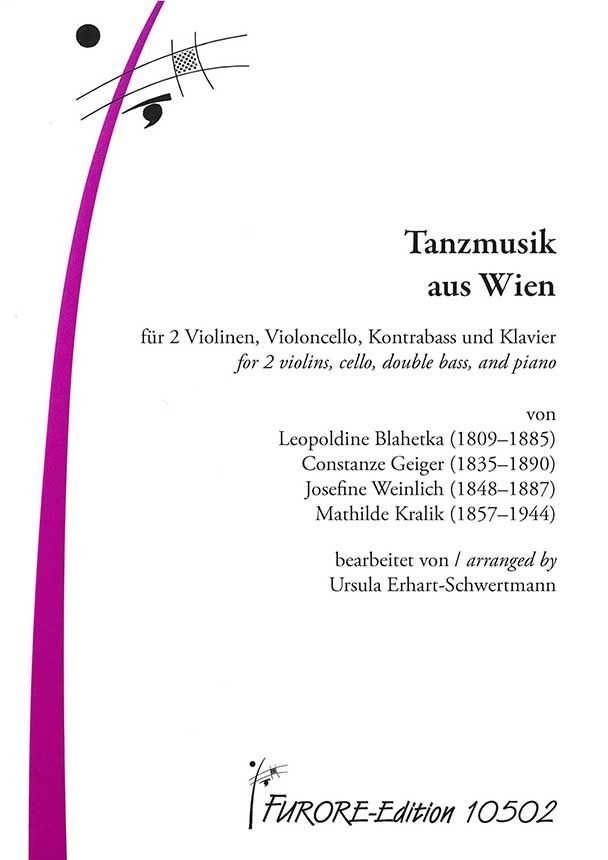
Constanze Geiger, Josefine Weinlich, Leopoldine Blatheka, Mathilde Kralik von Meyrswalden
Tanzmusik aus Wien
für 2 Violinen, Violoncello, Kontrabass und Klavier
Constanze Geiger, Josefine Weinlich, Leopoldine Blatheka, Mathilde Kralik von Meyrswalden
Tanzmusik aus Wien
für 2 Violinen, Violoncello, Kontrabass und Klavier
- Instrumentation 2 Violins, Cello, Double Bass and Piano
- Composer Constanze Geiger Josefine Weinlich Leopoldine Blatheka Mathilde Kralik von Meyrswalden
- Editor Ursula Erhart-Schwertmann
- Edition Sheet Music
- Publisher Furore Verlag
- Order no. FUR10502
 ships within 4-8 working days
incl. tax,
excl. shipping costs
Not available in all countries. Learn more

Description:
At the time when Johann Strauss was celebrating his great successes, there were, alongside the well-known and famous composers, a number of women who also created works in the "Viennese music" genre. Among the four selected works in this volume, Constanze Geiger and Josefine Weinlich—two female composers from the dance music scene—are represented; while the pieces by Leopoldine Blahetka and Mathilde Kralik are actually atypical for these two composers, yet they demonstrate the significance of dance music even among "classical" female composers.
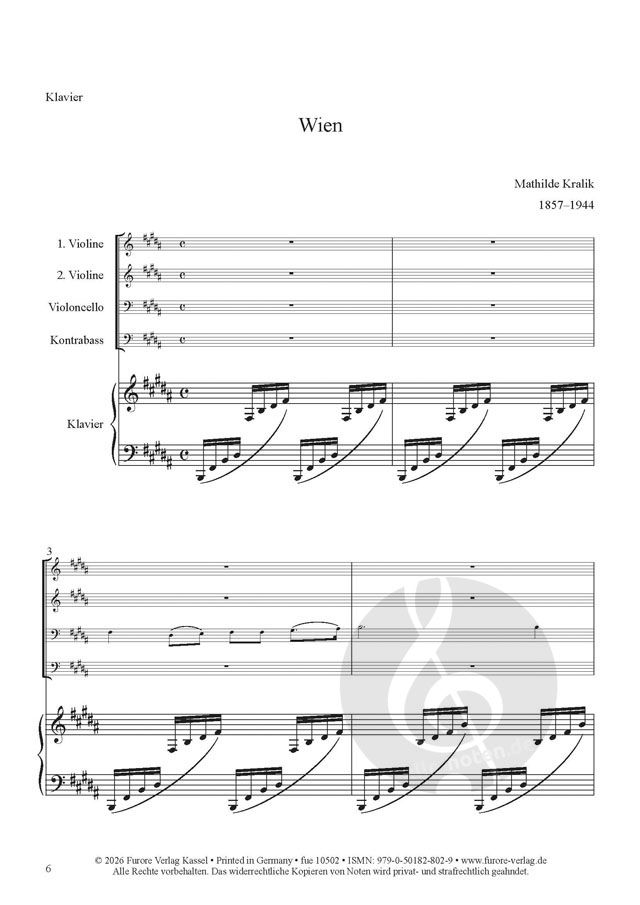
Very often, only piano versions were created by these female composers; based on these, arrangements for various instrumentations—often for orchestra or military bands—were made even at the time of their composition. The selection of instruments for the arrangements in this volume—featuring two violins, cello, double bass, and piano—could be described as a small-scale version of the "salon orchestra." The first violin takes the leading role; the second violin occasionally takes on a second melodic line and often plays the "follow-up notes" that are indispensable to Viennese music, while the double bass provides the foundation with its bass notes. The cello serves as a sort of "wild card"—it can play second melody lines, octave the first violin's part, perform solos, provide counterpoint, play melodically divided harmonies in pizzicato, or even play bass lines in unison with the double bass. The piano is entrusted with solo parts, especially during introductions, transitions, or when doubling the melody; however, its primary role is to provide the harmonic and rhythmic foundation.
Very often, only piano versions were created by these female composers; based on these, arrangements for various instrumentations—often for orchestra or military bands—were made even at the time of their composition. The selection of instruments for the arrangements in this volume—featuring two violins, cello, double bass, and piano—could be described as a small-scale version of the "salon orchestra." The first violin takes the leading role; the second violin occasionally takes on a second melodic line and often plays the "follow-up notes" that are indispensable to Viennese music, while the double bass provides the foundation with its bass notes. The cello serves as a sort of "wild card"—it can play second melody lines, octave the first violin's part, perform solos, provide counterpoint, play melodically divided harmonies in pizzicato, or even play bass lines in unison with the double bass. The piano is entrusted with solo parts, especially during introductions, transitions, or when doubling the melody; however, its primary role is to provide the harmonic and rhythmic foundation.