
Arnold Bax
Threnody and Scherzo
Arnold Bax
Threnody and Scherzo
- Instrumentation Bassoon, Harp and 6 Strings
- Composer Arnold Bax
- Editor Bodo Koenigsbeck
-
Difficulty Level
- Edition Score and Parts
- Publisher Accolade Musikverlag
- Order no. ACC2066
 in stock
ships within 1-2 working days
incl. tax,
excl. shipping costs
Not available in all countries. Learn more

Description:
Description by Mona DeQuis:
Sir Arnold Bax dedicated Threnody and Scherzo to the composer Patrick Hadley. It was premiered in London on December 11, 1936 (the night the English king abdicated) and then lay dormant for some forty years until it was resurrected in the form of a bassoon concerto.
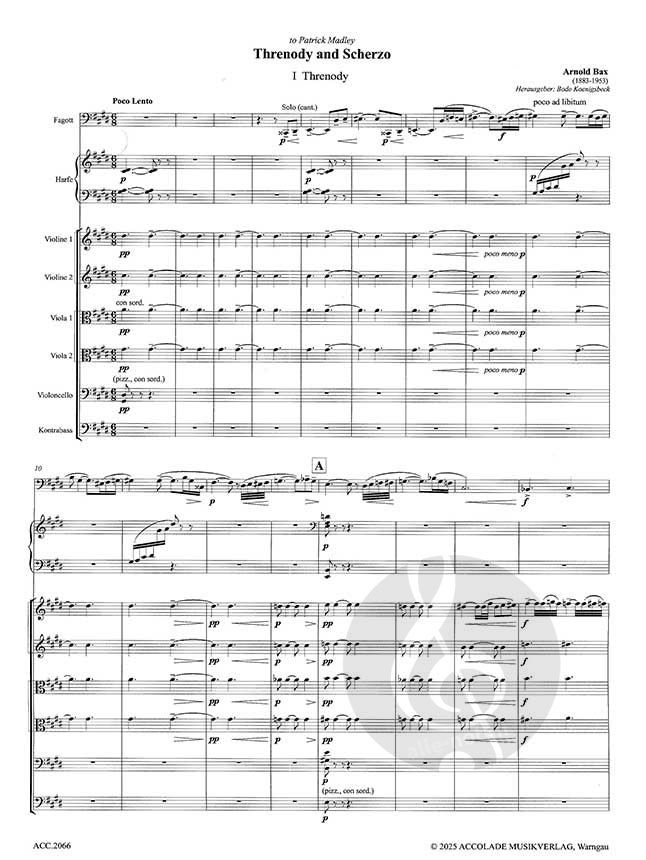
From the first chord in the strings, it is clear that Bax's musical language is more in keeping with the French impressionist composers across the Channel (Claude Debussy and Maurice Ravel) than with its British brethren (Ralph Vaughan Williams and Edward Elgar). The beautifully ambiguous key, the passionate lyricism and the unusual instrumental timbres are signatures of Bax's chamber music style. The mysterious chromatic bassoon theme in the opening creates an ominous and dark mood. This thematic material becomes the theme for the entire Threnody. The intensity increases until finally, after about two and a half minutes of the movement, the light breaks through with the change to a major key. Noteworthy is an interesting exchange between the bassoon and the double bass using the opening material. The powerful bassoon announces a lively little theme, which is also taken up by the strings ( ) and dominates the scherzo. A transition in the harp leads to a cheerful, contrasting episode that paves the way for the return of the main theme. Arnold Bax's creative power lies in his ability to paint pictures of sound (especially in his symphonic poetry)
Sir Arnold Bax dedicated Threnody and Scherzo to the composer Patrick Hadley. It was premiered in London on December 11, 1936 (the night the English king abdicated) and then lay dormant for some forty years until it was resurrected in the form of a bassoon concerto.
From the first chord in the strings, it is clear that Bax's musical language is more in keeping with the French impressionist composers across the Channel (Claude Debussy and Maurice Ravel) than with its British brethren (Ralph Vaughan Williams and Edward Elgar). The beautifully ambiguous key, the passionate lyricism and the unusual instrumental timbres are signatures of Bax's chamber music style. The mysterious chromatic bassoon theme in the opening creates an ominous and dark mood. This thematic material becomes the theme for the entire Threnody. The intensity increases until finally, after about two and a half minutes of the movement, the light breaks through with the change to a major key. Noteworthy is an interesting exchange between the bassoon and the double bass using the opening material. The powerful bassoon announces a lively little theme, which is also taken up by the strings ( ) and dominates the scherzo. A transition in the harp leads to a cheerful, contrasting episode that paves the way for the return of the main theme. Arnold Bax's creative power lies in his ability to paint pictures of sound (especially in his symphonic poetry)