
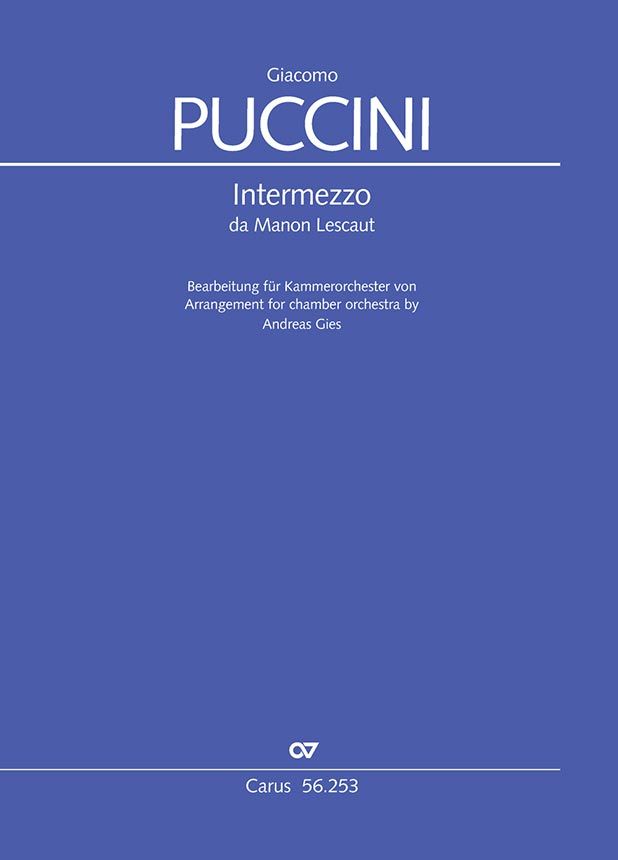
Giacomo Puccini
Intermezzo
from: Manon Lescaut, Act 2. Arrangement for chamber orchestra
PDF
1
view
PDF
2
view
Giacomo Puccini
Intermezzo
from: Manon Lescaut, Act 2. Arrangement for chamber orchestra
- Instrumentation Chamber Orchestra
- Composer Giacomo Puccini
- Editor Andreas Gies
- Edition Score
- Publisher Carus-Verlag
- Order no. CV56253-00
 in stock
ships within 1-2 working days
incl. tax,
excl. shipping costs
Not available in all countries. Learn more
Description:
Giacomo Puccini's operas are largely dramatically through-composed. Only in a few places does the master of verismo allow himself to linger longer in the form of an aria. These arias are highlights of his operas and are often performed in concert.
The Italian conductor Andreas Gies has arranged Puccini's best-known arias and duets for a reduced wind ensemble to enable them to be performed in smaller settings. The string section can be adapted, but should not be too small due to the many divisi.
The "Intermezzo" from Puccini's opera "Manon Lescaut" invites you on a sonic journey through the emotional worlds of the protagonists. This beautiful instrumental interlude transports you into the atmosphere of Manon and Des Grieux and captures the mood and tension between the dramatic scenes of the opera. It is far more than just a musical pause between the acts; rather, it represents an emotional climax that lifts the opera's plot to a new level and unfolds a powerful instrumental effect.
For a balanced sound, we recommend a minimum string instrumentation of 5-4-3-3-2.
The Italian conductor Andreas Gies has arranged Puccini's best-known arias and duets for a reduced wind ensemble to enable them to be performed in smaller settings. The string section can be adapted, but should not be too small due to the many divisi.
The "Intermezzo" from Puccini's opera "Manon Lescaut" invites you on a sonic journey through the emotional worlds of the protagonists. This beautiful instrumental interlude transports you into the atmosphere of Manon and Des Grieux and captures the mood and tension between the dramatic scenes of the opera. It is far more than just a musical pause between the acts; rather, it represents an emotional climax that lifts the opera's plot to a new level and unfolds a powerful instrumental effect.
For a balanced sound, we recommend a minimum string instrumentation of 5-4-3-3-2.
Customers rated this product:
Manufacturer Information:
Carus-Verlag GmbH & Co. KG
Sielminger Str. 51
70771
Leinfelden-Echterdingen
Deutschland
Related products:

- Chamber Orchestra
- Score Download
- Andreas Gies
- Carus-Verlag
-
immediately available
Download immediately after ordering - Instant download