
Jean-François Michel
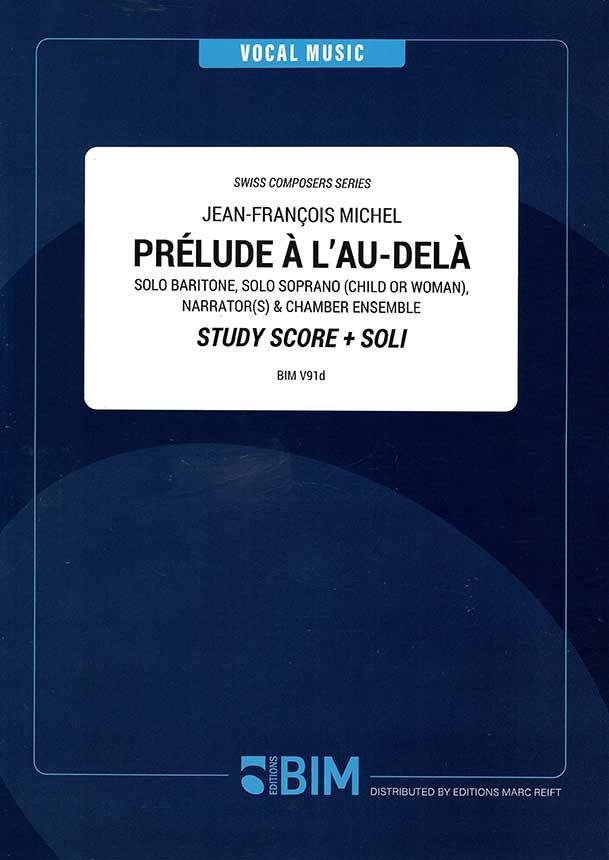
Prélude à l'au-delà
for Solo Baritone Voice, Soprano Solo (Child Or Woman), Narrator(S), Chamber Ensemble
Demo
listen
PDF
view
Jean-François Michel
Prélude à l'au-delà
for Solo Baritone Voice, Soprano Solo (Child Or Woman), Narrator(S), Chamber Ensemble
- Instrumentation Soloists (SB), Speaker and Chamber Orchestra
- Composer Jean-François Michel
-
Difficulty Level
- Edition Study Score Download
- Publisher Editions Bim
- Order no. BIM-V91D-DL
 immediately available
Download immediately after ordering
incl. tax,
excl. shipping costs
Not available in all countries. Learn more

Description:
If there is one stage in our existence that sooner or later triggers reflection, it is probably the end of our earthly career. And for many, beyond doubt and questioning, the hope of a future. I have tried to portray this "gentle trepidation" musically. Jean-François Haas' deep, emotional and honest lyrics provided me with the ideal material for this. The title "Prélude à l'au-delà" (Prelude to the Beyond) leads the listener to Gabriel Fauré's (1845-1924) Requiem, the masterpiece he composed between 1887 and 1900. I think that the contrast between historical and contemporary music - beyond developments in style and civilization - illustrates the inevitable fact and eternal confrontation of every generation with death. Listening to Fauré's Requiem countless times has not only sensitized and strengthened my soul, it has also spurred me on to this great challenge of writing this Prélude à l'au-delà, whose instrumentation, incidentally, is identical to that of the Requiem. Important: the narrative part should ideally be performed by a speaking choir in order to achieve the vocal cluster effect of the Greek tragedies (alternative: a solo speaker). This part is a "Sprechgesang". The performers can freely shape expression and intonation in order to intensify the dramaturgy accordingly. Jean-François Michel, Courtepin, Switzerland
Here is how the download works:
1 Buy download sheet music
Purchase the download score from our online store
2 Order confirmation with download link
Immediately after completing your order, you will receive an order confirmation by email listing all items. You will find the download link next to each item. You can use this link to start the download right away. Please also check your spam folder if necessary.
Customers rated this product:
Manufacturer Information:
Editions Bim
Route d'Echallens 51
1674
Vuarmarens
Schweiz
Related products:
Jean-François Michel
for Solo Baritone Voice, Soprano Solo (Child Or Woman), Narrator(S), Chamber Ensemble
- Soloists (SB), Speaker and Chamber Orchestra
- Study Score
- Editions Bim
-
-
ships within 1-2 weeks
- Also available for download!