
Modest Mussorgski
Ein Nacht auf dem kahlen Berge
for orchestra
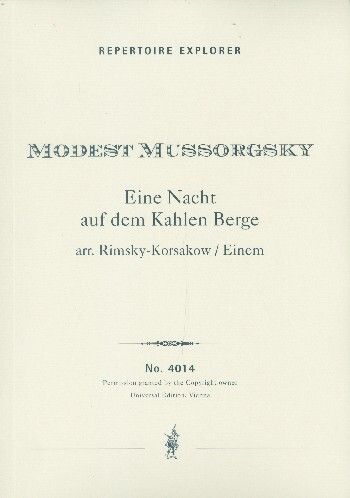
Modest Mussorgski
Ein Nacht auf dem kahlen Berge
for orchestra
- Instrumentation Orchestra
- Composer Modest Mussorgski
- Editor Nikolai Rimski-Korsakow Gottfried von Einem
- Edition Sheet Music
- Publisher Musikproduktion Höflich
- Order no. MPH4014
 ships within 1-2 weeks

Description:
Revised and orchestrated by Nikolai Andreyevich Rimsky-Korsakov in 1886–90. Revised version from 1967–84 with an altered ending (starting on page 78) by Gottfried von Einem.
Modest Mussorgsky’s "Night on Bald Mountain" is one of the best-known works of Russian program music. However, the version popular today is by Nikolai Rimsky-Korsakov, who streamlined Mussorgsky’s wild, chaotically ending original (1867) and gave it a conciliatory, idyllic ending (dawn).
This new version by Gottfried von Einem (1984) offers a gripping alternative: it retains Rimsky-Korsakov’s formal rigor and orchestral brilliance, but rejects his peaceful conclusion. Instead, Einem has the work end—entirely in keeping with Mussorgsky’s original version—with the eerie, triumphant character of the Witches’ Sabbath.
Gottfried von Einem (1918–1996), one of the most important composers of the 20th century and known for his great operatic successes (including *The Death of Danton*), combines historical fidelity to the original spirit of the work with modern sonic precision in this adaptation.
Modest Mussorgsky’s "Night on Bald Mountain" is one of the best-known works of Russian program music. However, the version popular today is by Nikolai Rimsky-Korsakov, who streamlined Mussorgsky’s wild, chaotically ending original (1867) and gave it a conciliatory, idyllic ending (dawn).
This new version by Gottfried von Einem (1984) offers a gripping alternative: it retains Rimsky-Korsakov’s formal rigor and orchestral brilliance, but rejects his peaceful conclusion. Instead, Einem has the work end—entirely in keeping with Mussorgsky’s original version—with the eerie, triumphant character of the Witches’ Sabbath.
Gottfried von Einem (1918–1996), one of the most important composers of the 20th century and known for his great operatic successes (including *The Death of Danton*), combines historical fidelity to the original spirit of the work with modern sonic precision in this adaptation.