
Gabriel Fauré
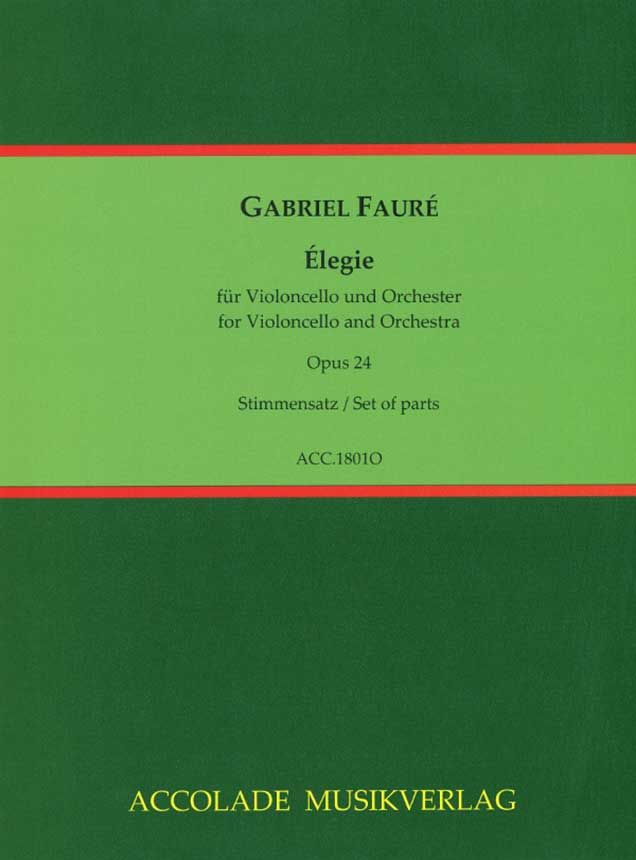
Elegie op. 24
for Violoncello and Orchestra

Gabriel Fauré
Elegie op. 24
for Violoncello and Orchestra
- Instrumentation Cello and Orchestra
- Composer Gabriel Fauré
-
Difficulty Level
- Edition Set of Parts
- Publisher Accolade Musikverlag
- Order no. ACC1801O
 in stock
ships within 1-2 working days
incl. tax,
excl. shipping costs
Not available in all countries. Learn more

Description:
Die Élégie op. 24 entstand in ihrer ersten Fassung mit Klavier- begleitung im Jahr 1880 und ist Jules Loëb gewidmet, der das Werk am 15. Dezember 1883 bei einem Konzert der Société Nationale in Paris zur Uraufführung brachte. Die Orchestrierung erfolgte erst etliche Jahre später (ab 1895). Wie Robert Orledge ausführlich erläutert, ließ sich der Komponist dabei beraten, möglicherweise durch seine Freunde André Messager oder Camille Saint-Saëns. In dieser Form wurde die Élégie am 23. Januar 1902 durch Carlo Sansoni unter der Leitung von Léon Jéhin in Monte Carlo uraufgeführt.
The Élégie op. 24 was originally written for violoncello and piano in 1880. It is dedicated to Jules Loëb, who performed the work on 15 December 1883 at a concert of the Société Nationale in Paris. The orchestration has been made several years later (from 1895). As Robert Orledge explains in detail, the composer sought advice, probably from his friends André Messager or Camille Saint-Saëns. The first performance of this version took place on 23 January 1902 by Carlo Sansoni under the direction of Léon Jéhin in Monte Carlo.
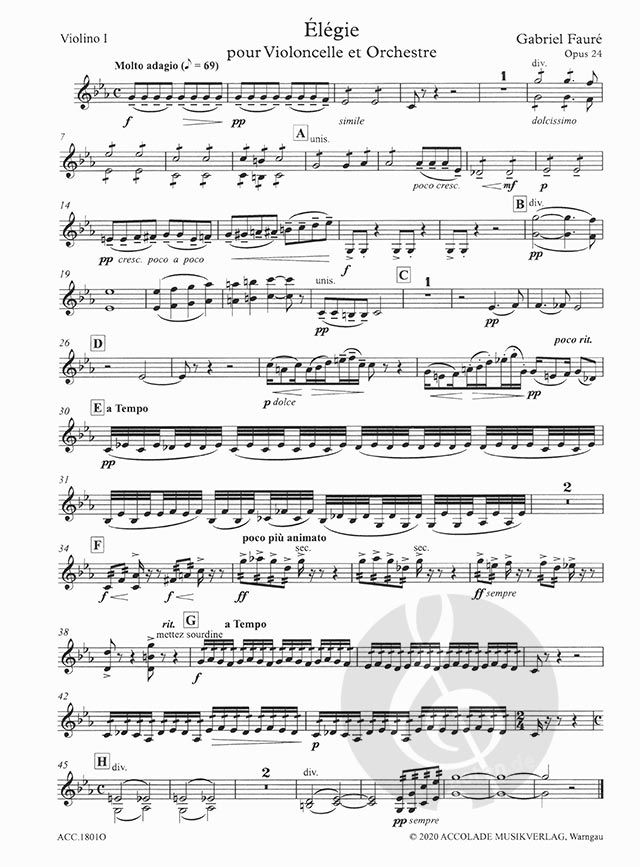
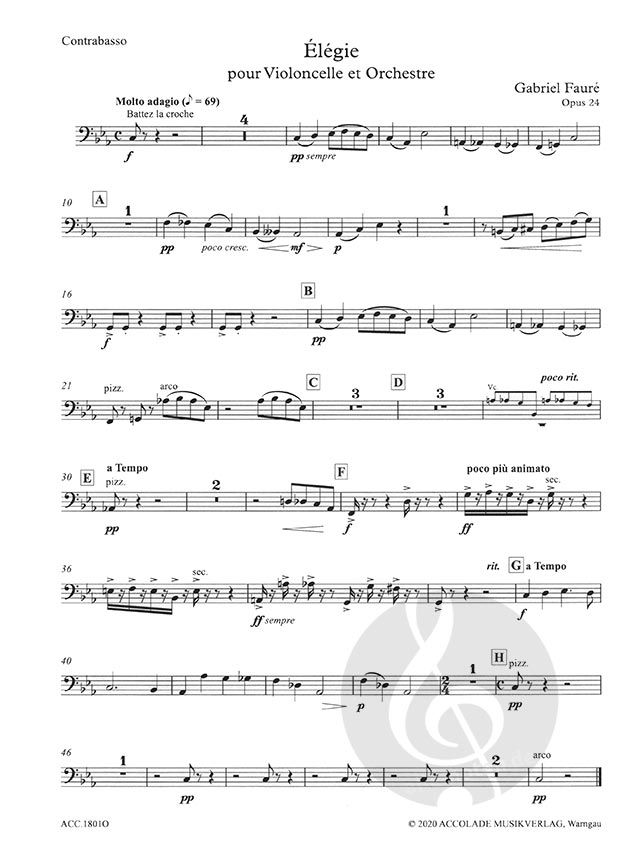
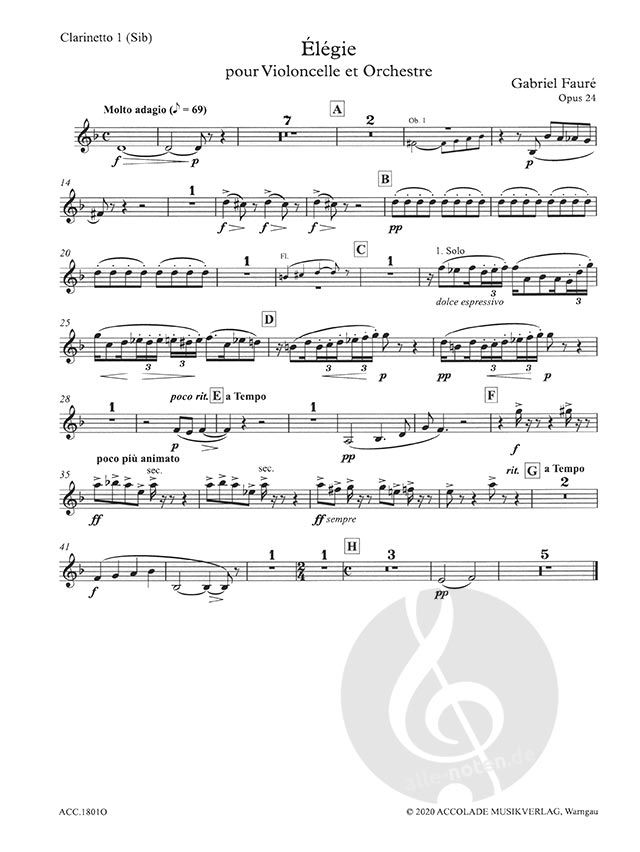
Der Stimmensatz enthält:, Cello solo, 2 Flöten, 2 Oboen, 2 Klarinetten, 2 Fagotte, 4 Hörner, 4 x Violine 1, 4 x Violine 2, 3 x Viola, 3 x Cello, 2 x Kontrabass
The Élégie op. 24 was originally written for violoncello and piano in 1880. It is dedicated to Jules Loëb, who performed the work on 15 December 1883 at a concert of the Société Nationale in Paris. The orchestration has been made several years later (from 1895). As Robert Orledge explains in detail, the composer sought advice, probably from his friends André Messager or Camille Saint-Saëns. The first performance of this version took place on 23 January 1902 by Carlo Sansoni under the direction of Léon Jéhin in Monte Carlo.
Der Stimmensatz enthält:, Cello solo, 2 Flöten, 2 Oboen, 2 Klarinetten, 2 Fagotte, 4 Hörner, 4 x Violine 1, 4 x Violine 2, 3 x Viola, 3 x Cello, 2 x Kontrabass
Related products:
Customers rated this product:
Manufacturer Information:
Accolade Musikverlag
Giselherstraße 21
85053
Ingolstadt
Deutschland
Other customers also bought:
- Cello and Orchestra
- Score
-
in stock
ships within 1-2 working days
- Clarinet and Piano
- Score and Parts (Urtext)
-
in stock
ships within 1-2 working days - Also available for download!

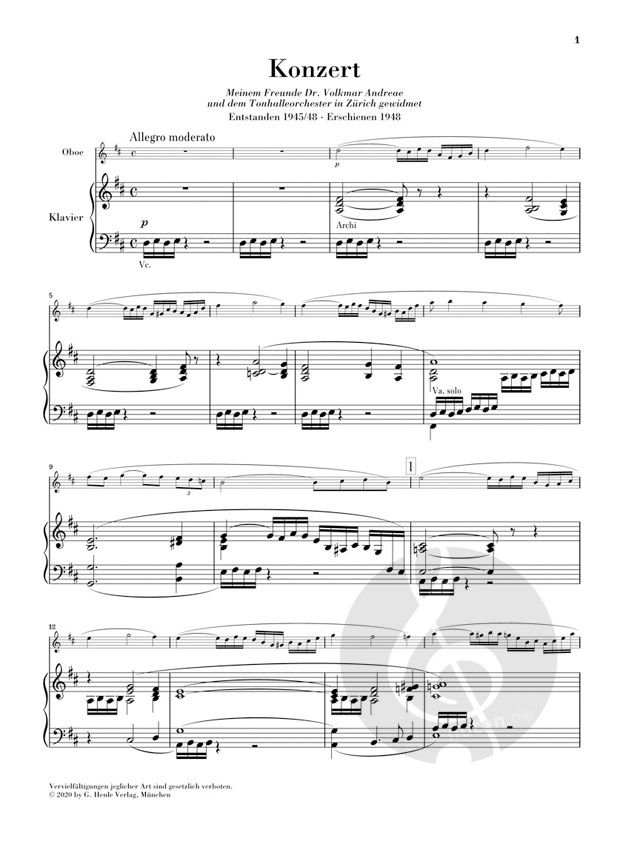
- Oboe and Piano
- Piano reduction with part(s) (Urtext)
-
in stock
ships within 1-2 working days