
Franz Liszt
Kleinere Orchesterwerke
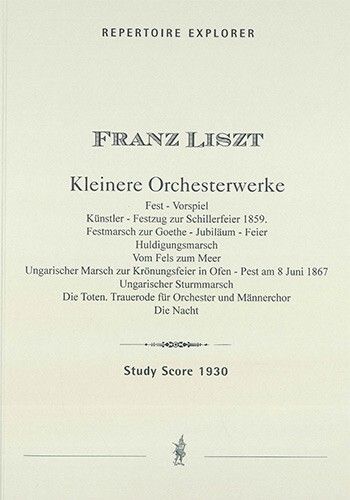
Franz Liszt
Kleinere Orchesterwerke
- Instrumentation Orchestra
- Composer Franz Liszt
- Edition Sheet Music
- Publisher Musikproduktion Höflich
- Order no. MPH1930
 ships within 1-2 weeks

Description:
Franz Liszt’s orchestral marches and occasional compositions constitute a fascinating, yet often unjustly neglected part of his orchestral oeuvre. This volume brings together works that document Liszt’s characteristic tendency toward constant reworking and revision, as well as his deep connection to Hungarian history and identity. Many of these pieces, originally composed for festive occasions such as the dedication of the Goethe-Schiller Monument or royal coronations, demonstrate Liszt’s mastery of large-scale, ceremonial orchestration and are often the result of a long evolutionary process spanning various piano and orchestral versions.
In addition to the powerful marches, which are representative of 19th-century public musical life, the collection also includes deeply personal and innovative compositions such as the funeral odes "Les morts" and "La notte." These works, which Liszt explicitly intended for his own funeral, captivate with their devout transcendence and extraordinary details of instrumentation, such as the inclusion of a narrator or a men’s choir. Thus, this edition not only offers insight into Liszt’s role as a sought-after festival composer but also sheds light on his private, religious, and patriotic convictions. It represents a significant expansion of the orchestral repertoire beyond the well-known symphonic poems.
In addition to the powerful marches, which are representative of 19th-century public musical life, the collection also includes deeply personal and innovative compositions such as the funeral odes "Les morts" and "La notte." These works, which Liszt explicitly intended for his own funeral, captivate with their devout transcendence and extraordinary details of instrumentation, such as the inclusion of a narrator or a men’s choir. Thus, this edition not only offers insight into Liszt’s role as a sought-after festival composer but also sheds light on his private, religious, and patriotic convictions. It represents a significant expansion of the orchestral repertoire beyond the well-known symphonic poems.