
Matilde Capuis
Ouverture
für Orchester
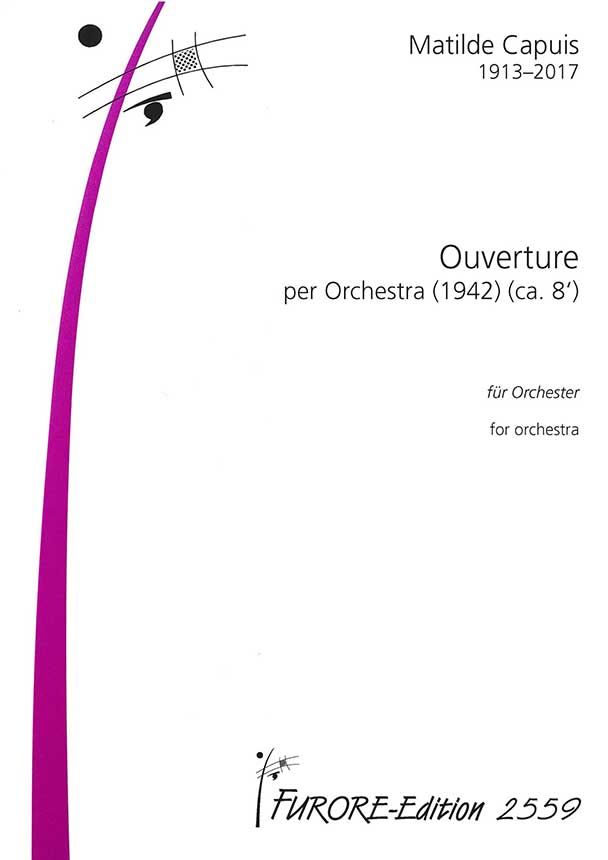

Matilde Capuis
Ouverture
für Orchester
- Instrumentation Orchestra
- Composer Matilde Capuis
-
Difficulty Level
- Edition Score
- Publisher Furore Verlag
- Order no. FUR2559
 ships within 4-8 working days
incl. tax,
excl. shipping costs
Not available in all countries. Learn more

Description:
Ouverture for orchestra (2.2.2.2.-2.2.2.0., Timp, Str): The Ouverture for orchestra (1942) by Matilde Capuis is an early symphonic work for classical orchestra. It stands stylistically between late Romanticism and modern tonal language and is historically remarkable because its planned performance in 1942 was prevented for sexist reasons.
The work was composed during Capuis' student days at the Accademia Musicale Chigiana in Siena and was already a political issue at its first performance: in 1942, the overture was to be performed as part of a final concert and broadcast on the radio. When the conductor Antonio Guarnieri found out towards the end of the rehearsals that a woman was hiding behind the precautionary cover of "M. Capuis", he wiped the notes off the podium and shouted: "I will never conduct a work by a woman."
The one-movement work combines a clear, classical form with an expressive and melodic tonal language. It is characterized by the contrast between an energetic, rhythmically striking main idea and lyrical, vocal passages, which appear primarily in the woodwinds and strings.
Capuis' music remains committed to extended tonality and deliberately avoids radical avant-garde experiments. Instead, the expression of personal emotions and a cantabile melody are at the heart of her compositional style. The overture demonstrates her confident command of orchestral colors and her preference for the warm sound of the strings early on. Today, the work is considered an impressive example of Italian orchestral music from the 1940s.
The work was composed during Capuis' student days at the Accademia Musicale Chigiana in Siena and was already a political issue at its first performance: in 1942, the overture was to be performed as part of a final concert and broadcast on the radio. When the conductor Antonio Guarnieri found out towards the end of the rehearsals that a woman was hiding behind the precautionary cover of "M. Capuis", he wiped the notes off the podium and shouted: "I will never conduct a work by a woman."
The one-movement work combines a clear, classical form with an expressive and melodic tonal language. It is characterized by the contrast between an energetic, rhythmically striking main idea and lyrical, vocal passages, which appear primarily in the woodwinds and strings.
Capuis' music remains committed to extended tonality and deliberately avoids radical avant-garde experiments. Instead, the expression of personal emotions and a cantabile melody are at the heart of her compositional style. The overture demonstrates her confident command of orchestral colors and her preference for the warm sound of the strings early on. Today, the work is considered an impressive example of Italian orchestral music from the 1940s.