
Antonín Dvořák
Requiem op. 89
for Soloists, Choir and Orchestra
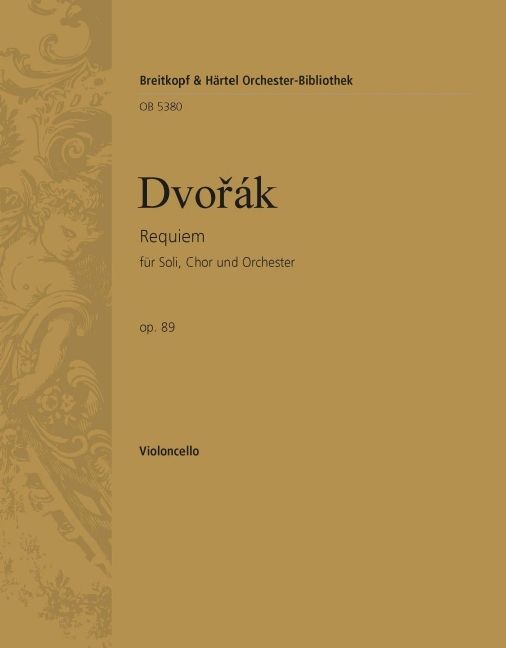
Antonín Dvořák
Requiem op. 89
for Soloists, Choir and Orchestra
- Instrumentation 4 Soloists (SATB), Mixed Choir (SATB), 2 Flutes, 2 Oboes, 2 Oboes d'Amore, 2 Violins, Viola and 2 Viole da Gamba
- Composer Antonín Dvořák
- Editor Klaus Döge
- Edition Instrumental Part: Cello
- Publisher Breitkopf & Härtel
- Order no. OB5380VC
 ships within 2-5 working days
incl. tax,
excl. shipping costs
Not available in all countries. Learn more

Description:
Dvorák's is one of the Czech composer's great works of church music and one of the most important Requiem settings in music history.
The profound effect is based on a sequence of variations on a death motif that seems to be based on the beginning of the second Kyrie from Bach's Mass in B minor. The work was commissioned by the Novello publishing house in 1890 for the Birmingham Music Festival, where it was first performed under the composer's direction on October 9, 1891. Dvorák used a copy of the score which he had checked and which later served as an engraving.
The Dvorák researcher Klaus Döge succeeded in tracking down the place where it was kept and evaluating this important source for the first time. It contains the last-hand version and also offers valuable insights into Dvorák's conducting workshop. It served as the main source for the Breitkopf Urtext edition.
The profound effect is based on a sequence of variations on a death motif that seems to be based on the beginning of the second Kyrie from Bach's Mass in B minor. The work was commissioned by the Novello publishing house in 1890 for the Birmingham Music Festival, where it was first performed under the composer's direction on October 9, 1891. Dvorák used a copy of the score which he had checked and which later served as an engraving.
The Dvorák researcher Klaus Döge succeeded in tracking down the place where it was kept and evaluating this important source for the first time. It contains the last-hand version and also offers valuable insights into Dvorák's conducting workshop. It served as the main source for the Breitkopf Urtext edition.
Related products:
Customers rated this product:
Manufacturer Information:
Breitkopf & Härtel KG
Walkmühlstraße 52
65195
Wiesbaden
Deutschland
Other customers also bought:
- 4 Soloists (SATB), Mixed Choir (SATB), 2 Flutes, 2 Oboes, 2 Oboes d'Amore, 2 Violins, Viola and 2 Viole da Gamba
- Instrumental Part: Double Bass
-
ships within 2-5 working days
- 4 Soloists (SATB), Mixed Choir (SATB), 2 Flutes, 2 Oboes, 2 Oboes d'Amore, 2 Violins, Viola and 2 Viole da Gamba
- Instrumental Part: Violin 2
-
ships within 2-5 working days
- 4 Soloists (SATB), Mixed Choir (SATB), 2 Flutes, 2 Oboes, 2 Oboes d'Amore, 2 Violins, Viola and 2 Viole da Gamba
- Instrumental Part: Violin 1
-
ships within 2-5 working days
- 4 Soloists (SATB), Mixed Choir (SATB), 2 Flutes, 2 Oboes, 2 Oboes d'Amore, 2 Violins, Viola and 2 Viole da Gamba
- Score
-
ships within 2-5 working days
- 4 Soloists (SATB), Mixed Choir (SATB), 2 Flutes, 2 Oboes, 2 Oboes d'Amore, 2 Violins, Viola and 2 Viole da Gamba
- Set of Parts - Harmony
-
in stock
ships within 1-2 working days
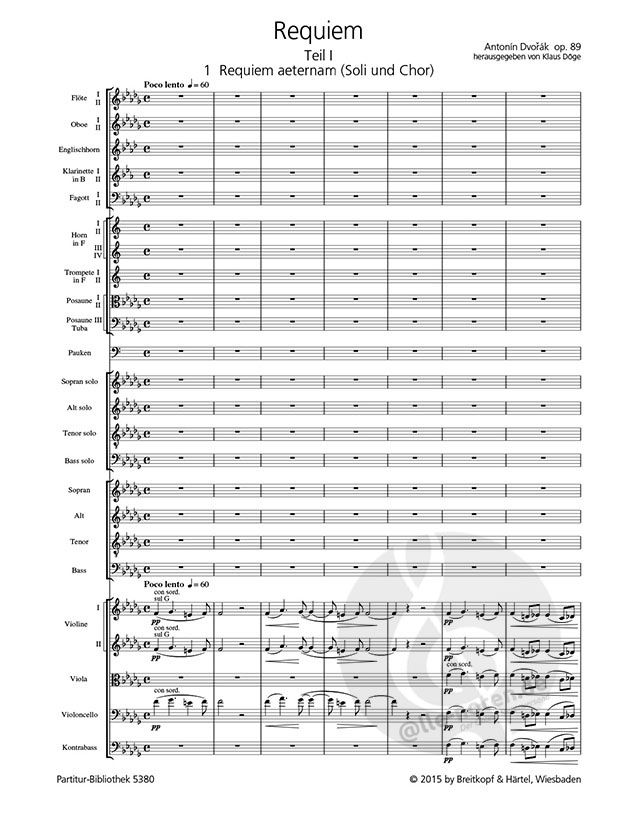

- 4 Soloists (SATB), Mixed Choir (SATB), 2 Flutes, 2 Oboes, 2 Oboes d'Amore, 2 Violins, Viola and 2 Viole da Gamba
- Piano Reduction
-
in stock
ships within 1-2 working days
- 4 Soloists (SATB), Mixed Choir (SATB), 2 Flutes, 2 Oboes, 2 Oboes d'Amore, 2 Violins, Viola and 2 Viole da Gamba
- Instrumental Part: Viola
-
ships within 2-5 working days